

 Apple Podcasts

 Spotify

 Amazon Music

 iHeartRadio

 Pandora

 Castro

 RSS Feed

 Audible
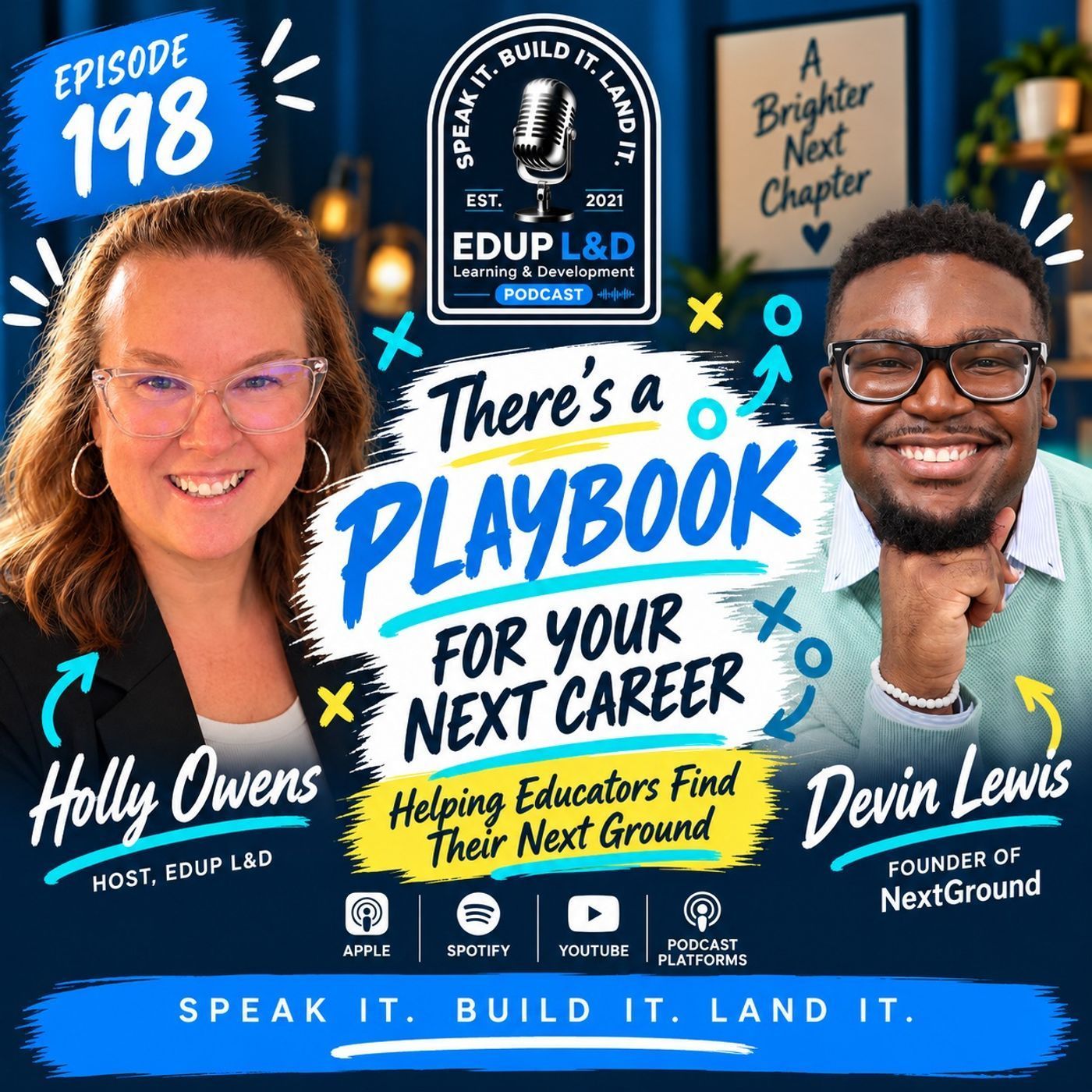
What’s next for educators who are ready for a change? In this episode, Holly Owens sits down with Devin Lewis, founder of Next Ground, to discuss career transitions, professional growth, and the opportunities available to educators both inside and outside the classroom. Devin shares what inspired him to create a career navigation platform designed to help educators find their next path without having to figure it all out alone.
There’s a Playbook for Your Next Career: Helping Educators Find Their Next Ground with Devin Lewis
What’s next for educators who are ready for a change? In this episode, Holly Owens sits down with Devin Lewis, founder of Next Ground, to discuss career transitions, professional growth, and the opportunities available to educators both inside and outside the classroom. Devin shares what inspired him to create a career navigation platform designed to help educators find their next path without having to figure it all out alone.
In this episode, we discuss:
- Devin’s journey from teaching to educational leadership and entrepreneurship.
- How NextGround is helping educators explore new career pathways.
- What teachers need to know about transitioning into instructional design.
- The importance of mentorship, sponsorship, and transferable skills.
- Why educators should know their worth and advocate for themselves.
- Devin’s three pieces of advice for educators ready for their next chapter.
Connect with Devin Lewis and NextGround:
Connect With Us
💼 Follow Holly on LinkedIn: Connect with Holly
📹 Watch EdUp L&D on YouTube: Subscribe here
📰 Subscribe to the Newsletter: It's Not Just One Thing in L&D
💃 Follow on TikTok: @ihollyo
💌 Connect with Holly: Schedule a conversation
💙 Thanks for subscribing, listening, and supporting EdUp L&D!
Thanks for tuning in! 🎧
Holly Owens: Hello everyone, and welcome to the EdUp Learning and Development Podcast. My name is Holly Owens, and I'm the host of this show, but I'm also a higher education professor, instructional designer, entrepreneur, and a proud helper of humans. I've worked in the L&D space for almost 20 years, and I'm here to share what I know, what I'm learning, and what's happening in our industry. We'll talk about instructional design, L&D AI, technology, careers, and the humans behind it all. Along the way, I'll bring in some friends to share their stories, experiences, and expertise too. Because at the end of the day, L&D is all about humans helping other humans. This is EdUp L&D. Here. Hello, everyone, and welcome to another amazing episode of Ed Up L D. My name is Holly Owens, and I'm your host, and I am super excited. I am legitimately excited, authentically excited, because I have my friend Devin Lewis here, who is the founder of Next Ground, and you're gonna learn all about that in this episode. So, Devin, welcome to the show.
Devin Lewis: Hello, hello, hello, good to see you, Holly.
Holly Owens: Yes, I'm I know we've talked a lot like via text and things and Devin and I met on TikTok and we've become fast bestie friends. So and what he's building at Next Ground is I definitely had to have him on the podcast to talk about all the wonderful things he's doing. But before we get into that, Devin, tell us about yourself, tell us about your journey, what you've been doing for the past few years, and then we're definitely gonna get into some next ground conversations.
Devin Lewis: Alrighty. Thank you for sh thank you for having me on. I really appreciate it. And I just wanna say that you are an amazing human being and anybody that watches your podcast, anybody that has the pleasure of knowing you, like they are already gonna be blessed. So I just want to start
Holly Owens: you're gonna make me don't make me cry.
Devin Lewis: ple don't make me cry either. You know, it's not time. It's not time. We can do it at the end of the episode.
Holly Owens: We might cry. Yeah, yeah. Sounds good. Sounds good.
Devin Lewis: Well, my name is Devin Lewis and I am first first and foremost a teacher. You know, that is my background, that is my history, but I definitely see myself as tenacious, I see myself as driven, I see myself as somebody that's an overcomer, especially for all the things that I've been through in life. And I know that kind of speaks to all the overcomers that are probably watching this episode. So I'm really appreciative of all of you that are watching. And a little bit about my history. I'm a little bit I'm from Texarkana, Texas, where you can stand in Texas and Arkansas at the exact same time. I didn't think
Holly Owens: Love it.
Devin Lewis: that was, strange growing up, but a lot of people are like, what? First off, the name Texarkana. They're like, what's a Tex Arkansas? And I'm like, TexArcana, Tech T-E-X for Texas, ARK for Arkansas, and A-N-A-Anna for Louisiana. And so,
Holly Owens: Mm-hmm.
Devin Lewis: we're I say we're like the little rascals in a trench coat trying to get into the movie theater, all throwing together.
Holly Owens: Love that movie.
Devin Lewis: but I was raised by a single mother, raised by my grandparents as well. And they instilled a lot of great values in me that I am so appreciative of, especially in my generation where, where it's needed to be able to show what integrity and perseverance and all the different characteristics that make you a you know, a decent human being, you know? and that's out in front of my life. And so I hope at the end of my life that people still say he had a lot of integrity. Also that he's kind of cute, you know. I hope I hope, you know, I hope I age gracefully, but
Holly Owens: Yeah.
Devin Lewis: Yeah, I'm super excited for what life has been holding for me. so yeah, I taught sixth grade social studies. I've kind of done it all. Taught sixth grade social studies
Holly Owens: We never talked about this. I taught ninth graded government. So we both our social
Devin Lewis: What?
Holly Owens: study we never talked about that. We said we were both to so I taught ninth grade government.
Devin Lewis: I love this. Okay, we're b we're we are bonded for life.
Holly Owens: Yeah. Absolutely, absolutely.
Devin Lewis: Well, I definitely love social studies, but I find my found myself doing a lot of things in deaf education. I taught math for a year. Never again. Not doing that.
Holly Owens: Ha ha
Devin Lewis: and I yeah, I taught in Houston, Texas. And, you know, I'm from I I'm from Texas, Orkana, but I also like to say I'm from Houston, Texas, where it's the land of the Lizzo and Beyonce.
Holly Owens: Mm.
Devin Lewis: So super excited. I even have merch that's Texas, even my water bottle has to have all the through Texas.
Holly Owens: nice.
Devin Lewis: And so,
Holly Owens: I have my little w I'm from Maryland originally, so I got my little flag back there. Represent
Devin Lewis: Yes, Maryland. Maryland. but yeah, super, super dedicated to my craft and making myself better because I know making ourselves better Especially people like us, we want to be able to help the next person. We want to help the next generation. We want to help the people that are around us that really want to learn, want to grow, and want to be better. And that's actually what led me into instructional coaching. I went and got my master's from Houston Baptist University. Shout out to the Huskies. And I really found a love for teaching adults. And I don't know exactly when that happened, but I discovered a love because I remember growing up myself and I I didn't know I was a neurodivergent learner. I just knew I it wouldn't click right away. And I would go home and I would try to study. I would try to make up different things in my head to make it a game. And I definitely wanted to ensure that any adult that learns from me never feels like whatever questions they have or however they felt about learning was going to be a pleasurable experience. But also I never wanted people to feel shame behind not knowing what they don't know. You know, and
Holly Owens: Right.
Devin Lewis: I think that's a big part of why I am doing why I created created next ground. I want people to be able to get that information readily in hand and understand, okay, it's not that I'm stupid or dumb or not smart, it's just the knowledge just not has been shared with you. You know, there's a playbook
Holly Owens: Yeah.
Devin Lewis: for everything. And once you get the playbook, then you can start internalizing it and then being able to manipulate and do what you need to do in order to succeed in life.
Holly Owens: Yeah, I feel like people, you know, like when they get into a new job or if they're they're making a a change, they're like, they feel like they have to know everything. And that's not
Devin Lewis: Absolutely.
Holly Owens: that's not the case. Like any good company, as far as I'm concerned as a job seeker and what I've seen over the years, they will upskill you. They will train you how to do things. Like, even though the job market right now, I can say that They're very specific about what they want. They want people just in hitting the ground running. That's the shift that I see happening. But I feel like any good company should have a thirty, sixty, ninety day plan to get you prepared. Just, you know, you're
Devin Lewis: Absolutely. Absolutely.
Holly Owens: to help you be successful. Yep.
Devin Lewis: Absolutely. I definitely agree. And any company, I steer away from companies that say we need to hit the ground running, because then I'm like, what does
Holly Owens: I know.
Devin Lewis: onboarding look like? is it right.
Holly Owens: It's like in the fire you go. Really it is. It's like jumping, drinking from the fire hose situation.
Devin Lewis: Exactly. And we want to ensure that people are set up for success. that's part
Holly Owens: Mm-hmm.
Devin Lewis: of part of a manager's job or a director or any level of where you support other people. You always need to ensure that, hey, if I were in their position and I did not have the knowledge I have right now, what can I do to ensure that this person one feels like they belong? But two, feel like this place is going to be a long-term environment for them and not try to do the smoke in mirrors where it's like, okay, we're we have a great culture, we have, and no matter how great your culture is, if you aren't setting individual people up for success, to be able to have a sustained long-term career, we really have to take a real hard look at our company values and our culture as well.
Holly Owens: Absolutely. And I think that's even tougher for teachers. teachers that are currently teaching, teachers that are thinking about transitioning out of education. And they just feel a s I feel like they feel this sense of just from talking to people. They're like, I don't know what the heck what the hell is like what's going on? Like what do I want to do? I mean, I'm having like this midlife crisis right now where I'm like, I don't know what I wanna be when I grow up and I'm gonna be forty three years old soon. I'm like, what I'm I you by this, when you're younger, and I'm sure you probably felt this too, and my grandparents phrased me as well, because my mom was a single mom too, so we share that in common.
Devin Lewis: Yes.
Holly Owens: they and they were born in the 40s. So they
Devin Lewis: Yeah.
Holly Owens: they really, you know, the structure, the my grandmother would every other Saturday our asses were getting up and we were Windexing those all the mirrors throughout the the the house, the seventies house and All everything dusted and we couldn't do anything until that
Devin Lewis: wow.
Holly Owens: was done. yeah. Yeah. So having that sh having that
Devin Lewis: I agree. Same for me. Baseboard. Popcorn ceilings.
Holly Owens: yeah. baseboards, yeah, all I could tell you some stories about how tired and sore I was even at
Devin Lewis: Yeah.
Holly Owens: a young age from doing some of that cleaning. But
Devin Lewis: Yeah.
Holly Owens: I think that we sometimes people feel lost when they're they're getting out or they feel lost in what they're currently doing because they Absolutely love their learners. I think that's the hardest part of leaving teaching when you leave it is that you don't have that direct interaction with your learners anymore. and you have to kind of acclimate to that besides everybody's like, you don't get summers off. I didn't have summers off anyways. I was coaching field hockey and doing all the things and professionally developing. but I really want to speak to the transitioning teachers that listen to this podcast. And tell them that they're not alone. And I I so admire your how you discovered that you like teaching adult learners and helping them. so let's jump into next ground. Let's let's talk about it a little bit. Tell us what it is, what you're planning to do. just just tell us how this whole idea I know about it, so I'm like really excited right now. I'm excited for the audience to hear about it. So tell us about next ground.
Devin Lewis: Absolutely. So I when I left my position as the director of teacher evaluations for the largest school district in the state of Texas, I knew my next move would need to be something that was going to feel sustainable in long term, if that makes sense, as far as like work-life balance. And you know, just like any other teacher right now that's probably watching this podcast thinking that is exactly what I want at this point in life, right?
Holly Owens: Yes, yes, absolutely.
Devin Lewis: And so I remember applying to a couple of jobs and and in this job market, you can be exactly what they want on paper and still get a rejection email. And I just know that for me One of the jobs that I just knew I was a shoe-in for, but not cocky enough where it's like, I know they're going to pick me, but it's like I feel pretty confident that I am a great candidate and I would do a great job for this organization. And I remember getting that rejection email and it was late at night, and I went and sat on the patio, and I was like I'm disappointed. I've learned to start naming the thing. So when I start naming the thing, I can get past it quicker. And so I've learned to start saying, I am disappointed. I am upset. And there is something else better out there for me. And I know that's for my prayer, you know, I always told God, I'm like, you know what? I want this or something better. So that something better allows me to be able to have an open mind to know that this wasn't for me, but something else has my name on it. And so I remember sitting on the patio thinking, okay, you can either cry about it or you can do something about it. I do both. You know, because
Holly Owens: I've cried about stuff recently. Yeah.
Devin Lewis: in in the tears, it's a release to say, hey, let this go. and let be be ready to open and receive something else. And so I I was thinking, you know what? What did that other candidate have that I didn't? And then I kept thinking, you know what, that's may that may not necessarily be the best way to to look at it, but That is what led me to think about next ground because I said, you know what? There's a playbook that I just don't know about. And I was thinking of my own history. And I said, when I became an instructional coach, when I became when I shifted into ed tech, when I became the director of teacher evaluations, I was like, many people came to me, like, what is the playbook? And I'm like, I have a playbook to how to do that, but I would like more people to know what that playbook is and I would like to know what other playbooks look like. So in case I want to shift and do something different, information is not hidden. So that's what NextGround really is intended for. Next Ground is a career navigation platform for educators wanting something different outside of the classroom. And so I don't see us as an exit program. My intention is not to get teachers to make a mass exodus to leave education because education will still be there.
Holly Owens: Well, you don't have to do that 'cause it's already happening.
Devin Lewis: Abs it absolutely is. It absolutely is, And for various reasons, right? From administration to health to pay to benefits to take being a caretaker of of someone else, you know?
Holly Owens: Yes.
Devin Lewis: And how dare I hide the information that I know and not help someone else, especially if I'm looking to do something different. it's like rules for thee but not for me. And I don't believe in that. I believe in transparency and I believe in honesty.
Holly Owens: Abs my gosh, I just love everything you just said. I feel like okay, so I left the classroom back in 2011 when it wasn't the cool thing to do, and there was not a stitch of resources.
Devin Lewis: Mm.
Holly Owens: I got a job working as an e-learning developer as a government contractor over since I lived in Maryland, Northern Virginia. For those of you in the DMV, you know the hellacious traffic I went through. And I was excited because I was going to make three thousand more dollars. Than I was making as a teacher. So
Devin Lewis: Wow.
Holly Owens: I thought that was great. I thought that was good. I, you know, I just bought a house and you know, I'm rolling in the dough, right? not the case, not the case at all. It was it was like the best part about it was I had a really good mentor in that position. I was only in it for six months, and I had a really great supervisor who told me the playbook, who told me he would take us on these walks around the building and he looked at me one day and he said, and I'll never forget this. I'm I'm gonna text him after this. and he said, Holly, he says, talent recognizes talent. And I was like, What the heck does that mean?
Devin Lewis: Yeah.
Holly Owens: Cause I'm like, I'm just as little old, like I just started my career, you know. And he's like, There's a job at Northern Virginia Community College, and I think you should interview. It is called an instructional support specialist. And I'm like, okay, I never thought about higher education. I'm just, trying to sustain right now. I applied for it. They interviewed me 15 minutes after I left the interview. I got the job. So
Devin Lewis: my gosh.
Holly Owens: it was it was I was like, he is so right. it was like supporting doing trainings and supporting faculty higher education faculty how to incorporate ed tech in the classroom. Well, as a high school teacher, when I first started, I did a grant with the state of Maryland and they gave me a set of clickers, which no longer exists, and a smart board. So I started incorporating that into my course design, my lessons, and then I started training at the Board of Ed. And that all prepared me for this role that I was about to take at Northern Virginia Community College. All that to be said, that I wish things like next ground had existed then because I think I probably would have jumped straight into higher education instead of taking that that bridge job as people call it, even though I learned a lot. because there there really were no resources for teachers. Like, you know, I had said I was gonna I wanted to be a teacher since I was in eighth grade. And then I'm like, not for me anymore.
Devin Lewis: wow. So that season you had realized that season was up for you.
Holly Owens: Yeah, I had yeah, I had realized that season was over for me. And I thought about going back quite a few times, but then I'm like, I just can't with the w the things I'm hearing nowadays. My middle-aged self wouldn't be able to assimilate to some of the things that are happening. But all that being said is that next ground really does prepare you. It is going to prepare you, it is going to make you feel like you were supported from the beginning. There's gonna be practitioners in there who are experts, who've done this, who've made this transition. And like there's a world of possibility out there. There really is.
Devin Lewis: Absolutely. Absolutely. And that makes me super excited. Especially so for the for the viewers, I actually followed Holly on LinkedIn a long time ago.
Holly Owens: Yeah.
Devin Lewis: And I was like, my gosh. When the idea of next ring came next round came about, I was like, I know exactly one person that I want to have on board. And I was like, I don't know how much she's gonna charge me, but I was like, I need to make this happen. And then Holly found me on TikTok. And so, if I had to give any nugget of wisdom right in this moment, I did
Holly Owens: You put that out to the universe and and look what happened.
Devin Lewis: I did, I did, and that's the biggest thing I'm I wanted to talk about or say rather is It's okay to put imperfect things out there in in the in the ether, Because that had I not done that, I wouldn't have met Holly. Had I not done that, I wouldn't have had people that were so excited to be able to give me that boost of energy to say, keep going. Because when you're building something from scratch and there is no playbook, you don't have a mentor, you don't have financial resources.
Holly Owens: You don't have clients. You don't have cli you know Yeah.
Devin Lewis: Exactly, exactly. And so putting imperfect things out there, you know, for all of us that are imperfect people, in the end it's always going to yield a return rather than just sitting and waiting until it's perfect. Because if you wait until it's perfect, perfect may never come about.
Holly Owens: Yeah, perfect doesn't exist as far as I'm concerned. It's like it's I learned on Amazon, and I'm not saying that this is happening with NextCround that there's something called MVP, a minimal viable product or minimal lovable product. So and
Devin Lewis: Yes. Yes.
Holly Owens: in an education, especially, you know, we iterate everything. Like the lesson is never perfect. The
Devin Lewis: Yep.
Holly Owens: the test assessments are never perfect. Nothing is ever perfect, but the important part is that you are deciding that. you are going to learn and grow from that, that you are going to create a better lesson next time and you're talking to other people. I always love sharing with my colleagues what I was doing because I would get their feedback and I'd be like, I didn't think of that. you know, and I think that's something that Next Ground can offer too is like the the ability to talk to other people, build community. I think a lot of us are afraid to just talk about these things and like we don't have to be perfect. that That honestly does not exist. You you wanna find something, you wanna find a role and always say where you're appreciated, you're respected, you're valued, but you also remembering
Devin Lewis: Right.
Holly Owens: that life is meant to be lived. And
Devin Lewis: Absolutely.
Holly Owens: and I think, you know, teachers take their work home constantly. They're always right. Yeah, right. You do take everything,
Devin Lewis: Not just the work, we take our kids home.
Holly Owens: like all the all the things. So
Devin Lewis: Mm. And you're always, especially when you're lesson planning on that Sunday, while your family's enjoying the festivities of the Sunday, whether you're watching Sunday night football or whatever the case is, and you're sitting there, you're writing lesson plans, you have this particular child in mind of, they would be able to grasp it in this manner or in that manner. it it becomes a very heavy cognitive load for teachers, especially because we are having to always ensure that we perfect our cra perfect our craft each. and every day even though we only have those students for maybe a hundred and eighty days but remember field trips we have assemblies we have so much that goes on so that time actually diminishes and so
Holly Owens: Right.
Devin Lewis: it's really trying to ensure that we have as much impact as we can within the time that we have them.
Holly Owens: Yeah, absolutely. So tell us about I know you've been updating your website and you've incorporated some pathways. So tell us a little bit about those.
Devin Lewis: Absolutely. So our very first two pathways, which I'm super excited about, is the first one's going to be first time instructional leader pathway. And then the second will be instructional design. And so a little bit about the first time instructional pathway. This is this pathway is for those that may not go into ed tech or any other field, and you want to stay within education. However,
Holly Owens: Mm-hmm.
Devin Lewis: you might want to be a content specialist or a curriculum writer or a district leader or a campus leader. First-time instructional leader doesn't necessarily mean I'm going to teach you about lesson planning. It really means the framework and the foundation that you need in order to start leading at a different level. Because we know leading adults is very much different than leading. Children, it is a completely different skill set, and a lot of people don't realize that,
Holly Owens: Yes. Yeah.
Devin Lewis: And so I think about I actually started something, a project before Next Ground, and it was called Unlikely Influences. And it was like, my gosh, my heart bled for unlikely influences because I always look around to see what are the things that have influenced me to make me who I am today. And so that was actually an unlikely influence that led into Next Ground because I
Holly Owens: Love it.
Devin Lewis: actually had five pillars of any article that I wrote. It was based on people, culture. systems, leadership, and advocacy. I was like, you need really all five of those things in order to really be grounded and successful in any role that you're in. So I think about people. Do you know how to lead people? Do you know how to lead yourself? Are you someone that people actually want to work with or are they running the opposite way? Culture. Right? Exactly.
Holly Owens: really questioning and reflecting. Yeah.
Devin Lewis: And then I think about people. Right? It's not just about hiring the right people. It's making sure that every I always say that bad things happen to people and they still have to go to work. So how are you taking care of the whole person so that way when life does happen and they still have to come to work, how are you still able to meet the priorities of the organization while also meeting the needs of the people that you have with you? And
Holly Owens: Yeah.
Devin Lewis: then I think about systems. Our systems, my gosh, systems run the world. We Eat, breathe, and lift systems. Whether people believe it or not, the way you get up in the morning for work is a system. There are different processes within that system, but it's still a system nonetheless. So we
Holly Owens: Right.
Devin Lewis: live our life in systems. And so I think about absolutely,
Holly Owens: Humans love a routine. They love structure.
Devin Lewis: absolutely. Whether you put your right shoe on before your left shoe,
Holly Owens: Yeah.
Devin Lewis: that is a process. Part of a greater system, right? And so I definitely know that our systems inform our culture. And bringing those people also, because people always want a great culture, but they forget that you can have great people, but if your systems don't allow your people to be great, mmm, it's like Absolutely, absolutely.
Holly Owens: That's definitely gonna impact the culture. And you bring the culture too. That's the thing. You're not not relying on everybody else to bring the culture or like set things up. You are a voice in that too.
Devin Lewis: Exactly, exactly. And it this I think about all the systems that need to take place in order for people to be able to go home and live their lives, without thinking about work, Within within reason. And then the last two, leadership and advocacy. leadership is not just about leading others. It's about how do you lead yourself? how are you showing up in every organization that you're in? Whether you have the title or if you don't, because you can lead exactly from where you are. If you want to go into leadership, you really need to look at yourself now and say, how am I leading with the platform that I have right now, even if I don't have that title?
Holly Owens: Yeah.
Devin Lewis: And then the last but not least, advocacy. I know advocacy is a hard thing to do. It's not for me for others,
Holly Owens: Ha ha
Devin Lewis: but it has been for myself, right? And I think you're
Holly Owens: Yeah.
Devin Lewis: probably the same way, Holly, where it's like you don't mind speaking up
Holly Owens: The confidence.
Devin Lewis: and speaking out for others, right? But as soon as you
Holly Owens: Yeah.
Devin Lewis: need a little bit more money or you need a little bit of time off, it's like a I hope, I hope, you know, and it's like say what you need.
Holly Owens: I you you you make yourself smaller, which is not great. You know what I mean? Yeah.
Devin Lewis: Right. Exactly. Exactly. So those five pillars are have shifted into Next Ground's base. operating procedure of how we operate in this in this in this business, because you need all of those things no matter where you're going, whether it's within education, education adjacent, or beyond education. You still need all five of those pillars in order to be successful. And then the practitioners then also go into some role specific or I really think about industry specific information that you need in order to be successful.
Holly Owens: Nope. Tell us a little bit more about the instructional design pathway.
Devin Lewis: yes, yes, instructional design pathway. Yes, so one thing I absolutely love is instructional design. Teachers, I would absolutely think about What instructional design is and what instructional design is not. If you do not know both of those things, I would encourage you to take a little bit more time to research what both of those things are. Because one of the misconceptions that I hear a lot is, well, I've been a teacher, so therefore I'm an instructional designer. Those are not Say it, Holly.
Holly Owens: No, sorry, sorry people. You're not. I've I've come across peop I've come across people, they've sent me their resumes to to like look over for them that are teachers. And as much respect you have transferable skills, no doubt. Okay. But you have not been an instructional designer. You've been in front of students' pedagogy. You haven't done the adult learning theory. You haven't touched a lot of the tools that are required for it and also a lot of the theoretical stuff. that's important there. So when I get like, I don't know, I I get so frustrated when my trans I don't want to say my train, but my transitioning teacher community go to coaches and they tell them the put that you're a teacher and instructional designer. Now if you're an instructional coach, that's a little bit different because you do have some skills that an instructional designer has, but you're still not fully an instructional designer. So I'll get off my stovebox now, but sorry, you're
Devin Lewis: Yeah.
Holly Owens: not an instructional designer, but you're working towards that.
Devin Lewis: Exactly. And that is
Holly Owens: Ha ha ha.
Devin Lewis: why Nextground wants to definitely offer instructional design. So that way you can hear from experts like Holly and who whoever else might join, which I know we're going to have a plethora of people, you know. I
Holly Owens: I have a lot of connections.
Devin Lewis: Exactly. And I'm super excited to bring those folks on. And I talk about bringing folks on, which I know we're shifting just a little bit, but when I talk about bringing practitioners on, I one of the qualities that I'm looking for in a practitioner is If does it feel like I could sit across from the couch from you or sit across and have coffee from you? Because if there feels like there's a power imbalance, people typically do not feel safe in order
Holly Owens: Right.
Devin Lewis: to try and fail. Because failure has to be part of the process, especially with next ground. I always say these three things: let's fail fast, let's fail cheap, and let's fail forward. Fail fast. let's get let's get through this to see what works and what doesn't. Fail cheap. Let's try to do this as cheaply as possible because we don't want to spend, more than what's necessary in order to learn a lesson. And then failing forward. Failing forward means what are the lessons that you've learned that you will take with you moving forward? My grandfather used to say that's a bought lesson. I didn't know what a bought lesson until I got until I became older. And I was like, that's what he meant by that. Sometimes you go through something. And you realize, woo, I learned that the hard way. And that is a bought lesson. You bought it, you paid for it, you lost the receipt, you can't take it back, you can't exchange it. That lesson will always stick with you and you do not have to learn it again because you already know it.
Holly Owens: Yep. Yep. Life my my grandmother s always says things like with those bought lessons though, she's like, This too shall pass. She says that all
Devin Lewis: Yes.
Holly Owens: the time. Because when I'm like she and my grand unfortunately, my grandfather passed away in the fall, but my grandmother's still alive and kicking. She's eighty five years old and she's still to this day, she's st says the same things she said growing up. And I think it's really cool that we get to talk to the older generation still because they do have a lot of wonderful life lessons. They the technology they had is like nothing today. And I'll tell you,
Devin Lewis: Ha ha ha.
Holly Owens: my grandfather, he loved technology. I was his personal, he'd call me like every day with a tech problem. Like, this isn't working, that isn't working. but yeah, I think I think people need this kind of support. They really, really do. and they need, like you're saying, that safe space to come into and feel like they can they can fail. I mean, failure is a part of success. I hear this from people who are like super like influencers, you know, like fail they always say failure is a part of the process. and
Devin Lewis: Yes.
Holly Owens: I've done a lot of things and I'm sure you've done a lot of things where you you failed at it. But I think the important thing is it's like You get that knocked down ninety-eight times, you get back up ninety-nine situation. 'cause I know a lot of people who are listening are feeling defeated right now, especially in this job market, or figuring out like what they want to do next with their lives. And, you know, maybe the role that you've had for fifteen to twenty years, whether you got laid off or you decided to leave is just wasn't good for you. Like, what are your next steps? What are you gonna do?
Devin Lewis: Absolutely. And you talk about the job market and yes, it is tough right now. However, life is cyclical, right? And sometimes it's a pendulum. It's going to swing the other way. Right now, the job market's not looking too great. Employers really have the upper hand here, but it will swing the other way. And it's like as the time is going to pass anyway.
Holly Owens: It's a seller's market, not a buyer's market.
Devin Lewis: Exactly.
Holly Owens: Yeah, yeah. Yeah.
Devin Lewis: And the time is going to pass anyway. So what are you doing now in this training ground that you have? To be able to get ready to upskill, to be able to perfect a craft, start a new craft. What are you doing right in this moment? So when the pendulum swings the other way and you're ready for a move, you aren't behind anybody else, and you can boldly say, Hey, I am ready for this position, I am ready for what's coming, and I'm ready to embrace my new life. Because it's not just a new career, right? With a new career comes a new life. It comes, you know, different. Different amounts of freedom, flexibility, and it's not every company, and I want to put that out there too. Teachers, not every company is sunshines and roses, right? So that means you also need to know your worth, know your value. Don't take just the first thing just because you're ready to leave the classroom. If it doesn't feel like a good fit, then your your gut is telling you something. Exactly,
Holly Owens: And it's in your gut. Yeah.
Devin Lewis: your gut is telling you something. I would also caution taking less than what you can live on. Because taking less than what you can live on and thinking that maybe later they'll give me a raise within six months or a year, it doesn't work that way as always. Because typically private companies need to ensure that it meets a business value, right? Like what added business value If we're going to give you a raise, what what more are we getting? it's not like education where you're guaranteed a raise every single year based on the step step scale, right? So you want to ensure that whatever life that you want, you can live comfortably, even if it's a little rough, even if we have to, cut down on some things, ensure that whatever role that you're applying for can meet the basic necessities and a little bit more of what you need.
Holly Owens: Yep, absolutely. Especially when you're you have to save for retirement and do all those diff all those different things and making sure you you can sustain. Like I've thought of I've thought of a lot of times like taking less, and I'm just like, I don't think I could do it. Also, too, it is a kind of work. Like when you've done the grunt work over and over again and you've done it for a long time, it's not necessarily something that's fulfilling to you anymore. and you
Devin Lewis: Right. Right.
Holly Owens: And I always say I want to give the best customer service, best customer experience possible to everyone because this, for example, this might be their first time being a SME with an instructional designer. And I want that to be the best interaction, the best experience possible for that person. Like I don't want them to feel like they're dragging me along or I'm dragging them along. I want to build the relationship.
Devin Lewis: Right.
Holly Owens: I want to build the trust. I I wanna treat it as it it's highly respectable. Like and do all the things necessary to support them and then in turn for them to support me with what I need what I need from them. So thinking about that too is like I if that's not fulfilling me anymore, then I have to figure something else out. Yeah. Yeah.
Devin Lewis: Bingo. Bingo. And do it quickly.
Holly Owens: Yeah. And do it and do it quickly.
Devin Lewis: Fail fast.
Holly Owens: God, but I do I do love working with higher education faculty. I know sometimes they get a bad rap and I give them a bad rap sometimes too. But some of them are so amazing. They have so many ideas. And some of them like really faculty in general or SMEs, they understand the world of instructional design. When you meet that SME that actually understands your world, it's so awesome. all right.
Devin Lewis: are doing as much translating you you know the the principles of adult learning which is
Holly Owens: Right.
Devin Lewis: really different from you know child development and any sort of you know K-12 pre-K through 12 learning you know it's it's a different field it's a different environment we can't talk to them the same way we must embrace their lived experiences we must embrace what they already know and take really take all of it into consideration
Holly Owens: Constructivism. Yep. Yep. And I always tell people that you have to think about the what's in it for me aspect of the conversation or the people want to know nowadays what's in it for me. Like what am I getting from this? you know, that I otherwise wouldn't have if I didn't have that experience. Because if we're investing in something, whether that's time or money, we want to make sure that. people are getting what they expect to get within reason. Cause I know some people some people like to take that here's the line and here's some people they go they go further than than they should. so I I just love the what's in it for me, I think about that too when I'm doing like presentations for my audiences or doing these podcast episodes. Like I'm constantly talking to my audience and saying, I know you're out there listening. I know this is resonating with you. So please take all this into consideration and maybe change your direction and ultimately change your life.
Devin Lewis: Yeah. It's it's okay to say, you know what, I'm going to try, and if it doesn't work out, hey, I can always go back to the classroom, It's not to say that our children are a second choice. That's not what I'm saying. But what I am saying is you always have a home in education. Because
Holly Owens: Yes.
Devin Lewis: good educators, I would love for great educators to stay in education, you know, and I
Holly Owens: We need them.
Devin Lewis: know that the the current environment isn't necessarily being too kind to educators at the moment, And maybe that's a very much an understatement. I know it's being, very it's an it can be unsustainable, especially depending on the state, the city, the ordinance that you're in, the the the council, you know, the district council, the superintendent, the curriculum that you use, your your campus, your planning partner, if you even have one.
Holly Owens: A lot of factors.
Devin Lewis: there's so many factors and so it's like I would love for educators to stay close to education even if they want to leave, rather than leaving altogether. But teachers and educators still deserve freedom and flexibility and career growth. And it also be transparent, not hidden. And so
Holly Owens: Right.
Devin Lewis: everyone deserves that. Because in I think about nursing. You can be a charge nurse, you can work in dermatology, you can work in pediatrics. You can there's so many branches out there and it is not hidden at all. They they tell you up front, these are all the places you can go. You don't think
Holly Owens: Yep.
Devin Lewis: that you're great, you know, bedside, you can become, you know. whatever else, there's so much out there. And so education doesn't work the same way. And so I want it to be as visible as other fields are, you know, and I want us to get paid people to get paid, you know, appropriately for their
Holly Owens: Yep.
Devin Lewis: craft.
Holly Owens: Yep. The salaries definit are are definitely nowadays not keeping up with the cost of living. They're way behind as far as I'm
Devin Lewis: Absolutely.
Holly Owens: concerned. especially for teachers and notoriously, and you know, when I work with eventually work with Devin and do talk to those in the instructional design area, the pathway, higher education notoriously pays less than corporate. But There are different there's opportunity costs going into one or the other. So we we'll definitely
Devin Lewis: Mm.
Holly Owens: talk about those. This has been fun. We could talk
Devin Lewis: Yeah.
Holly Owens: all day, but I have two final questions for you that I want you to to answer. I know
Devin Lewis: Yeah. Okay.
Holly Owens: people have learned a lot from this episode, and we're definitely gonna have everything in the show notes about where to connect with Devin and next ground and sign up for the pathways and information. what you are building is something that has probably been in my mind map somewhere that I just haven't been able to put down on paper. And I love what you're doing. you're you're really thinking about the whole human here and especially the educators. I'm I'd imagine that you're gonna get some people who are already in the professional world in this and they want to join and there might be a pathway for them if they're looking to transition because I know people hop back and forth between corporate and education or nonprofit or government thing all so what you're building right now is something that is honestly sustainable. It's it's so needed. And a human like you, I I honestly like where have you been? That's
Devin Lewis: Ha ha ha.
Holly Owens: what I think. Where's where's Devin been? Because we we share so many lived experiences and I disappreciate you is what I'm trying to say. I think what you're building, I I truly one hundred percent believe in it and I would put if I had any money, I put a whole bunch of money behind it. Yes. Yes. They're out there.
Devin Lewis: And we are looking for investors and partners, there I have not found anything wide scale that touches what I'm trying to build. And I would really love for foundations or donors to be able to pay for seats for educators. You know, if you love an educator out there. If you know an educator, you were taught by an educator, So really educators have touched every life on this planet. And so if you love an educator, I would really love for someone many people to sponsor, to donate, to partner with us, to be able to provide. growth in flexibility and freedom and guidance and navigation for educators. Again, it's not to just leave the classroom, right? It could be within education, education adjacent. Those are my main two buckets. And then it's beyond education, but even beyond education, even when teachers go into another field, it changes the perspective of the people that they interact with 'cause they're like, they're the bomb dot com. It's like, you
Holly Owens: Yeah.
Devin Lewis: were a teacher. That makes sense. so then we I want to help boost the the the respect level and the the all the things about education to reclaim what an educator can do. we're not just in the classroom cutting up papers. No, we are doing some hard work. Yep.
Holly Owens: I hate the phrase those Yeah. I hate the phrase those who can't teach. That is the worst. Whoever came up with that
Devin Lewis: Ha ha ha.
Holly Owens: I just no. I mean I I can't even see some of these people that I've worked with in corporate like be in front of a classroom. You have no idea, people. You have no idea. So Devin
Devin Lewis: Yes. Yeah.
Holly Owens: Is there anything else you want to share, next ground or otherwise? And then the final question is three pieces of advice maybe to give transitioning teachers or teachers who are in currently education or resources. What would you tell them right now?
Devin Lewis: Yeah, I think that's about it for next round. There's a lot more, more pathways are going to open up as we get more practitioners. We have everyone that have signed up on the wait list to tell us what pathway they would like to see open next. And so keep signing up, keep letting us know, keep giving us feedback so that way we can find the right practitioners to be able to help write the curriculum and provide all the guidance that you need in order to make it.
Holly Owens: Yeah.
Devin Lewis: transition so excited about that and last but not least there are three things that I would tell any teacher right now that is looking to make a change one follow your history think about what has lit you up the most in life Whether you worked at a Starbucks, whether you worked any at a grocery store before you went to education, what what is the scope of your history? What were the things that lit you up to say this did not necessarily feel like work even though it was? Because it it takes work
Holly Owens: Hmm.
Devin Lewis: in order to do those things, right? And so when you go back on your history, yes! Yes.
Holly Owens: Podcast. I d that is yeah. It don't make any money, but it it lights me up. I love it. What
Devin Lewis: Yeah.
Holly Owens: is your what are yours, teachers? Tell us.
Devin Lewis: Exactly. Please please tell us I'm gonna read I'm gonna read And
Holly Owens: Yeah.
Devin Lewis: so follow your history, determine what it is that lights you up because it You can be in a job that pays you really well and it doesn't satisfy you. And you can be in a job that may not pay as much, and sometimes even better. don't limit yourself to think that your dream isn't going to pay you as much. it's out there. What you want is out there. So follow your history. The second thing I would say is get a mentor and a sponsor. A mentor is someone that can sit across from you, give you advice, and sit with you. A sponsor is different. A sponsor is someone that is in the room. rooms that can speak your name to say the things say the good things about you so that way when something comes about your name has already been floated around right
Holly Owens: Right.
Devin Lewis: and so getting a sponsor is different than a mentor but you really need both to succeed and the last but not least take on what stretches you a lot of times I heard the phrase well I don't get paid for that you know you really have to check your mindset
Holly Owens: Not my job.
Devin Lewis: Which it it might be true, right? You may not get paid for X, Y, and Z. And again, I said it earlier, this is the training ground. Right now is the training round for you to be able to take on some really hard things and still have some guidance, still have people that are going to surround you and help you and support you. And you may not still have the same level of responsibility or consequences behind it at as if compared to if you have the job and then it all falls on you and the weight of the world is on you, right? Now is the time to use the training round really well, get in those those reps, you know, develop the muscles, develop the the language that you need. vocabulary take the time now to do that even if it's volunteering even if it's volunteering to set up a new car line procedure maybe it's a how we talk to how we set up the the one drive on our right like for the team
Holly Owens: Yeah. my gosh. We had like H and J drives and they were a mess.
Devin Lewis: Exactly. And so like maybe create a one pager that shows people how to do those things, right? That becomes those reps that you need. So that way when you go into another organization, they're like, dang, where'd you learn that? You know,
Holly Owens: Yeah.
Devin Lewis: I'm an educator.
Holly Owens: Ha ha ha. Touch your shoulder off.
Devin Lewis: So yeah, that's about it for that's it for now. I I know you and I said we could talk about this all day long, but yeah, those are the three things that I would suggest teachers do, especially if you're looking to transition within the next year or two.
Holly Owens: Yeah, th gr three great pieces of advice. And I loved how at the beginning of the episode you also talked about the advocacy. I think that's one, two people forget. And building that confidence in what you do. It's like teachers come out of the classroom that there's a lot of trauma before you can get into another job that you have to deal with. so Devon, this has been so much fun. You're gonna have to come back after next ground launches because I want to hear all the success. I hope that I hope that I'm a valuable part of the experience and I can tell continue to tell people about it. But thank you for sharing your time, sharing your advice, your expertise, your story. I know the listeners appreciate it. And like I said, everything on how to connect with Devin, how to sign sign up for those pathways is going to be in the show notes. So thank you, Bestie, for coming on.
Devin Lewis: Thank you for having me. This is my first podcast. I'm so excited.
Holly Owens: Woo now you're forever and shrine of an episode of Ed Up L and D. so you're out
Devin Lewis: Yeah.
Holly Owens: there now. So and I know once you launch this more people are gonna be asking you to do their podcast too.
Devin Lewis: I hope so. I I would love to be a more podcast. I love to Kiki.
Holly Owens: Yeah. Well, that's a wrap on this episode of EdUp Learning and Development. A huge thank you to our guests for joining me and sharing their experiences, insights, and expertise. Be sure to check out more great episodes at eduplnd.com Until next time, keep learning, keep sharing, and keep helping other humans. Speak it, build it, land it. See you next episode.


Founder, NextGround
Devin M. Lewis is the founder of NextGround, a career navigation platform that helps K-12 educators move into coaching, leadership, and roles beyond the classroom. Originally from Texarkana, Texas, and now based in Houston, Devin started as a paraprofessional and sign language interpreter, then taught deaf education, social studies, and his district's first American Sign Language course. From there he coached teachers across five Texas districts, served as a content specialist for Teach For America, led strategic initiatives in EdTech, and became Director of Teacher Evaluation for Houston ISD, the largest district in the state. He studied at the University of Houston and the University of Houston-Downtown, earning a Bachelor of Science in Interdisciplinary Studies, and holds a Master of Science in Learning, Technology and Design from Houston Christian University.
Devin built NextGround because the advancement game in education isn't fair. The rule book is hidden. His mission is to hand it to every educator who's hungry for the next step, and to help them prepare before the title.
Learn more at trynextground.com.