

 Apple Podcasts

 Spotify

 Amazon Music

 iHeartRadio

 Pandora

 Castro

 RSS Feed

 Audible
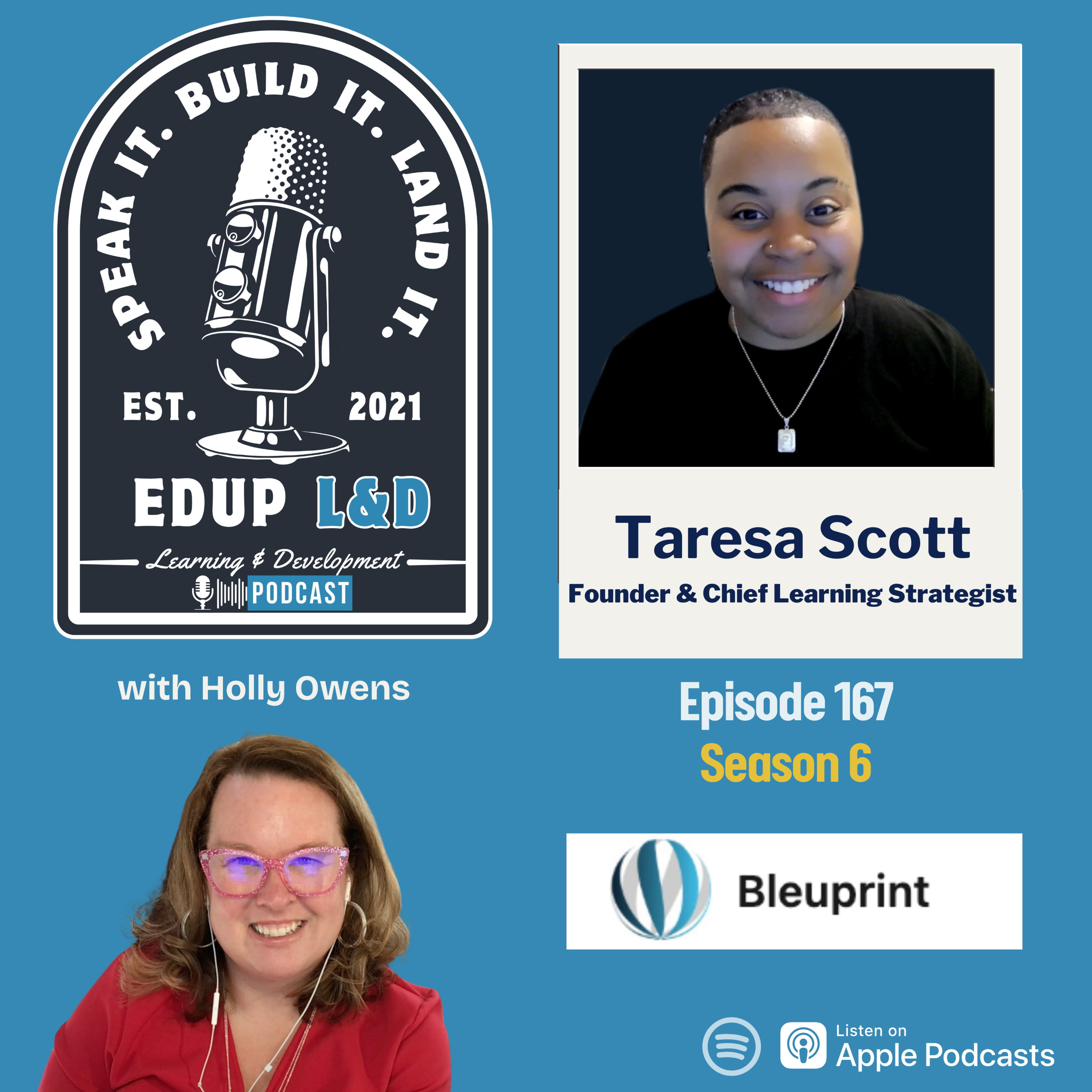
In this episode of EdUp L&D, host Holly Owens welcomes back Taresa Scott, founder of Bleuprint, to discuss the critical aspects of onboarding, employee retention, and the role of middle management in organizational success. Taresa emphasizes the importance of effective onboarding experiences, the need for continuous learning, and how middle managers can significantly impact company culture. The conversation also touches on navigating job interviews, the evolving landscape of learning and development, and practical advice for educators transitioning into corporate roles.
Resources mentioned in this episode:
Guest Contact Information:
___________________________________
Episode Sponsor: iSpring Solutions
🎙️ Huge thanks to our friends at iSpring Solutions for sponsoring this episode of the EdUp L&D podcast! 🙌
If you haven’t already, be sure to check out the iSpring Learning Exchange Community — a vibrant space for creators, educators, and L&D pros to connect and grow.
And don’t miss your chance to join the iSpring Course Creation Contest by July 25! 🚀
Grateful for the support and excited to see what our community creates 💡
Thanks for tuning in! 🎧
0:01 Welcome back to another powerful episode of Edda Pellendi. Today, I'm beyond thrilled to welcome back someone who brings equal parts insight, energy, and real talk to the world of learning and development. Teresa Scott. If you don't know Teresa yet, you're about to meet a true force. She's the founder of Blueprints, Spelled Bleu, where she helps organizations transform their onboarding, leadership development, and internal mobility strategies into true employer retention powerhouses. And let me tell you, she does not sugarcoat it. If you're onboarding suck, she'll tell you. And then she'll show you how to fix it.
0:41 In this episode, we dive deep into everything from the myth of hitting the ground running to how middle managers are the make or break point for your company culture. We talk about asking the right questions and interviews, building career confidence, and the real ROI of continuous learning. Whether you're a transitioning teacher, a burned out manager, or just someone trying to navigate the wild world of work, we've got wisdom, laughs, and truth bombs waiting for you. Let's get into it. Hi, we're ispring, an international team of e-learning enthusiasts who help more than 60,000 clients across the globe succeed with better online learning.
1:27 Our two flagship solutions are ispring Suite and ispring Learn LMS. Ispring Suite is an intuitive, all in one authoring tool for creating engaging e-learning content, and ispringlearn is an innovative online training platform for onboarding, upskilling, and certifying your teams. We also provide tons of free resources for aspiring and experienced e-learning professionals, conduct weekly webinars with top industry experts, and organize annual e-learning conferences, challenges, and championships. We'd be happy to get to know you and pick a solution that fits your needs best. Go to www.ispringsolutions.com to learn more about us, download our resources, and connect. Hello everyone and welcome to add up L&D. My name is Holly Owens and I'm your host and I'm smiling right now cuz Teresa Scott is here and I'm excited We were just laughing before so we're we're joyous to be here right Teresa? Yes, that's.
2:33 Probably an understatement. I don't. Yeah, we're just right now. Yeah, you've been on the show before, so it's really, it's really exciting to have you back and see you. What you've been up to that episode? I don't know. It's a while ago. It's like probably a year ago I was. Like I don't really a year like we might be like somewhere around like the like that 12 month mark. So, yeah, yeah. Yeah, we have a summertime vibe going on, so that's good. Well, welcome back, but for those of the listeners who don't know you, I'd love for you to reintroduce yourself, talk about what you do at Blueprint, your journey and everything. We love to share stories here on Ed Up L&D, so tell us all about you. Yeah, No, first and foremost, Holly, thank you for having me back.
3:20 Like this is kind of like my jam kind of being able to be in the space of talking about learning, geeking out and just exploring all the things. Yeah. But yet to clarify, Yeah, of course. My name is Teresa. I am the founder of Blueprint. And at a very high level, what we do is we help organizations leverage learning as their employer retention strategy. So when you think about those strategic onboarding experiences, when you start in day one in a, in a new role in your current company or even a new role to the a brand new company as a whole, we're in charge of really developing that experience. Another area because onboarding sucks. Onboarding sucks. I'm not going to lie, it still sucks, Teresa, even after you've been working as long as you have on this stuff.
4:04 I know and you know, it's going on a lot, you know, and it's so funny because of my clients engagement, this first thing, said Teresa. It's, it's bad. We know we're not doing it well, like. Well, that's OK. And talk about where we I'm happy they admit that. That's hard to admit. Like when you have flaws, it's hard to admit. So I'm happy that they admitted that. Go ahead. I'm sorry. Yeah, on board is one piece. Another area is leadership development. I'd like to do a little spin on leadership development really from the middle manager standpoint, because again, when we talk about employee retention, the middle level managers, the frontline managers, those are the ones who are doing the groundwork and they they are the reason that your employees stay or they leave. So a lot of our leadership development center around the mid level managers.
4:48 And then last but not least, just department based skills. So you think about, you know, I've been at this company two years in IT. What does it look like for me to go into marketing? What does it look like for me to go to HR and these other areas of the business? So a little bit of department skill path, but also even career pathing so you can grow within that organization. So at that point we're talking about internal mobility. So as a whole, we are really your fractional learning and development partner, really helping to take these organizations from A-Z and just ultimately taking training off their plate because they realize that at this point they cannot do it themselves. It is a lot of work. People. I mean, when we were in person, it was a little bit different. You get to spend time with people, you know, like sitting across the table and like you.
5:34 But still, you would do like a whole day of orientation and I would come out of that day feeling exhausted and like I didn't process anything, you know, And with a lot of our sectors roles being remote, like onboarding is the most, I feel like it's the most important piece because again, like you're saying, like it introduces you to the culture, to the people to like how things operate there. And if it's bad, it's going to leave a bad taste in that employee's mouth for a long time. Oh, yeah. Because when I sit down with CEO's, HR executives, the first thing I say is, what is your brand story? And they're kind of looking like what we're talking about, learning development. But I'm like, yeah. I know it, we don't know it. And I'm like, but it's so important to tell that story like you got somebody come into your business brand new, get them excited by working here.
6:22 They, they accepted the offer, but give them a reason to state that emotional connection runs much deeper than just that check because they can get a check from anywhere. But what is your story? What is your history? What are your values? What do you, what resonates with me and my core values? You know, how can I how how's the work I do really make an impact. What do you value me? You know, what were the opportunity even from their understanding the story good in my confidence to even do this job? Well, you know, there there's there's so many little pieces even that on boarding process they get skipped. We want to say, OK, all right, come in. All right, there's the bathroom. Here's your manager. We talk on Slack and then that's it.
7:03 Right, right. And then the lucky ones, they make it a mentor. But then a lot of times, you know, if you think about that mentor, for lack of better words, it's almost the blind leading the blind because who trained them coming through the door? You know, they they're guiding this new person coming into the business. But do are they even doing their job effectively? Like you may say, you expect the job to be done XY and Z and they might do XADG, you know, and they're and they're. That is so true, yes, so. And I talk about this from personal experience. When I talk to my clients and we sit down, we have real conversation and this is what is happening. And they're like, yeah, we know. Or if they don't know per SE, when you start getting what I do, I talk to a lot of the people in the business. I want to hear again, real world experience, what's really happening here.
7:54 We start talking to employees, understanding their actual experience versus what the executives and CE OS really think. Oh, that that's where we're really able to bridge that gap. And again, to your earlier points, a lot of work like we're we're a lot of times these conversations, this information to be gathered is just being skipped in the process to really create. That's why that's why I emphasize experiences because it's not just checking a box. OK, come on in. Let's just go down the list. You know, here, you know, this is your job, this is your manager, this is your, this is your point of contact, those type of things. Let's really get into the nitty gritty of what does it look? What does right look like to do this job? 306090 day actually post Post that. 306090 day plan, six months, 12 months, you know, like lay all that stuff out from the beginning. I think because it becomes, you know, like it, it becomes a mess of like trying to figure out like what you're supposed to actually be doing at the company. And as you were talking, I was thinking about, I know we're, I'm not going to stick on all Oram boarding, but I have AI have a thorn in my side with Oram boarding at a lot of different companies.
8:59 And one of the things that you mentioned is that like getting to know the company and what they're, what they're really about. And I was thinking like, how come, how do you feel about this? Let me ask you a question. How do you feel about this? Companies say, and I say this in some of my job postings too, if I'm hiring somebody, somebody that's ready to hit the ground running. So to me that indicates like there's gonna be no or very little onboarding. So when you hear people say they really need to bring in people already with the experience and they just need to be able to do the job, how do you approach that sort of situation?
9:40 Yeah, that's a tough one. It is a tough one because I remember in the past, even with organizations at a certain level, I've been lied to an initial saying, OK, I'm going to hit the ground running. So what type of support do I have? What are your goals? What are your plans? What resources do you have? And I said, oh, well, we have, we have this intranet and we're willing to support you and all these different things. And then you really get into it. You start asking questions, you start leaning on people, you start looking for resources and it's not factual and so. He disappears too. Yes, and everyone's going and go ghost and in the moment something goes quote, UN quote wrong or not to the expectations, which by the way, they never communicate what those were. They're looking at you like, oh, you can't do your job. And So what I would almost say is just the same as you go into an interview and they give you a lot of scenario based questions. I would absolutely give that interviewee the same, same sort of scenario based questions.
10:38 OK, you want me to hit the ground running. So if I hit the ground running and I say I want to do XYZ and plan and I start distributing to the to this group of people and it doesn't go to plan, how would you react? You know, I would start framing scenarios to get A to get a feel because as an educator, we have to learn to read between the lines. And even still, again, you could always be lied to, but I think interviewing the interviewee in a lot of areas or consulting, whatever you want to call it, having these conversations, that's just what is a conversation at the end of the day to ask these questions about the what if? Because that's that's they want to know what if? What do you want to do? Well, what are you going to do? Yeah, right.
11:20 But I, you know, I want wholeheartedly agree. And I always tell people because there's so much anxiety surrounding the, the interview process and the oil boarding process, I'm like, during the interview, I'm like, this is just you interviewing them just as much as they're interviewing you. You are scoping them out and checking them out just as much. Because I think people go into these conversations and they're like, Oh my gosh, I need a job, I need money. I, I just have to, I'm just going to have to acclimate to what they say and give the correct answers and use the correct jargon and all that stuff. And then they get into the role and they're like, Oh no, like I made a mistake. You know, I found to have, I always say elevate yourself.
12:03 You know, at the end of the day, we, we, we work as a whole because we need money. We have to take care of our families. We want to do whatever, achieve whatever goals we have as monetary. But I do think that we always bring values to the table, whether it's starting the new, you have transferable skills, whether you've had the skills for the last five or ten years, you bring value to the table. And I think it's important to understand what you're walking into because yes, you need that role. But if 90 days down the line, it goes out the window, you waste your time. And you could have been going into another interview for a company that better aligned and that was better supportive of what you needed. And so, you know, going to the wrong situation in 9090 days or 120 days, you'd be back in situation that you thought you were exiting from.
12:44 And then you're back looking for a job and it's it's a hustle and it's hard and it's burnout consistently. So don't. It is I and I think I think personally elevate your, your your language, elevate how you you show up. And I think it's so important to even let a person interview asking you those quote UN quote hard questions. I think support you ask them back because if you find yourself, if you find your some position where they're getting stumped, they don't have answers, then you can make a more informed decision about is this actually coming for me? Even if they're even if they're able to respond, what did they say? Not the not even just the words. So long body language, tone, you know, what words do they use? You know, when we think about, you know, I've seen job descriptions that said, you know, we're looking for a Unicorn.
13:30 Oh, we're. Not I use that against them. Now I wrote a whole did you see my post only I'll talk about it a minute. Go ahead. No, but it I did see the post and it's so true because and I bring those, I bring those things back to the forefront because I'm not going to say that that's every single company. But if you I've noticed a trend in language and reality. And so when those type of words are used, run or, or if you don't, or if you lean into a say, Hey, I need this job. When if you land that interview, scenario based questions are going to be your friend. Those challenging questions will be your friend because you need to understand what are you walking into?
14:14 Because you know, you have these certain leaders who think, you know, oh, you know, we're paying you a check. You know, we just need, we just need somebody in the seat or whatever, whatever their mind frame is. You need to cut through that noise and really understand what this what this culture and company could look like with asking the right questions. You can find out a lot about the organization really quick, you know, if you're asking the right questions and those. They're on the same page because I say that to people, people that ask me, they're like, what can I do to stand out or what can I do to like? What should I be asking? And that's exactly what I tell them they they need, need to be asking from the, from the get go, like about the company and the onboarding and you know, promotions or professional development, all those sorts of things. So you get an idea, because if companies like, no, we don't do that here.
15:02 No, we don't do that here. I'm going to say bye. And the Unicorn thing. So I, I've used it, I've used it in the other way. So when I was applying for roles before I got my role at yellow dig and like I took the Unicorn thing and I put in the chat sheet. BT I'm like, I just made-up a whole like slogan thing about like I'm the Unicorn you're looking for. And it has some other stuff in it. And it, it got that post got some traction on LinkedIn for sure. Because I don't think companies realize like it's not butterflies and rainbows having a job like us in the middle to upper middle class or other classes. We're not looking to work for 40 years. We just kind of have to, you know, like we have to, we have to, we have to save for retirement, you know, we still want to live our lives.
15:54 So like looking for a job is just like it's part of the lived experience wherever you may be. But I really don't feel like, oh, we're going to like if we didn't have the, if we had the option not to have quote UN quote jobs, I feel like the culture would be a little. Bit different. Yeah. You know, it is it's really, it's interesting because I see a lot of a lot of things around Gen. Z in the workplace. And you know, I've had some leaders come in and say, you know, they don't want to work, they don't want to work. No, that's not the case. That's not true because most of them are just calling out the BS that a lot of Gen.
16:35 Y Gen. even later millennials have taken have have just absorbed over years. And the reality is they're just questioning why are things in this fashion? It's simple. It's simply asking why. And because they're challenging you, they don't want to work. No, you're just uncomfortable now. And I think even, and that's why I emphasize when you talk about wanting to stand out in these interviews, it doesn't hurt to present a healthy challenge because as an educator, that's your job to really be challenging to to bring things to the forefront. People can't grow and develop in the safe zone. So why? Why are we playing it safe in the interview when we're talking to these executives and these leaders? This is the prime time to challenge their thinking because the reality is, subconsciously or consciously, people are a mirror of their leaders, even up to the executives.
17:29 So if the executive team is uncomfortable with this change or this line of questioning, what do you think your employees are going to be? So how much work are you really going to get done as AL and D professional team won't even respond to it or properly, you know, give you a a thoughtful answer and then think about it. Are they actually going to support you? Will you go into the business and start asking these hard questions to the employees? You know, it's, it's a domino effect when you, when you really sit down and think about how can we really progress for if you know, land job, because again, that those things can waste so much on your on your mental like, and that is way more costly than missing a check. Yeah, I agree.
18:16 They have a long term effect that can take years to recover from depending on the role, the position and the amount of time that you've really poured into something that's not pouring back into you. Right, let's talk about the middle management people a little bit. We've talked a lot about onboarding and asking questions. So what do you consider to be like a middle management person? And like how, how does blueprint help them, you know, up their game or become confident in their skills? And like, sometimes I feel like at the beginning of the career, like you're just so naive or oblivious to like actually what the role is to do. You're just trying everything. And then when you're in the middle, it's kind of like you have a, there's a little bit more of that expectation that you know what you're doing, but you're not exactly leadership, but you're not entry level. So you're, you're stuck in the middle. So how does how does a blueprint kind of help with that? Yeah.
19:09 So the real focus is almost, it's almost like mentorship in a sense, because it is, it's, it's all of those things. What you're saying it is helping you to take a step back to look at things objectively from really elevating yourself because it can be really challenging to go from an individual contributor where you're worried about your own self to going to leadership role. And now you are focused on not just developing yourself, but of of your your team, not your peers. But. Your and doing all your work. Yeah, it's still doing work. Like you have a, you have a low cut out for you. And so for me, I think I look at the team lead all the way up to the director. And even if there's a level above the director, I know sometimes there's like a. Executive vice president or senior? Yeah, Senior Vice President.
19:55 Yeah, because, because a lot of those those levels are really, really close to that frontline employees. So they're leaning on you, you know that that you have somebody come, you say, hey, can you approve my time off? You're responsible for their development, you know. Yeah, yeah. Yeah. And so it's really helping them think about, you know, communication styles, building positive relationships, really trans trans, transitioning our mind from just a leader that's or a delegator to an A coach. You know, how can you elevate this person? How can you support this person? And really, because at the end of the day, being a leader is not about having all the questions. It's about being confident enough to find the answers.
20:37 And even speaking, I'm saying I don't know, you know, so. I know somebody that does know though. You hire people smarter than you. Absolutely. And not be intimidated by it. Absolutely. I'm not intimidated anymore. I mean my 20 something year old self would have been intimidated or and or jealous My 40 something year old self. Although you know what's are out the window. I want people. Smarter than me? Smarter, not harder. Yes. You know, because if if you have someone who is who's willing to raise their hand, bring out this to the forefront. And my question is, how can I support you? You have some wonderful ideas as a coach.
21:18 Let me support this initiative. Have you thought about doing XI? Really like this idea. Have you thought about doing X as well? OK, great. Well, what can I do to help you get this to the forefront? Who are you trying to do this with? Is it are you able to? Is it can you manage this with your existing course work? Do you need any support or launching this initiative? You know, how can I help you? You know, those are those are what I call low live, high impact things that really can make a difference for your team members to feel seen, valued and heard. But these these are mindset shifts though. These are real mindset shifts that we really help these mid level managers to to really develop. And into your earlier point that you mentioned, like, you know, when we were in person, you know, you go on 1/2 day all day workshop, you walk out like, oh, OK, what do I do with that?
22:05 You know, you're pumped, you got these documents. So really our goal is to really take it piece by piece overtime using A702010 model to learning. So whether it's over a period of 12 weeks, 12 months, is, is really going incrementally to say, OK, these are key skills to build this week. Let's talk about practical ways you can apply it in the workplace. I'll give you a little homework that you can apply into for reflection and apply into your world of work. And then we'll come back into the classroom again. It's done an hour at a time, so very. That's how it goes. Yeah, so he's. Trying to figure out the formula, right? Like yes, in digestible formats and you can sit down and like just sit with it. Like I don't, I feel like nowadays, especially in a corporate culture, we don't get the amount of time we need to actually absorb the information and process it and figure out where does that fit into what I'm doing?
22:56 Yeah, You know, it's strange because like in corporate America, we treat learning like it's an event, right? Like it's a big game there. All right, let's go into the game now, go and work, and then we don't come back to it for six months. Or when when somebody emails us, us, we have to take this training. Yeah, it's security training and. The reality is we're constantly growing, evolved, and the world is changing so fast. You know, when AI, you know, really came into the work, the workplace, it's been evolving ever since. Like if there's so many new platforms and developments and ways that you can use it, like even a single platform of ChatGPT has about what, four or five version versions at this point.
23:36 So that's continuously learning. And so even if you think about athletes, 80% of the time is on the field training and the other 20 is performing, but the workplace is reversed. They feel like 80% should be performing and 20% should be training, but you're not You're not. How can we sustainably grow this business if we're not continuing how continuing to learn how to evolve with it? Your industry is constantly changing. So many things are constantly changing around you. Why do we, why do the executives and leaders not think that learning is just is not just as important to be done on a continuous basis? And so that's really our focus to bridge that gap on having a continuous way to learn to adapt. So as you're, you know, setting your big goals for 2025 or 2026, where does learning come in the middle to say, OK, we want to, we want to increase sales by XY and Z in this particular product.
24:28 We want to improve our net Net Promoter score by this amount for customer service. You know, just we talk about employer retention, happy employees leads to happier clients for for higher client retention. You know, there's so many ways to weave in. That like we, we make it so complex in our heads. It's really simple. It it's like it is it to me, it's like if we, if we put it in the flow of work. That's why I emphasize the flow of work because again, it, it doesn't have to be, it doesn't have to take a whole lot of time. It doesn't have to be, you know, it just had to be just one time a year or twice a year. It could be something just as incrementally as an hour a week or 30 a week. You know, as long as it is meaningful, relevant and digestible, you can make such an impact by being consistent with it.
25:19 You know, I've, I've actually had several articles I've, I've published in the last several weeks around consistent learning for just for change management alone. We'll. Share those in the show notes. But I think about all these things when you ask, you know, how do we help is, is, is putting it to a flow, making it relevant, making it meaningful and helping again, professionals to apply. Because the biggest thing that I'm finding organizations that they're either really good at providing information, like a ton of content, but a lot of times what happens is, and once they get that content, they still don't know how to help help their people to apply it.
26:01 So it still goes out the window. So we're helping them to, to blend the two worlds of content, like learn, adapt and apply, learn, adapt and apply. So again, it's, it's not just knowledge, it's just being absorbed and like squeeze out like a sponge. It's actually being absorbed. But then this is how we can apply it at work. This is how we can apply it to your role. This is how we can apply it in these different scenarios. So that's the goal of how we really operate. So when we talk about strategically and sustainably, that's really where we show up to really, again, the rubber meets the road. So it can take off right here. Gosh, I know that you said it so well.
26:41 I, I, I don't even need to comment or say anything. I don't even need, you know, we have a lot of people. We're already almost on the episode. I can't believe see, this is what we do. With each other. We have such a good spot and it goes by imagine if we live closer to each other cuz I'm in Wilmington, NC now. So now I'm not that close. I know cuz I'm out here in Dallas, TX so yeah I know in the middle. That would be so much fun. You know, I didn't realize like you've worked for like eBay, AT&T, Dave and Buster's like you've, you've like done the gambit pretty much in your in your career.
27:26 You've been involved in ATD Directvi was just looking at your LinkedIn and I forgot. So lots of people in our audience are looking to jump into learning development, especially transitioning teachers. So if you had to give like 3 pieces of advice to them as a take away from this episode on what they could do, and now you're you and your own company, you're doing your own thing and you have been for about 6-7 years. What would you say to them as they're transitioning, maybe into like to work for somebody or to work for themselves, either way? You know, I would say think about your transferable skills because, yeah, now I won't pretend as if I've been in the like the classroom education space, but I've been in the corporate classroom before.
28:12 And what I is, you know, think about some ways that you've been able to really engage and connect and really help your students to learn new skills and talk about great advice. Yeah. And then and then ask yourselves, you know, what are some areas you feel like you would really enjoy? Like for a long time it took, it took me a while to really niche down because I'm like, oh man, you know, I really enjoyed doing, you know, this industry and that industry. But then I thought about the work I actually did. It was very customer centric. I, I really even with this been branding, marketing, onboarding, department based, it's all around good customer service.
28:55 And a lot of times people think customer service is just, you know, like a business to a consumer, but it's even being a good customer internally. You know, if I'm, if I'm in learning and development, I work and I work with marketing. How can I be a good customer to marketing or a good client to marketing, vice versa? And so for me, I really, I, I really love being in those areas because it's all about good communication, good collaboration and teamwork. So, so for me, it's been able to really communicate how I like how, what I really enjoy, how I show up best 'cause we do a lot of things. It's, it can be so dynamic. So I say, you know, think about those experience when we we've really been able to help you help engage your students, level them up and really see their their development grow.
29:39 Then also, what would be some areas that you're really passionate about, like if, if, no matter what. That's where the niche part comes. Yeah, yeah. And when I flip it down, like what would that thing be? That's like, you know, what if I think back to, to to a couple of projects or a few things that I did, I really did enjoy X area. And I would say get clear on those things first, because as you apply to roles and you look into these different companies, you'll, you'll start to do a little research and kind of see, OK, is it somewhere I can see myself? You know, do I want to do instructional design for healthcare or do I want to do instruction design for automotive or for, you know, restaurants or retail? It can really help you to get a little, a little bit clearer and kind of niche down in your role and focus. Same thing.
30:25 Even if you're starting looking to start your own freelancer consultancy, again, same thing. Who do you want to support? I think when we identify our, our who and our expertise, then everything else becomes a little bit clearer along down that path, you know? Yep. So that that's my my big big taking while providing anyone that's thinking about this. Yeah, I think that's great, Great advice, like thinking about your transferable skills, niching it down, thinking about in terms of thinking about what you're passionate about with that. And then you also mentioned communication, like how do you communicate that as well to the role you're potentially going to be interviewing for also too, Like how do you, in terms of communication, how do you talk about it yourself?
31:10 How do you talk about yourself? Do you do mock interviews or things like those are three great pieces of advice. Teresa, thank you so much. All right, we're coming up on the end of the episode here. Where can people find you? You know, where do they go? We're obviously going to have everything that you mentioned, your articles and about you is all going to be attached to the show notes. But tell us where people can connect with you. Learn more about Blueprint. Oh, I would highly encourage LinkedIn because we're on Facebook and Instagram, but I'll tell you why. Why where we live the most is really on LinkedIn. So you can find our company page. Blue is spelled Bleu, so we're literally unique in that aspect. LEU. Yeah. So of course, connect with us, follow us. Like I said, I'm really conscious about putting pushing out newsletters and content.
31:57 That's really helpful. And yeah, let's keep it rock'n'roll from this. That's how we that's how we're sharing the love. So connect with us there. Yeah, LinkedIn world is where it's at for sure nowadays in the professional space. I mean, we like, you know, I use Facebook and Instagram too, but that's more for like pop culture type related stuff. Yeah, my family's up to like Linkedin's where it's at. Yeah, that's I will. Die on that hill. I will die on that. Hill You know, if you're in a corporate space, that's just where it makes sense, you know? Absolutely, absolutely. You know, before we wrap up, Facebook tried to do like a professional thing recently and I accidentally clicked on it and my grandmother was, my grandmother was like, she's like, why? What is this professional thing you're doing on Facebook? I was, Oh no, I was just looking at it. I didn't mean to click on it, but you know, like the other companies are seeing the value of that, like what's happening on LinkedIn.
32:51 So they're kind of trying to figure out a way to get in that game too. I guess. I don't know. And. You know, and I've, I've seen a lot of chatter about, you know, even your Instagram posts like your like the the the captions are feeding over the Google for SEO. So I see yeah. So the social platforms, they're really trying to beef it up. So I I guess they're seeing, you know, a lot of people like content creators and things are posting out there. So I mean not not saying it's wrong, I just I also learned early too that if you're starting something out that if you try to be everywhere you'll burn yourself out. So as you build it, pick one platform, go with bonus piece. Of advice. Bonus piece of advice. Another piece of advice, So pick one platform and go with it, build it, nurture it for a while and then you can even scale it up from there and then add some additionals on. So that's my last take away I.
33:44 Love it. That's a great piece of advice as well. Well, Teresa, thank you so much for coming back on the show. I really enjoyed having you again and I hope we do this again soon and have fun. Everything about Teresa and Blueprints going to be in the show notes, so go there, check it out, and follow them on LinkedIn. Thank you for having me see you next. Time bye. Hi, we're Ice Spring, an international team of e-learning enthusiasts who helped more than 60,000 clients across the globe succeed with better online learning. Our two flagship solutions are Ice Spring Suite and Ice Spring Learn LMS Ispring Suite is an intuitive all in Go to www.ispringsolutions.com to learn more about us and connect. Thanks for spending a few minutes with Holly. She knows your podcast queue is packed. If today's episode sparked an idea or gave you that extra nudge of confidence, tap, follow or subscribe in your favorite app so you never miss an episode of Ed Up L&D. Dropping a quick rating or review helps more educators and learning pros discover the show, too. Want to keep the conversation going? Connect with Holly on LinkedIn and share your biggest take away.
35:06 She reads every message. Until next time, keep learning, keep leading, and keep believing in your own story. Talk soon.

Founder
Taresa is the Founder of Bleuprint, an EdTech Company focused on delivering personalized e-learning experiences to onboard, upskill, and reskill professionals in the workplace. With a Master of Science in Education, Taresa has a strong background in instructional design, learning experience design, and e-learning development. Through her company, Taresa is on a mission to empower modern learners to own their skill development so that they can learn, grow and thrive in their careers'.