

 Apple Podcasts
 Spotify
 Amazon Music
 iHeartRadio
 Pandora
 Castro
 RSS Feed
 Audible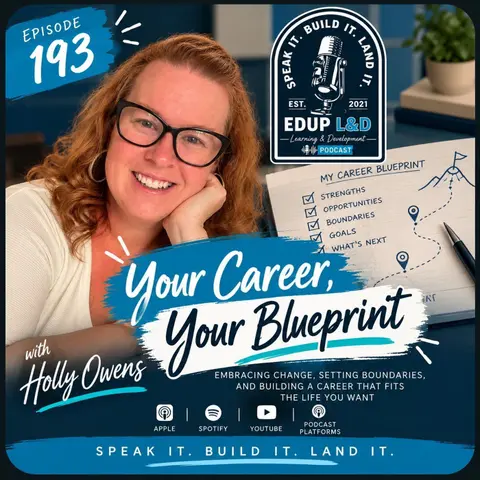
This episode was previously recorded as a LinkedIn Live on 9/23/26.
Holly kicks off the live session with a little housekeeping before inviting listeners to reflect on their own career journeys. The conversation dives into what it really means to build a career around your strengths, and why the experiences that seem unrelated at the time can actually become some of your greatest career assets.
Together, the discussion explores:
- Embracing change and knowing when it’s time to pivot
- Evaluating career opportunities based on what you actually want
- Setting healthy boundaries in the workplace
- Redefining what career success means as your life evolves
- Recognizing the value of your experiences—even the unexpected ones
- Building a career blueprint around your strengths, goals, and aspirations
The big takeaway? Your career doesn't have to follow a straight line. You can change direction, redefine success, and build a career that fits the person you are now—not just the person you were when you started.
If you're questioning your next move, feeling stuck, or wondering what comes next, this conversation is for you.
Shoutouts and resources shared:
- Your Career Blueprint
- SKIP - Use the code "HOLLY" for 10% off your subscription and follow my friend Chelsea Maude Averitt on LinkedIn
- NextGround - Go join the waitlist for the NextGround paths (coming soon!) and follow my friend Devin Lewis on LinkedIn
- Check out and register for the Next Chapter Conference happening in New Orleans on November 4 & 5, and follow my friend Ella Epshteyn on LinkedIn
- Check out the fantastic master's programs offered through Touro University's Graduate School of Technology (where I teach!)
Connect with US
💼 Follow Holly on LinkedIn — Connect with Holly on LinkedIn📹
📹 Subscribe to our YouTube Channel
📰 Subscribe to the Newsletter — Get It’s Not Just One Thing delivered to your inbox
💃Check us out on TikTok
💌 Connect with Holly — Schedule a conversation
Thanks for subscribing, listening, and supporting our show! 💙
Thanks for tuning in! 🎧
Holly Owens: Hello everyone, and welcome to the EdUp Learning and Development Podcast. My name is Holly Owens, and I'm the host of this show, but I'm also a higher education professor, instructional designer, entrepreneur, and a proud helper of humans. I've worked in the L&D space for almost 20 years, and I'm here to share what I know, what I'm learning, and what's happening in our industry. We'll talk about instructional design, L&D AI, technology, careers, and the humans behind it all. Along the way, I'll bring in some friends to share their stories, experiences, and expertise too. Because at the end of the day, L&D is all about humans helping other humans. This is EdUp L&D. Well, hello everyone. Welcome to this live session of talking about your L&D career blueprint. You're gonna design your career. We're gonna think about your career. I'm so excited that you are here right now with me. I am live streaming out on YouTube. I am live streaming out on LinkedIn. So thanks to those of you who have joined, I see about 10 people. Have joined, which is amazing. We had 75 people registered, and I know some people registered so that they can receive the recording recording following this session. So, speaking of that, before I jump into the session, I just want to do a few housekeeping things. the first is that you might see me looking in other directions because I'm keeping track of the lives and making sure. I'm answering your chat questions if they're in the chat or just making sure things are going as planned. I don't have a moderator, so I'm doing all these different things by myself. Also, too, this session will be recorded. So this session is being recorded right now via Riverside, and it will be released this Thursday, that is tomorrow, as a podcast episode on my podcast. EdUp L&D If you don't know about EdUp L&D that is my podcast. It has been around for six years now. we're going on seven, no, yeah, we're five years, we're going on six years. So if you don't know about the podcast, I'm gonna put a link in the chat that shares with you how to access the podcast. It is a wonderful show where I interview people from different walks of life and L&D and ed tech. so please go. Do me a favor, check it out if you haven't checked it out. You can relisten, like I said, to this episode. so I would love for you to go out to eduplnd. Let me put it in the chat.com. This session is all about you. This is about reflecting back on your career journey, thinking about where you're headed, thinking about where you are now. Maybe you want to make some changes in your current role. So thinking about all those different things. So please, if you have a question, you're probably seeing my dogs make an appearance as they are right now. I also want to tell you that I have some amazing friends that have agreed to sponsor this event. So you're gonna hear me read some copies from these people. they're wonderful friends of mine. They have different businesses and things like that. so I'm going to read some information from them throughout this presentation. So you definitely want to check them out. All right. All right, it looks like that you're able to see the screen. so one of the things that I want to open with is thinking about your career. Your career is not just one thing, it's not you don't have just one job, you don't do just one thing, the same thing, every single day. you are not one thing. You grow and evolve in your career and your jobs and the things that you have. And as we're talking. Throughout this presentation or throughout this session, I really want you to reflect on where you have been, where you are now, and where you were going in the future. It's important that we continue to grow and we continue to learn when we're thinking about our careers. Gone are the days, and you know, I do still know a few people. Gone are the days when people stay in roles for 20 plus, 30 plus years. we are moving, we are moving to make more money, we're moving to you know get a get with a company that more aligns with our goals or the mission that we have in life or the people that we want to interact with. so if you're I'm sorry if you're hearing the dogs. I I'm hopefully it's rounding it out, but they're being very loud right now. so I really want you to take this time to reflect and think about where you are and where you are going. so I'm gonna go ahead and I'm gonna introduce the episode now. Hello, everyone, and welcome to another amazing episode of EdUp L&D My name is Holly Owens, and I'm your host. And today I am very excited because this is a LinkedIn live that we have previously recorded. And I'm doing a session on your career. It's not just one thing. And we're going to talk about all the different ways you can reflect on your career experience, set goals for yourself. I have some tips and tricks. Maybe talk a little bit about what's happening in the job market. So you're really in for a treat here, listening to this episode and seeing this present this wonderful presentation that. AI helped me put together. so welcome. Come on in, sit down, grab your favorite beverage, grab a snack, and get prepared and be ready to learn a lot. So let's get started. Right. So one of the things I said, your career is not just one thing, and neither are you. I'm working on a book in the background. So that's why my it's not just one thing, because a lot of the time. I get a lot of information in my LinkedIn inbox about, well, what's the one thing I can do to stand out, Holly? What's the one thing I can have amongst all the other applicants? Please tell me what's that one thing. It's not one thing. As you know throughout your career, you've done a lot of different things and you just haven't, there's not one magical solution to standing out. There's not one magical thing you can do to make things different. You have to build and you have to do different things. So a little bit about my career journey before we pop in to the session. So I started my career out as a high school social studies teacher. And I had always wanted to be a teacher. I was going to be a teacher for the rest of my life. I started thinking about teaching when I was in middle school. And by the time I got to undergrad, I was like, please Just give me the degree so I can go out and be in the classroom. Then I got into the classroom, started teaching, and I realized how much teaching was regulated, how much administrative work there was. It really wasn't focused on the learner. It was just focused on a lot of different things. So there was a combination of things that made me decide that I needed to do something else. So in 2011, I stepped out of the classroom. and into e learning development as a contractor for the federal government. And I did this when it wasn't the cool thing to do. Okay. So everybody who's been jumping out of teaching and into like instructional design or learning and development, I was doing it before all these fabulous people and all these fabulous resources were available. So I did that for about six months. I had an amazing manager, amazing supervisor. We would go on these walks and he would talk to me about. what I can improve, what I was doing well. And one time he said to me that there was this opening, because I lived in the DMV area, the DC, Maryland, Virginia area at the time. He said there's this opening at Northern Virginia Community College. And if you know Nova, they have a lot of different campuses within that area. And he's like, I think you should apply. So I started thinking about it. I was like, yeah, you know what? I really do love education. I really want to go back into it, not K to twelve. I want to, you know, I could try higher education. So, long story short, I went and I interviewed for this position. It was called instructional technology specialist at the time, not necessarily an instructional designer. And within 15 minutes of leaving the interview, they called me. They said I had the job. So I was officially becoming an instructional technology specialist in higher education. And this was back in 2012. During this time, I also decided that I was going to start teaching adjunct. in higher education. So I I looked around for different positions because I had gotten my master's degree in instructional technology. And I landed a role at Trinity Washington University teaching education courses. And I also taught some courses at Northern Virginia Community College, like in computers, like learning how to use Microsoft. So that again began began my higher education career as a technology specialist. And then jumping into adjuncting. Which I'm still doing. Next, what happened? I got recruited to the state of Maryland as an instructional designer for Koppen State University. I graduated from the US one of the USM institutions, UMBC. I eventually left Copp and I went to UNBC. and then eventually life took me to New York and I became an instructional designer at Toura University, where I currently still teach adjunct and have been doing so since 2018. So that's eight years, you know, teaching and being in the classroom is my thing. and then eventually I started a podcast. so the podcast that you're listening to right now, I have to shout out Elvin Fritz and Joe Salustio from the EdUp Experience because they encouraged me to start a podcast about educational technology, which I did interviewing CEOs and founders. Then eventually my career led to working at Amazon, working at the candy company Mars. I just did a little lollipop. And I did get a job in ed tech as the director of growth marketing at Yellow Dig. So at this point, I've been I've been in ed tech, I've been in corporate instructional design, I've done some contracting work with the government, I have started my own podcast. I'm still teaching in higher education. And then came along Ed Carta, and I became for I started doing some contract instructional design work with them, and I became the VP of academic programs. And I've since left Ed Carta and now I am working as an entrepreneur, you know, doing my podcast and freelance instructional design. So as you can see from the theme of this session, it is not just one thing. My career, and I'm sure yours is, is full of different experiences that make up who you are. Today. and again, as we progress throughout this session, I really want you to start thinking about what you've learned along the way, what you can continue to be learning right now in your current position. And we're gonna talk a lot about a lot of different things. And don't forget, at the end of the session, I'm gonna share with you my L and D career blueprint. So I've created this with the help of AI, of course. I've created this blueprint where you can go and you can fill out different things. It does have like a A blueprint kind of it has like a career quiz kind of thing where you can kind of score yourself or where things are at. and this is for you. You can take it, you can print it, and you can you can use it and reuse it and reprint it as much as you want. But speaking of jobs, I want to pause here for a quick update. I'm gonna do my best ad voice, and I want to talk about Skip. If you all follow me on LinkedIn World, you I talk about Chelsea Malt Average ski skip. Ed skipped job board a lot. So if you're working in L&D, you definitely 100% know how challenging it can be to figure out which companies are actually hiring right now. You know, LinkedIn posts jobs, they promote jobs. Chelsea's board is different, and that's why I love recommending her job board. They actually use it personally, I actually use it personally. I'm signed up for a subscription when I've been looking for a new job, which I am right now. So this is one I can speak to from experience. Skip brings together remote jobs from hundreds of job boards and filters that makes it so much easier for you to figure out travel requirements, salary, and experience expectations. It's not just for experienced L and D practitioners. Honestly, it's the kind of site I wish that had existed when I love teaching because she has ed tech, she has marketing, she has so many different. Jobs that she goes out and she curates. it's a wonderful site. So if you're if you're a teacher thinking about making the move into L&D or anybody else thinking about making some sort of move, I would definitely recommend Chelsea Skip. and I also love that it's affordable. It's pretty much less than the Netflix subscription at $15 a month. Plus, Chelsea was nice enough to give me a coupon code for this session. So if you use the code Holly, H O L L Y, you get an additional 10% off of any of the subscriptions out on Skip. So go out to Skip, sign up, and use the code Holly to get 10% off. Okay, first ad done. I love Skip. Hi Chelsea, you're amazing. You already know that. Let's talk about what this is all really about when it comes to your career. So it really comes down to four things. The first one is what your career. Good at. That is bigger than any job title that you've ever held. These are the things that you're passionate about. These are the things that bring you to life when you do them. And for me, that is podcasting. That is talking to other people. That is connecting people. That is having conversations. That is building relationships. So think about what you are good at? Your job title might not encompass those things. So maybe. It might be time for a shift for you. so that's the first thing. What are you good at? What you value. No longer compromising things. And I'm at this point, and I know a lot of people are in their their career, where they are thinking about what's next for them or how they can continue to upskill in their current position. So what are you no longer compromising? One of the things I'm no longer compromising is I'm not taking a salary lower than. what I need to sustain my lifestyle. I'm not taking a job where it says it's remote, but then it requires up to 50% travel because I just can't do that with the responsibilities I have at home. So just thinking about what's no longer up for that compromise. Then along with that, the next thing, what is the life you want? I recently listened to a podcast with Mel Robbins and Gary Vee, and I can put the link to To this podcast episode in the show notes. And one of the things that Gary V touched on is how we're all going to die. I know that seems very blunt, but when you think about it, it's obviously the truth. And I want you to think about what's the life you want. Your career, what do you want for your career at this point? What do you want in your life? What do you want to do? What do you want to experience? You know, how can all those things be balanced together? And then of course the blueprint of it all, how it all fits together for you. So thinking about using that L&D career blueprint that I'm going to share at the end of the session and also having the show notes for people and how everything fits together. So what's it really about? Thinking about what you're good at, what you value, the life you want, how it all fits together for you. Because coming from a person who started out a career that I was going to have for the rest of my life and now I'm sitting here and I've listed a thousand jobs that I've had, I wouldn't want to do it any other way. It has made me a better human. I know it that sometimes it's challenging, but I want to encourage you to take care of you and figure out what's the big picture here and what do you want? All right, what we're gonna talk about, and I'm getting a little long-winded, so I'm gonna speed this up a little bit. So I want to talk about building a career around your strengths. I recently did a podcast episode with David Fano, and we talked about like, you know, the like job descriptions. We talked about people saying, like, well, my job doesn't really fit like what I wanna do or what I wanna be, or you know, what I'm really passionate about. So one of the things that you should do is you should build your career around what you love, what your strengths are, what your passions are. And if you can't find that role, create it. I've done that. and it's really invigorating and it's really fun to create a job that kind of fits what you want to do. And working with people who were willing to take a chance on me and give me a job, you know, just create this job for me is really what it made me stay in those positions. So really thinking about building that career Around your strengths. What are you no longer willing to sacrifice? Like I said, I was coming through like traveling too much, taking a lower salary, working with somebody who's a micromanager, thinking about all those different things. Turning your unrelated experiences into ads assets. My podcasting, because I have done this, I have learned how to do different things, including the big one marketing. So think about different things and hobbies you may have. Maybe you're good at TikToking, or you're good at maybe knitting, or you're good at, you know, I I don't know, insert said thing here and how to turn that into an asset for yourself. I mean, knitting takes a lot of concentration, it's attention to detail, that sort of stuff. Redefining your success as your life changes. We all go through different stages of life. And I I really do appreciate the people that stay in one role for a long time and the role evolves with them. I think that that's wonderful and that's a great company or organization to work for. So thinking about what success looks like in your twenties and your 30s and your forties, 50s, and 60s, and so on, because we're obviously working well into our sixties now. so what does that look like? Navigating those pivots and changing your mind. I recently, and if you don't follow me on TikTok world, I can talk to you about that. I recently left a full-time job without having another job lined up because I want to do something more. I want to help people. And I changed my mind about what I wanted to do. And I changed my mind about like I wanted to pour my energy into things like this, into people. I wanted to pour my energy into sharing content. I want to pour my energy into giving people advice. So I It's okay to do that. It's totally okay to do that. It's yesterday I recorded a video where I was like really raw with my emotions about like all that I'm experiencing. But if you change your mind, I just want you to know that that's okay. Yes, Devin, it's okay to take care of you. and then we'll talk about how it fits all into the bigger picture and then evaluating the opportunities that you actually want. All right. Building a career around your strengths, not just your top job title. So if you could sit here right now, and it's hard for people to do, even me, to sit down and think about what are your strengths? So take a minute to think about. And for those of you listening, if you're not seen on the screen, What you're good at is bigger than any one job description. So I want you to try to list out before the end of this presentation five of your top strengths. Five of your top strengths. Because your job title is not just that's not who you are. Yes, I'm an instructional designer. Yes, I'm a podcast host. Yes, I'm an educator. Yes, I'm a higher education professor. But it's so much more than that. So you have to think a little bit deeper. and what are you good at? And and really give yourself some credit. Give yourself some credit. So finding those strengths, write those down right now. And I'm gonna pause to let you take a couple seconds to really think about that. because this is something that's going to lead you into what's next for you, whether that's staying in your current career, whether that's finding something else, whether it's whether that's going into entrepreneurship. So really, really thinking about that. Okay, what are your strengths? And I'm talking, I'm speaking to you, transitioning teachers community. I'm speaking to you people who don't think that they have any strengths. You do, you have, you encompass so much. Humans are amazing, complex creatures. We are good at a variety of different things, and everybody has strengths, and everybody has weaknesses, and that's what makes us unique as a species. So please take a couple seconds to Think about what are your strengths. And while you're doing that, I am going to read something from my friend Devin Lewis, who is in the LinkedIn Live. I want to tell you about Devin. And Devin and I just met out on TikTok land. It's totally unexpected. We became fast friends. he taught, he has taught, he coached teachers, he led teacher evaluations for the largest school district in Texas. He built Next ground. It's for educators who know they want to advance. The ones who Google jobs for teachers, me, I did that at 11 o'clock at night, not because they're done, but because they want to know what else they're built for. This goes great with this slide. Because the career ladder in education isn't a ladder anymore, there are a lot of ways forward now, and nobody lays them out for you. Really, they don't. Next ground does. Inside education, education adjacent, or beyond it entirely. And it gets you ready before you even get the title. So go try nextground.com. That's T R Y N E X T G R O U N D dot com. So go try it. Go sign out. Join Devin's wait list with Next Ground. He's doing amazing things. he's in the chat if you have questions for him. and I just love speaking about people who are doing amazing things in this space. So I hope you took a couple minutes and you figured out some of your strengths. So now thinking about turning unrelated experiences into career assets. So I never thought that. I was going to be a podcaster that wasn't on my list of things to do. So every path that you've taken taught you something worth using. So podcasting, like I said, has taught me marketing. what have other things taught you? What have other experiences that you've had? And this could be something a life event. You know, a lot of people have been through traumatic experiences, and maybe their strength now is talking about how to navigate grief. one thing I think about a lot is Disney, because I'm a huge Disney person. And how Disney sets up certain experiences and how they have turned experiences into things that people want and people, you know, continuously go back for. So thinking about any of your unrelated experiences, maybe you saw something and a billboard. Maybe, you know, you're like me when you go into the Buckeys, you think about how they set up training for their employees. those kinds of different things. And each path that you take, you definitely want to consider those unrelated experiences and turn those into career assets because sometimes we can bring those things and a lot of times we can bring those things back into what we are doing. So thinking about that, because everything in this world it's is connected and you connect things that you don't think are necessarily correct connected to your career, and those could be assets to you. One of the things that Dave Fano and I recently talked about on the podcast episode that we did is hold on, I lost my train of thought. We talked about, the best career asset that has the most ROI, and that's networking. So talking to other people so you can share these experiences with other people as well. All right. And this is something big. so navigating those career pivots and changing your mind. Totally okay. Nothing is guaranteed in this life. There the only thing that's guaranteed is death and taxes, right? That's what we say in the United States, death and taxes. So if you are currently navigating a career pivot or you're thinking about changing your mind, you're like, this might not be for me right now. That's okay. that's a starting point for you to really consider where you want to go. And yes, it might be difficult to make that pivot, or yes, it might be difficult to change your mind and do things like think about your own mental health and what you need as a human, but you should do it. You should talk about it. You should post out on LinkedIn. You should network with other people. it's okay to make those changes. And if you're making that pivot, I would definitely encourage you to give yourself grace when you're doing that, when you're changing your mind. We often as humans, and I know a lot of transitioning teachers do this, we beat ourselves up because we didn't stick with what we thought we were going to stick with. But we, like I said, we grow and we learn and we continue to grow and we change throughout our lives. Think about a relationship. If you're in a marriage or if you're in a long-term relationship, how much if you've been with that person for a long time, how much things have grown and changed with you. And that's okay. You're going to adapt to this. You're going to, of course, you're going to probably change your mind again about certain things. Maybe your mission in life changes. Maybe you don't want to be an instructional designer. Maybe you want to be at the VP level or you want to do something else. You want to start your own business. So make sure that you honor those things and that you give yourself the grace when you're making those changes. Like Direction, like I said, isn't a promise what it says on the screen. It's a starting point for you. And it's exciting to do those things. Like you are taking your you're taking control of your own experiences and what you want out of life. Right into the next slide. Like, what a great transition. So evaluating opportunities based on what you actually want. I can't tell you how many times that I have coached. Different transitioning teachers, other people who are in the corporate space and thinking about getting out of corporate or getting into corporate. And they are taking the first role that comes at them. They're taking the first thing. They're reading the job description. They're like, I kind of like this. I kind of don't, but I'm just gonna take it because, you know, I understand there's situations where you need the salary, you have to have, you know, an income. I really understand that right now. But you're just taking the job and then not even six months down the line, it doesn't work for you. It's something where let's let's say there's they're overcapacity and you're working 10 to 12 hour days, and that wasn't a part of the plan. That wasn't a part of the expectation that was shared with you, or the boss is micromanaging you, and there's somebody on the team who just isn't pulling their weight. you know, things like that. And and the mission of the company has shifted in a direction that originally that doesn't fit with what your mission in life is anymore. So just not doing things what look good, what looks good on paper anymore, thinking about what actually fits into your life because you only get to do this one time. You get to do this one time, folks. We don't get the opportunity. So why would you suffer because you need a paycheck? You know, I I I don't want you to do that. I want you to honor your experiences and I want you to take roles and they are out there. There are companies, there are great companies, and especially out on skip the c some of the companies that Chelsea works with that really honor and have like work-life balance and they they have such unique opportunities that you can find with jobs. And of course, it's always an option for you to create your own. Experience. It's always an option for you to create your own business. We have that freedom to do that. Like when with Devin with Next Ground, he's creating his own destiny here and he's putting it out there. So I definitely encourage you to figure out what fits into your life. And I do realize, like, I'm preaching to the choir here, and people are probably in the background saying, like, I just can't do that, Holly. I'm just gonna stay in this job. I'm just gonna suffer. And if that's the decision you make, that's the decision you make. And I completely understand having to take care of your family and finances and all that stuff. But you know, I want more for you. And this is why I'm doing this presentation. This is why I'm doing this LinkedIn Live because I want you to realize that you come with a fabulous set of skills, knowledge, you have passions, you are you are a wonderful human being and you deserve to be happy. You 100% deserve to be happy. All right. So what are you no longer willing to sacrifice here when it comes to a job? Like I said, I'm giving some examples here. boundaries and setting those boundaries in your job are a part of the blueprint too. And people are scared to do this because they think if they set a boundary that you're going to lose your job. Well I wouldn't want to work for a company who doesn't honor what I believe in or what who I am as a person. I am a very family oriented person and my family comes first. So if something happens with my family, that's what's going to that's what's going to happen. If there's an emergency, my health, my mental health is important. those things come first as well. those are a top priority for me. So if there's a company that's not honoring that, then I'm not gonna work for that company. You know, the expectations, especially with the younger generations that are coming into the workforce. I'm an elder millennial, so I have different expectations. I was told you go to school, you get good grades, you go to college, you get a job, you work for 30 years because we were raised by boomers and and elders who that's what they were taught. So gone are those days. So thinking about setting those boundaries. in the workplace. And, you know, also too, I'm not a therapist, but setting boundaries in your life really has helped me flourish quite a bit. and I love when I see people thriving. So when you look at a job description and if you see something that you're like, it kind of gives you the ick and you're like, I don't want to do that. maybe you might want to move on to the next job description or If you're in a current role and you do love your job and what you do, but there are some boundaries that need to be set, start setting them. Start having conversations with your current supervisors, start having conversations with the people around you so that you can be happy. It's it's important. You can be happy, you can make money, you can have a life, you can do all those different things. And I'm gonna pause here for another fabulous sponsor. And I think Ella is in the chat. And Ella and I met a couple, I think it's been like three years now, and I'm in Ella's book, You Are Hired. I can put a link in the show notes to that. But I have been watching what Ella's been doing, and she started a nonprofit called You Are Hired. and she owns a business called Addicts. So I want to talk a little bit about Addicts because it began as an L&D company, but every time they started asking like, what happens after the training? The question then led them to implementation, helping organizations introduce new initiatives. And I know some of us have been in higher education and organizations that do this, support adoption and make change stick. It's hard for people to change. Like the things that I'm talking to you about right now. What you're not willing to sacrifice, you have to be able and willing to change that. So the evolution of addicts is a great reminder that LN L and D experience can open doors beyond training. Implementation is a natural extension of L&D. Yes, we have to make changes when it comes to training and doing different things, and our companies and the roles and things are evolving. We also understand learning behavior and the barriers that affect application. Implementation expands the focus by asking: does the change happen? Do people adopt to the new process? And Ella is doing something amazing. She and her small but mighty team over at You Are Hired in Addicts are putting on the next chapter conference in New Orleans this November 4th and 5th. And this conference is going to be about exploring both organizational change and the next step in your own career. So it's going to be an extension of what I'm talking about here. So as you think about your L&D career blueprint, what skills do you have? What could you build? Where might experience take you next? And I'm going to put a link into the show notes and to the chat about joining us. And I'm going to be there too, hopefully, fingers crossed the next chapter in New Orleans this November. And continue the conversation with addicts and you are hired, folks. It's gonna be fun. It's gonna be amazing. And you should definitely join in. All right. I'm so proud of myself getting through all these different, these different copies. And these are my friends. I didn't I I wanted to talk about these things. These are these are important to me. And these are support resources for you that I'm sharing as well. All right. So redefining career success as your life changes, this goes along with the other things that we have discussed in this session and thinking about, you know, what does success look like in my 20s? Is it landing a role that maybe I got $60,000 salary? or I finished my degree and I I landed a role right away out of that. But what does that look like in my 40s right now? And I'm gonna be honest with you. I feel like I'm having a bit of a midlife crisis and thinking about what do I want to do with my life? What am I looking for? What do I want to be? I'm a grown-up, right? you know, I'm always looking for the adult year adult, you know, that meme. But what do I want to do for the next 20 to 25 years of my career? What does that success look like to me? That probably looks different than it did five years ago. Because five years ago, I was probably saying, you know, I'm just gonna stay in this job. I'm just gonna tough it out. I I really don't like it. You know, I've gotten as much out of it as I could. There's no upward mobility. so that six that was success to me, just earning the salary, paying the bills, doing what I needed to do. But now that's different. That looks different to me. I see my success as I feel like I am. You know, taking my life as it is right now and all the experiences I've been through and I'm sharing it back with the world. I'm giving back. That's what success looks like to me. I'm obviously I need to make some income on the side to support my family. So that's important to me to be able to sustain my lifestyle. and it's important to me that I love what I do because I want to get up every day and I want to be motivated to change things. I want to be motivated to help others. I want to be motivated. To, you know, go through life and feel like I'm making an impact. In some positions that I've had, I have not felt like I'm making an impact. And that's why I still teach, because every time I teach, I know that I am making an impact. So what does that look like to you? What does that look like to you today? so as your life changes and it's okay, I'm here telling you it's okay that as your life changes, your success and what is important to you is definitely going to change. And then finally, figuring out how all the pieces fit together. So when we're talking about evaluating the opportunities, reading those job descriptions, having a conversation maybe with somebody that works in the company before you apply, figuring out what you're no longer willing to sacrifice, redefining your success as things change, taking those unrelated experiences that you have or those talents and things that you're like, these might These might not be appropriate to my career, but they are. And turning those into career access assets and then building your career around strengths and not just the job title. You are so much more, and I say this all the time, than your job title. You your job title probably doesn't encompass nearly as much of the things that you're actually doing, because people are doing one, two, three jobs with job titles. So your job title probably doesn't reflect on All the things that you're doing and who you are as a person. So really putting all those pieces together and figuring out it's not just one thing, it's a blueprint. And blueprints do change, and that's okay. So right now, this is a free gift, and I'm gonna put a link in the chat here. And I'm gonna also put this in the show notes for those who are listening or watching the podcast. it's it's it says a workbook, but it's more like you know, six pages of like where am I now? My career blueprint, my 30-day action plan, my career non-negotiables, opportunity filter, and then also some bonus resources that I've included. and let me just end the show here. I really appreciate everyone's time. And I'm gonna start doing more of these live sessions coming up. So be sure to follow me out on LinkedIn World. follow the podcast, the YouTube page and the podcast. And I really look forward to seeing you again. And I want to hear about what you're doing. So please feel free, like I said, to DM me. And I appreciate your time so much. And you know what? You got this. You got this. We can do this. your life is what you want it to be. Enjoy and I'll talk to you soon. Well, that's a wrap on this episode of EdUp Learning and Development. A huge thank you to our guests for joining me and sharing their experiences, insights, and expertise. Be sure to check out more great episodes at eduplnd.com Until next time, keep learning, keep sharing, and keep helping other humans. Speak it, build it, land it. See you next episode.