


 Apple Podcasts
 Spotify
 Amazon Music
 iHeartRadio
 Pandora
 Castro
 RSS Feed
 Audible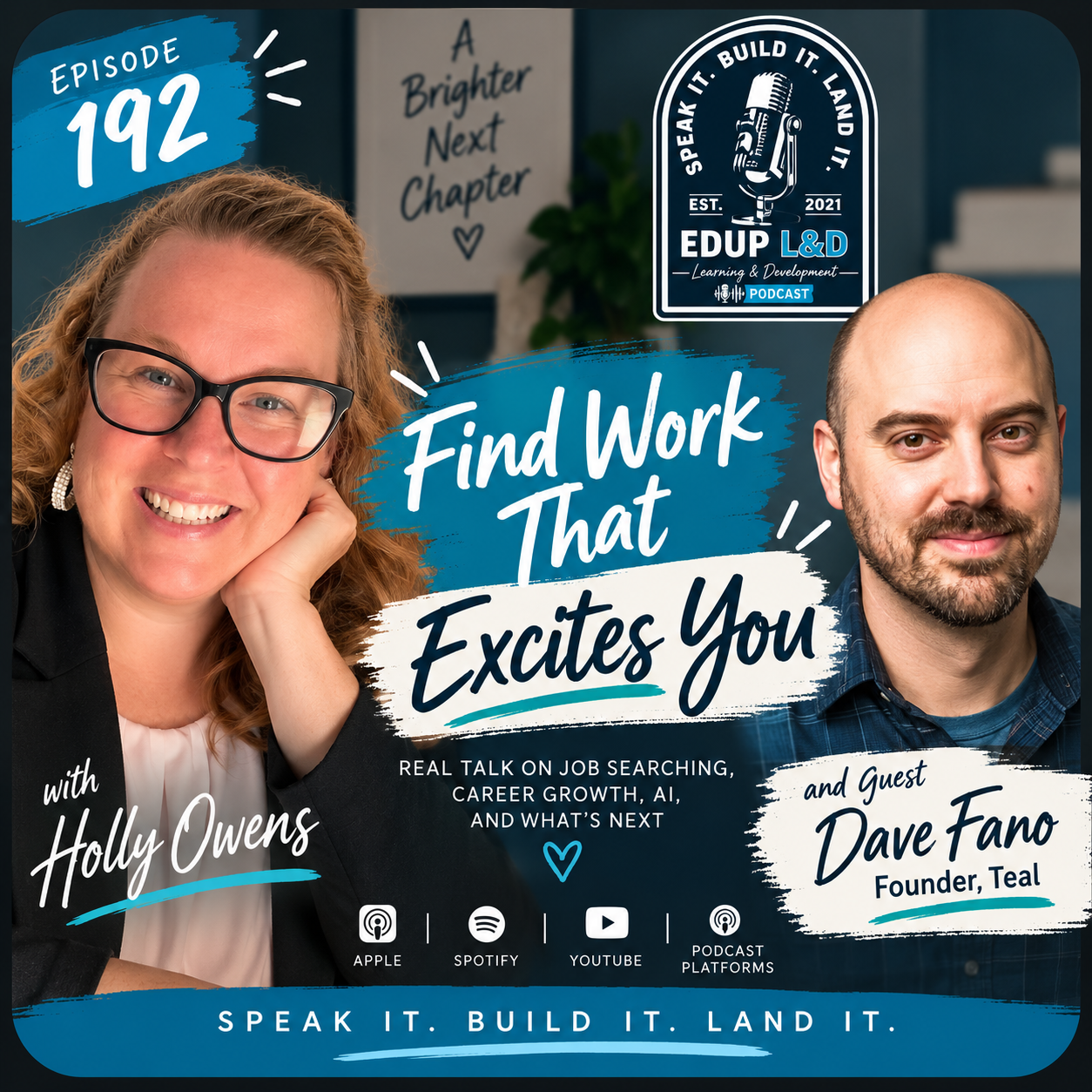
Yes — I’d make them all follow the same action-first format so the bottom feels cleaner and more intentional.
Episode 192: Finding Work That Actually Excites You with Dave Fano
What does it really mean to find a career that feels fulfilling—and how do you navigate the job search when the market feels harder than ever?
In this episode of EdUp L&D, I’m joined by Dave Fano, founder of Teal, a career platform designed to help job seekers take more control of their search.
Dave and I talk about what people are really looking for in their careers, why the current job market can feel so frustrating, and how AI is changing the way we search for and communicate about jobs.
We also dig into something I think gets overlooked way too often: excitement. What if finding a job isn’t just about checking the right boxes, but about finding work that genuinely energizes you?
Dave shares his perspective on approaching the job search more objectively, staying authentic throughout the process, creating opportunities instead of waiting for them, and navigating a job market that continues to evolve.
If you’re job searching, thinking about your next career move, or simply wondering what the future of work looks like, this conversation is for you.
In this episode, we talk about:
- Why pursuing fulfilling work matters
- The challenges job seekers are facing right now
- How AI is changing the job search
- The impact of AI on communication and how we present ourselves
- Why excitement should play a role in your job search
- How to approach your job search more objectively
- The importance of authenticity
- Creating opportunities instead of waiting for the “perfect” job to appear
Chapters
00:00 — Introduction to Teal and Career Aspirations
01:03 — The Pursuit of a Fulfilling Career
04:01 — Challenges in the Job Market
20:57 — The Impact of AI on Job Seeking
23:05 — The Impact of AI on Communication
32:48 — The Role of Excitement in Job Search
37:04 — The Value of Being Objective in Job Search
Connect with Dave & Teal
➡️ Follow Dave on LinkedIn
🔗 Sign Up for Teal — Start your job search with Teal
📹 Check out Teal's YouTube Channel
Connect with US
💼 Follow Holly on LinkedIn — Connect with Holly on LinkedIn📹Subscribe to our YouTube Channel
📰 Subscribe to the Newsletter — Get It’s Not Just One Thing delivered to your inbox
💃Check us out on TikTok
📲 Grab Free Resources — Check out Holly’s Gumroad for helpful resources and tools.
💌 Connect with Holly — Schedule a conversation
Thanks for subscribing, listening, and supporting our show! 💙
Thanks for tuning in! 🎧
Holly Owens: Hello everyone, and welcome to the EdUp Learning and Development Podcast. My name is Holly Owens, and I'm the host of this show, but I'm also a higher education professor, instructional designer, entrepreneur, and a proud helper of humans. I've worked in the L&D space for almost 20 years, and I'm here to share what I know, what I'm learning, and what's happening in our industry. We'll talk about instructional design, L&D AI, technology, careers, and the humans behind it all. Along the way, I'll bring in some friends to share their stories, experiences, and expertise too. Because at the end of the day, L&D is all about humans helping other humans. This is EdUp L&D. Hello everyone and welcome to another fabulous episode of Ed Up L D. My name is Holly Owens and I'm your host. And today we have back again as I'm starting the podcast, getting things back off the ground. One of my favorite people like that does all the job things. We have David Fano, who is the founder and CEO of Teal. And if you don't know Teal or you don't have Teal, you're definitely gonna need to go to the show notes right now and sign up. Dave, welcome to the show or welcome back to the show.
Dave Fano: Thanks, Holly I appreciate it. I was happy to see your message that you were kicking things off again and that you wanted me on, so thank you.
Holly Owens: No, well thank you for your time. Really appreciate it. so we're just gonna go right into it. Why don't you tell us a little bit for the folks that are listening, the audience that don't know what teal is, and then we're gonna dive into some great questions we're gonna talk about, like AI, job seeking, all the different like the hard truths that people need to hear. So tell us first about teal and what you do.
Dave Fano: Yeah, so I'll kind of start with why, Teal. I s sort of I believe pretty firmly that we should all have the choice to love our job. Not everyone has to love their job. but I feel like we should have the resources to pursue that if we so choose to. and a lot of people don't. and I've seen that, you know, even myself personally, I love technology, but my dad was a builder and in construction and I was an art kid and comic. Drawing comic books was not a real job. So I went to architecture school, which was
Holly Owens: Yeah.
Dave Fano: fine for what I wanted to do. But ultimately, like I really love technology. And I just didn't know. I wasn't exposed to that. My dad was like not a technology guy. He was a swing hammers and shovels kind of guy. And and I think that, you know, I've been lucky enough he was successful and I've had, you know, the path paved for me in a way that I could pursue a career that I was excited about and I loved my job. And whenever I didn't, I'd quit. Yeah, not just you know, I'd quit strategically. but
Holly Owens: Yeah.
Dave Fano: yeah, and I think that's kind of what I've set out to do with Teal in terms of our broader aspiration is give people the resources and tooling through content and technology that helps them pursue a career they're excited about. And right, you know, that's the last seven years that we've been around has really been around like the job searching tool because that's the job searching space. That's why I think when people kind of take a beat and say, like, hey, this sucks, I'm ready for a change, either by choice or by force. And it you know, it's a lopsided process. Companies have a ton of infrastructure and tools and teams and you know, you've got Google and well now Chat GPT and you know, maybe like a s a relative that's been an executive or something. and so I want, you know, to be able to help people to have that scaffolding and infrastructure to pursue a career that makes them happy and fulfilled.
Holly Owens: Yeah, absolutely. And that's why I love Teal so much because of the like the mission, the the feeling behind it. And I don't know if you know this, but for the past two years, well, in the past years, I've left two full time roles without having a job lined up. Because I feel the same way you do. Like I feel like you should love what you do. And not
Dave Fano: Mm-hmm.
Holly Owens: saying I haven't loved what I've done, but I just I've been feeling unfulfilled. And I know there's a lot of people in the audience that feel that way because we identify so much with what our role is, like what our jobs are. Like I'm
Dave Fano: Mm-hmm.
Holly Owens: this, I'm that, because of of a job, but you really want to find something that like people say, you know, that you love and that you can monetize and and be, you know, just have a good time with. I mean, life shouldn't be this like struggle to consistently go to something that we we don't love. because that's not fair to the company and that's not fair to you every day to wake up, you know, I I keep coming back to this this Mel Robbins podcast episode. Do you know Gary V? Gary Vanderchek? Yeah.
Dave Fano: Yeah, yeah. Yeah, well.
Holly Owens: So sh he was recently on Mel Robbins podcast and like he's one of the things that kind of stood out to me about this episode is he's like, You're gonna die. So you might as
Dave Fano: Yeah.
Holly Owens: well do you might as well do what you love. but with that being said, What are you kind of seeing in the job market right now that job seekers may not be seeing from their side of the screen? You know, people are going out like there there's the LinkedIn Easy Apply, there's Indeed, there's all these different places we can go to find jobs, but what are what are job seekers not seeing from their side?
Dave Fano: Well, you they they kinda talk about the job market right now as like a tale of two worlds. there are people that are getting astronomical out of this world offers, and are highly coveted, and then you have people that are really struggling. and there's you know, some of those things are in people's control and some are not, right? If you've got like pretty phenomenal logos on your resume, you just inherit that credibility, right? Like if you work at Chat G at at OpenAI or Anthropic, every company would love to try to poach you. Yeah. just, you know, from that con you know, you know, you're there and you're getting to learn from it. And everyone wants to kind of like siphon that knowledge off and learn from it. So, you know, I think there's that and and you know, that kind of cascades down. And you 'cause they're also recruiting. They want the best talent in the world. And so they're going and sort of trying to find people and and so you think you have that kind of like that strata of the labor market that is more competitive than ever. There was a great I listened to Lenny Rachinski's podcast a ton and he had cursors head of recruiting on there. and, you know, those guys can hire whoever they want at this point. No, now they're part of SpaceX. And but he was talking about just like, you know, the the challenges at that level. And then, you know, and then there's kinda like you and I logged into Lincoln every day and there's the stuff we see in our feeds, of people struggling and applying to a thousand jobs and You know, and so I think it's it's tricky to reconcile those things when someone's like debating between two five million dollar job offers and someone, you know, on LinkedIn is like posting about, you know, they just keep getting rejected and ghosted. you know, and there there's something probably to learn in in in there. but it's yeah, I think w what I think is important to take away from that is there are people that are having success in this market. Obviously there's people that aren't, but like what can we learn from it? Right. I don't I don't find it to be generally productive to kind of like complain about it. that's not gonna fix it. And honestly, if you complain about it publicly, I think that's detrimental to your image. But there's things to learn, right? now, if you're, you know, given your audience, if you're a teacher, you can't just like snap your fingers and become an AI researcher. But that's not entirely untrue. There's like interesting things happening with training data and data labeling, which we can get into like the weird, you know, sort of process of
Holly Owens: Sure.
Dave Fano: participating in your obsolescence. But but that's like a different thing.
Holly Owens: Yeah.
Dave Fano: you know, I I still think like that. There's a little bit of like leaning into what the future is gonna be and trying to participate in it in it in a productive way. 'cause I think a lot of people with AI, what I see is they're kinda like, you know, there's this like big tsunami coming and they're like standing there with their hands up that they're gonna block it. And it's like you're that's just not gonna work. You know, you need to figure out how to like ride that wave and be an active participant in it. and you've just seen that with technological changes. You know, people were averse to cars, people were averse to electricity. People were averse to the internet. You know, and then the people that
Holly Owens: TV You name it.
Dave Fano: like really capitalize on it are just the ones that embrace it. You know? and I think AI is inevitable at this point, you know? and so so I I think there's ways to like engage with it in a productive way, but try to figure out how it aligns with what would interest you, like what you jump out of bed for in the morning. Cause like that's who's getting hired. Who's getting hired is people who love what they do. Like it's
Holly Owens: Yeah.
Dave Fano: just I think it's kind of as simple as that. Even if they're generalists, they're people who have you know, you hear people talking about like high agency, you know, ownership mindset. It's people who it's not just a job. I like and you know, I and we use a lot of agents at heal and you know, like there's there is a a difficulty and friction that comes with working with folks that kind of have that relationship with their work.
Holly Owens: Yeah, absolutely.
Dave Fano: you know, you've managed people, I've managed people. And it's just clear when someone like hates their job and it's like, I'm sorry. You know, I got you know, and you know, and it's a lot, you know, I already have enough time like getting my kid to put down Roblox, you know, and have to like maybe sit her, you know, and like tell her to do her homework. It's like I don't want to do that with the people that I work with. Like I want you to like like
Holly Owens: Exactly.
Dave Fano: what you do. I want you to come in and show up because you enjoy it, not because you
Holly Owens: Mm-hmm.
Dave Fano: have to be here and because, you know, it's like I get it. Yeah, I I you know, I understand capitalism and I understand the systems we're in. But just like everything does start to compound in a positive way. If people like their job and they're around people that they like and you know, they're doing work that they enjoy. Again, I understand like all the things that need to fall into place to make that happen, but you do have a quite like active role in being able to make that happen. And then like I I really believe those things start to compound.
Holly Owens: Yeah, absolutely. So if like the negativity definitely starts to compound when you're seeing all the different things out on Link like you said on LinkedIn, like people not getting jobs. And I want to go back to the one thing you said, like people say they're applying to a thousand jobs. As a person who's been doing this, the you know, you own teal, you've co founded teal, and you're just based off of your experience in the professional world, how do you feel about that when people say I've applied to a thousand jobs and I haven't got any interviews? because I'm sure there's a lot of people who are in the audience right now listening, they're like, I've really put in the time and the effort to tailor my resume. I've applied to 250 jobs, I've barely got any bites, you know. Tell me a little bit about how you feel about that.
Dave Fano: think in like a like so I'm not questioning that they did that, but in terms of like what the market can bear, I think that's impossible. Like I think there are rarely that many jobs that you're truly qualified for. And so you're you're wasting your time. Right. You're you're you're not objectively qualified. I think a lot of people kind of dilute themselves, right? Because that's the thing. The jobs are not infinite. There's
Holly Owens: Yeah.
Dave Fano: only so many that I'm a bullseye for. I think this is a little bit of what people forget also. Like, there's no such thing as shooting your shot on jobs. It is not a game of luck. It is not a game of chance.
Holly Owens: I love talking to you. I love this. So good.
Dave Fano: It's I mean, like I sure, do occasionally we get lucky. But I'm more in like the kind of like you manufacture luck camp. but there was something they saw, right? You know, people's like, if I'm applying to Spotify, I'm gonna put on my resume that I played violin my whole life. It's like, sure, but that's not a game of chance. That's like you contextualizing your experience to something they care about. If you're applying to pets.com or whatever, I'm showing my age, like they don't care about that, you know? So what you're really doing is Showing why you're the best. I think what people don't realize is hiring ultimately is not about you as a candidate. It is about the livelihood of the person who's hiring you. Right? Ultimately, if I hire you and it doesn't work out, worst case scenario, I lose my job because we failed as a team. And I wasn't able to like why why did I even get to open a rec in the first place as a company? It's because We were short resources. We had some objective. We decided that we need people. We need to open up a headcount. And we're gonna hire this person. We're gonna allocate $100,000,000, $200,000 to fill in this role. And we're gonna yield some kind of productivity and make progress on a goal we have as a business. But ultimately, I'm the as the hiring manager. That's on me. Like I chose to hire you. If we fail, I lose my job. Again, going to like extremes, worst case scenarios, right? So ultimately,
Holly Owens: Yeah.
Dave Fano: that's like, that's what someone's thinking is like, is putting this person on my team gonna You know, help me succeed in my life. And if they you can't kind of like make that clear for them, why would they hire you? Right. If in
Holly Owens: Mm-hmm.
Dave Fano: any way you show any kind of doubt, it's like, well, then it's not worth it. It's almost better for me to not hire this person because that introduces risk and change. I know what it means to just have to like bite the bullet and work 12 hours a day. But if I hire you and I don't feel super confident that you're gonna increase my chances of success. Now I'm like putting my life in your hands, right? In terms of my livelihood. And I don't, I think that's why people think it's like super personal, but it's actually not. It's about the other person at the end of the day. And
Holly Owens: Mm-hmm.
Dave Fano: you need to convince them and make them feel that you being on their team increases their chances of success. And so that's why when people say it's like you really need like think about it that way in a very dry, literal way. It's not that like And and people do that in all sorts of ways, right? We do use proxies. So it's like, we went to the same school. Well, now I have a whole like life of experience of proxies to say, well, then you have some alignment on me. There's the way I know I got into that school. So you went through that process. So you can draft and inherit those. And like the more of those proxies you can use, well, the faster the person will shortcut to thinking you're qualified. So again, people don't think they tend to say, well, that's not fair it's not, it's not that it's not fair. We Do that. That is what we do. Like I'm kind of working on this like theory of how we're these optimal caloric burning machines. And it we're always looking for shortcuts. And
Holly Owens: Yeah.
Dave Fano: those are just short and it's not a bad thing, right?
Holly Owens: Yeah.
Dave Fano: Like if I had to read a why do I like an audiobook? Why do I drive instead of walking everywhere? It's more efficient. And I think like that's what our bodies do, our brains do. And you just need to learn to leverage that and help people get to yes faster. It's not Slimy. It's not trickery. Now, I'm not saying to be disingenuous and lie, but I think understand that's how we work. And so that's when I say, networking, can you get a reference in? Yeah. I am going if I have a person who can like shortcut your credibility and I trust them, then you are going to inherit that trusting. It's just human nature.
Holly Owens: Exactly.
Dave Fano: It's what we do. and so just embrace that. Don't be mad at it. Don't You know, yes, there's cronyism and all sorts of things. I get all that. But I think we spend our time di debating and arguing about like the five percent of the time that that happens when it's like used inappropriately. And then just don't talk about like the ninety five percent of the time. It's like that's just the way life works. And it's not coming from a bad place. Let's just like lean into it like learn how to play the game.
Holly Owens: Yeah, I always tell people that even though we have access to all of these like digital tools things and you know, whatever is out on the the job market, it's still very traditional and like who you know and and it's like the I don't wanna say the olden days because now I'm dating myself. But you know, like it it definitely is about who you know and who you talk to and who you develop these authentic relationships with. Like I can't tell you and I'm sure you have this happen how many times people are in my inbox asking for advice on where to start or what to do or how to land the role. And I'm just like, it's really not just one thing. It's it's a multitude of different things. Like there's no like one thing that you can you can do. But like this one thing, like the networking and having the authentic relationships and the connection is definitely going to put you at a level higher than somebody who doesn't have that those internal things, like you said, the proxy of the trust within the company or in has the ear of the the CEO and founder.
Dave Fano: Look, relationships are by far the most like high ROI career asset you can have. And what I think also people forget is they belong to you. They don't belong to the company, but people make these unfortunate associations, you know, you see people when they leave and they just want to like burn it all down. It's like, look, those relationships belong to you both like happen to work at that company at the same time. Maybe that's something you have to remind myself. There's all these people that I hold grudges with for my time at WeWork and I'm like, well that's stupid. Like that, you know, unless someone was like truly what I believe to be a bad person. We
Holly Owens: Right.
Dave Fano: were both we like, you know, we were there trying to do our best in a high pressure situation. If we had it to do over again, I'm sure all of us would do myself included, do things differently You know, but you never know. You never know when like a person you met could help you out in some kind of way. and
Holly Owens: Yeah.
Dave Fano: you help each other out. Like again, I think I also think it's okay to acknowledge that these things are transactional. Right. and so people think like it's fake. It's like just be be authentic about it. You know, I also think and look, and I think also re some people are more sensitive to like a lack of sincerity or transactionalness than others. Some people are like, Yeah, no, look, I don't want to do the small talk. Just tell me you want. Like some people prefer that, you know?
Holly Owens: like that. I l I love doing that for meetings, you know, like going into a meeting. Like I'm ready to get down to business and people that you know the nicest n the niceties, like talking about your days. I love that at certain points, but like when it's one of those meetings where you just you have a lot to do, let's just get right into it, Dave.
Dave Fano: Yeah.
Holly Owens: Tell me what needs to be done and what I need to do and then I can go about my day. Cause I think, you know, that's another thing too with some of And we could probably have a whole conversation about this. Like when you land the role. And I talk a lot about with people, or jobs that I've recently applied to, like protecting my calendar. Like you're in job you're in meetings all day long. When are you supposed to get the work done? So I love
Dave Fano: Yeah.
Holly Owens: just like past the niceties the niceties. I I know you, you're a great person. I know about your family. I'll ask about
Dave Fano: Yeah.
Holly Owens: that later. We can talk about it on WhatsApp or via text. Let's get down to business.
Dave Fano: Yeah, and and
Holly Owens: Yeah.
Dave Fano: you know, so I mean, I'm a big like work styles personality assessment person. And you know, I would argue that's just how some people are built, right? You know, like I'm like a competence first, you know, or task oriented, they might say, versus like relational first. And you like first meetings and mag you know, that that's all stuff on how you interview and like learning like ultimately we're working with people, you know, I like to joke and until we're all like food for the AI machines or something. you know,
Holly Owens: Yeah.
Dave Fano: people are we're gonna be here, right? We're people, we're interacting with people.
Holly Owens: Yeah.
Dave Fano: You if if the AIs are running everything, how are they gonna make money? You know, it's like you know, it's like
Holly Owens: Right.
Dave Fano: yeah, we're we're kinda still needed at least to be the customers, you know, until I guess like Amazon employs us all just so we keep buying it from Amazon.
Holly Owens: Hello.
Dave Fano: but you know, it's yeah, we work with people and it we're not all the same. and we're like highly complex emotional. Yeah, it's a great thing.
Holly Owens: And that's beautiful. That's wonderful. Absolutely.
Dave Fano: And like getting good at that, like acknowledging that that is a muscle to build, like how to work with people and how to understand people and not take everything personal. and everything's not about me oftentimes. It's like, you know, person's not paying attention. It's not because they don't like you, it's 'cause they got a million things going on in their life, you know? The majority of the time it's that.
Holly Owens: And their brain. Yeah. my gosh. So much of this, I'm sure this is resonating with the audience very much. And it's really resonating with me because I recently got told that you when you're talking about efficiencies, that my efficiencies to get stuff done were impacting the quality of my work.
Dave Fano: Mm.
Holly Owens: and it was kind of used in a way as I wouldn't say it was weaponized, but it it made me reflect. I appreciated
Dave Fano: Mm.
Holly Owens: the the structural criticism about because I grew up with my grandparents and my mom was a teen mom and my grandparents really helped raise us. So they're they're b they were truly boomers. And my grandfather was always like, work smarter, not harder, is was his theme for life. So I've been
Dave Fano: Uh-huh. Uh-huh.
Holly Owens: built around efficiencies and saving time to
Dave Fano: Uh-huh.
Holly Owens: get things done. And I'm very task oriented. My grandmother still has a stenopad that she keeps a list on the she checks things off the list and that feels good to her and that feels good to me. So you know, like that kind of stuck with me as like I would I do create quality work, but I also I'm very I wanna get it, check it off the list.
Dave Fano: Yeah. Yeah,
Holly Owens: Yeah.
Dave Fano: and I think it think it's knowing yeah, yeah, and I'll look I always tell people it's like you don't have to agree with all feedback, right? So, but I think being open to it is key and being able to be reflective and then and also I think we like to in this kind of like pursuit of efficiency, we we like to think in binaries. And it's like in some things I am and some things I shouldn't, and how do I? It takes more work and it's more like mentally tiring to kind of adjust yourself on the situations all the time. But
Holly Owens: Right.
Dave Fano: I think that that is what it is to work with people. and situations and that's that's what ultimately for me makes me bet on us over AI is like we're we can do that. We can read the room and
Holly Owens: Yeah.
Dave Fano: we can contextually adapt. But if we can't, then I'd rather work with an AI. Right? Like if if as a person you can adapt and I can't understand that we're human and give each other the benefit of the doubt, then I'd rather just work with something that's not gonna fight me all the time and and take it personal and make it really, really difficult.
Holly Owens: Yeah. One hundred percent agree with you there. So speaking of AI, how do you how do you think that AI is changing what employers actually look for in the candidates? And is there anything that job seekers should be doing differently because of this?
Dave Fano: Yeah, so I think AI
Holly Owens: We keep we keep floating around AI, so let's let's talk about it a little bit more.
Dave Fano: So an I think we it's kinda like two sides of the same coin here. Let me let me just say I think we have a when I say we, I mean like humans. A natural understanding of how much effort things take. And I think we appreciate it. Right? Like, I don't know about you, but when I go to a restaurant and like the waiter or waitresses remembers my name, like I appreciate that. When they remember, like if it's a place I go to on a regular basis and they remember my order, I appreciate that. And that's like they chose to like consume brain cells on that versus something else. And
Holly Owens: Yeah.
Dave Fano: and I think We appreciate that. We appreciate when people put in the effort. That's why people talk, the handwritten letter. It's like the handwritten letter is irrelevant. It's what that signifies. That means that clearly takes 10 minutes versus just like copy pasting 10 seconds. It's like, so you chose to invest 10 minutes on me. I don't think people think about it that explicitly, but that's kind of what's happening in the background. And so I think what AI is doing is showing that, and people don't appreciate the sh the shortcut, right? It's like It's okay if you did it. I don't like to know that you did it. Right. It's the same so if the waitress has like my name written on her hand and I found out, I was like, well, that's cheating. I don't like that. You know?
Holly Owens: Mm-hmm.
Dave Fano: and so I think that's a little bit of what's happening with AI. It feels cheap. It feels like you didn't care. It feels insincere. And so I think in an effort to do more, we're seeing a lot of people thinking that like volume is the answer. And what's we're seeing kind of that people are kind of calling bullshit. Sorry, I don't know if this is a family show.
Holly Owens: no, you're fine. I say the F word. You're fine.
Dave Fano: I listened to some podcasts where they use foul language with my kids in the car and my daughter always calls me. I'm like, it's fine. You'll hear this plenty.
Holly Owens: Yeah, you'll hear it later.
Dave Fano: yeah, she's seven, so I was like, don't whatever. They're just words. and and I think people don't like it, right? They just don't like that, you know. I I was just listening to this podcast with Toby, the CEO of Shopify, and he he calls them like slop grenades. And I like, Yeah, that's I'm super guilty of it too, because I'm like trying to do nothing. She's like, I didn't even read it. Here's just what the AI came out, and I just sent it over. And it's it's almost like a disregard for my time. You're
Holly Owens: Mm-hmm.
Dave Fano: not being, you're making me do the work. You're writing these like stupid, crappy outbounds that are super generic, and you've sent
Holly Owens: Yeah.
Dave Fano: them to everybody, and you're making me read it. You're like now imposing on me. And so I think that's what people are feeling. They're talking about it through the means as AI, as the bad guy. But it's really not. What they're really wanting to say is like, this is lazy. I feel disrespected by how little time you put into producing this. And so I'm gonna use that as an indicator of how you show up, which means I don't want to work with you. You happen to be using AI. It just wasn't as o everyone can do it now, but and it's not as obvious that I was copy pasting it. But we all got those emails that it's like, hey, brackets first name. Nobody likes that. Right? You know.
Holly Owens: Yeah. Nobody.
Dave Fano: you know, and what and they were done by hand. You know, it it's funny that just like a lot of these things that have always been the case, AI is like putting them at scale and we're seeing them more. and so I think that's a little bit of what's happening. And it's making things really easy. It's looking super generic and consistent. I mean, that's what these AIs are, right? They're like these like super duper averaging machines, whether it's language or who knows what. So it's kind of like homogenizing us in a pretty unproductive way.
Holly Owens: Mm-hmm.
Dave Fano: and so I think that's that's what we're seeing, and we're kind of like Okay. Like then like if you're not putting in an effort, why would I put in any effort?
Holly Owens: Yeah. There's a stigma around using AI, I feel like that has developed from people like cus these situations, like taking the shortcut or the short I d I use AI in a way like sometimes my words I can't put it in a way that sounds logical. That's always been a struggle for me to kind of like okay, for example, like when I used to work at UNBC in higher education, I had to put together workshop descriptions. It took me forever to just get
Dave Fano: Mm-hmm.
Holly Owens: the words right to exactly what I'm trying to say to the audience to get them intrigued to want to come to the workshop or get the learning objectives measurable. AI does that for me
Dave Fano: Mm-hmm.
Holly Owens: quickly and I can read over and be like, yes, that's exactly what I'm trying to say. You know, so I don't want people to think like, you know, you you you can use AI, but make sure that you're evaluating it and make sure that you're you're reading what it says before just like. The like the slop that's coming out of it.
Dave Fano: Yeah, and I think what a lot of people are doing is they're abdicating their thinking to AI. And that's bad. Like that's
Holly Owens: Yeah.
Dave Fano: really bad. And that's where we all just kind of look the same. And you know, there's another like a line that's going around on Twitter. You're a meat proxy. You're just kind of like this vessel for the AI to come out from like Claude to someone else and you're just passing it along. And like, that's not great. that's not
Holly Owens: Yeah. Now.
Dave Fano: great. You know, I want your judgment. Don't just like copy paste what Came out of the Chat GPT or Claude into my, it's like I could have done myself. Right. Like,
Holly Owens: Mm-hmm.
Dave Fano: what value are you bringing to this? What additional insight are you bringing to this? and so I think that's what people are kind of like bothered by. It's like, you're putting more work on my plate. I could have just done this myself. I don't think anyone
Holly Owens: Right.
Dave Fano: we've generally not cared about the means by which people do things. Yeah, it's just like AIs become. The way we talk about it as the means, but ultimately what we're saying is the quality of shit. I don't kind of care how you did it, you know.
Holly Owens: Right. Yeah. I agree with you.
Dave Fano: No, and think the bars gone up. What's kind of happened is you saw this on YouTube and video, right? Like, I mean, even the fact that we're doing this, this used to be really hard. This used to mean like we need a studio. We're streaming on some kind of thing, you know, that just makes it a possible through the web. You needed to have like an avid streaming machine that was like fifty thousand dollars.
Holly Owens: Yeah.
Dave Fano: We probably needed to be in the same room, you know. And so as the barrier goes down for production. So does the quality, but what it does is it raises the bar for what needs to be good. and I just think we're kind of like living that in real time with a medium we didn't expect it with before, which is like writing and and stuff like that. And it's very good at it, you know? And so we're all feeling like taxed by like how much harder we need to work to discern if something's good or not. Right. Like we're all I
Holly Owens: Yeah.
Dave Fano: had this conversation with my wife the other day. I was like, I don't think it's good for the world where we operate in a default state of distrust, which is where kind of like we're landing. It makes us cynical, it makes us question everything. And I think we need a baseline level. I mean, we're not gonna talk politics here, but I don't think like the political climate is helping. but if we're operating in a just like a pure state of distrust, yeah,
Holly Owens: I'm right there with you.
Dave Fano: it's not good. Right. I mean everyone is questioning everything. and so everyone is just feeling no one likes feeling tricked or duped. and then you know, and and we're really kind of like averaging down to the lowest common denominator, whether it's like five percent bad actors, but just to be safe, I'm just gonna assume everyone's doing it. It's like much safer for
Holly Owens: Yeah.
Dave Fano: me emotionally to just like assume everyone's lying. But it's it's so draining to operate that way.
Holly Owens: Yeah, because then how do you develop those relationships if you think everybody's tricking you? Like you're not gonna do it. You're just gonna, you know. I think one of the things people say to me, they're like, How do you talk to people? You know, they always want to say, like, if they want to work with me, they say, You're gonna be the face of this. You're gonna do this because you do the podcast and you know the people and all that stuff. I'm like, It's because I trust other humans and I believe everybody is inherently good and they wanna help others. So That's what I that's what I've been doing is going out there and, you know, trusting others like yourself and you genuinely want to help other people. and if I had that distrust, I would kind of question that or I'd be insecure about developing an authentic relationship with somebody else. So I 100% agree with you that the amount of distrust, like it's become a part of our culture and we've become so polarized and immediately, you know, and this is Just thinking about this, we're going little bit off like the job stuff, but we immediately judge somebody based off of what their beliefs are or what they're associated with. And I'm not trying to go too deep into this. Like if you're this, if you tell me that you you like a pink horse, then you're this, this, and this. You know? Like you immediately assume that that person re has it's stereotyping, it's discriminating, you know, whatever you want to call it. And I think that. That's really not great for our culture. And like you said, the current political climate and the things that are happening, they it's infused itself into our culture and society, for sure.
Dave Fano: To to to like break it down logically, because I don't defend it, but it right, it's kind of a safety mechanism. It's just easier to assume that like we're looking for proxies. Right. Like well, burst c best case scenario, I have time to like Google you and research you and spend a week really understanding where I cast my final sort of decision on you. It's like, or I can save myself all that and just look for these proxies and just make an assumption. Which I don't think is great, right? Like we don't benefit from that, but it is kind of what happens. So like on then being on the receiving end, I think we have to acknowledge that that is what we do. And I also think we just need to reflect and look at all the times we do it. So I think like getting back to the job search, I think I'm always looking for these like analogies in life that are out of the job search where I'm not on the sort of like, you know, disadvantaged side of it. And it's like, where are times in my life that I use these proxies? Yeah, before we jumped on, I just, you know, talked about like restaurants and stuff like that. You know, and I always look at like medical and it's like when people are gonna go get a doctor, like something really important in their life, they research
Holly Owens: Right.
Dave Fano: the heck out of it. They get reviews, they make sure it's a good doctor, make sure they have specialists, they look for referrals from friends.
Holly Owens: Uh-huh.
Dave Fano: Why would I not do that when I'm hiring someone? Right?
Holly Owens: Yeah.
Dave Fano: And and why would I not expect them to do that? They're going to back channel me. They're going to look me up. They want to make sure that I can do the job. Like if you're, you know, you got a problem with your skin, you're not going to go to like the foot doctor that just opened up a dermatology practice because they're trying to expand their market and make more money. It's like,
Holly Owens: Yeah.
Dave Fano: let me know when you're five years in. Then then we can talk. But I'm not going to be your beta test on dermatology. Like when
Holly Owens: One hundred percent.
Dave Fano: I when my foot hurts, I'll come back. That's what your specialty is. You know, it's like, but you know, people don't have feet anymore. They all drive. So I'm
Holly Owens: Your skin might get burned off, who knows?
Dave Fano: so I'm trying to like pivot into dermatology. It's like, well, cool, I'll come back when it's. When it's successful, I'm not gonna be one of your first customers. There are people who are just like, you know what? You're cheap. You're like ten percent of the price because I'm a beta customer. I'll give it a whirl. But majority don't. And so you need to understand that that's that's just not what we do.
Holly Owens: Yeah, absolutely. This has been a great conversation. I've loved every minute. I love talking to you so much. Like you you you give me a different perspective. Like I have my own feelings and beliefs about the job marketing and perspectives and you know, the people that I talk to, but you just you just bring so much like logic and like your experience. And I just I don't know. I don't know how see I need chat GPT to tell me how to say this, but I just love chatting with you, Dave. and
Dave Fano: Well thanks. I appreciate that.
Holly Owens: And in wrapping up the episode, if you could give the audience that's listening right now three pieces of advice that they could start like when they're job seeking and or resources besides teal, because you need to use teal, that they could use, you know, what would you what would you say to these people? Especially the ones who are like out there and saying, like, I've applied to a thousand, I can't find a job. You know, I'm seeing more and more people saying things like, I've been doing this for over a year or a couple of years.
Dave Fano: I always struggle with this question. because people kind of want like silver bullets. I would say I'm gonna kind of take a different approach here.
Holly Owens: Okay.
Dave Fano: Be excited. I I just think it's so obvious when someone's not you there's no way you could be a thous excited about a thousand jobs. It's impossible. Right. And it's just gonna come through. It's gonna feel like shotgun. rapid fire text that's just, you know, and I understand like I don't have time. I don't have time. It's like, yeah, use these tools to get you back time. Like you can use AI to research companies for you. You can use AI to research who the hiring manager is. You can do those things to sort of win back time. But be excited. Like actually learn about these companies. You know,
Holly Owens: Mm-hmm.
Dave Fano: you know, look for industries. I understand look, we gotta pay bills. There's money to be made. We don't have UBI yet. Like, I get it, but be excited. It's just so obvious. And you're like, well, I'm not, that's not sincere. Then then be honest with yourself. Like figure out what you're excited about. If you're
Holly Owens: Yeah.
Dave Fano: not excited about anything, like go back and figure that out. You gotta be like people wanna work with that's
Holly Owens: That's internal. Yeah.
Dave Fano: the inner, and that's what I think. It's like go like that's you. That's it. The market can't fix that. And the mar and but people can tell. People can tell. You know, I was yeah, to talk teachers. Like I went to my daughter's like open house the other day. I was like, wow, this lady has like this person, it's that's irrelevant. Like, she has like no interest in this job. And I was I left so like disheartened that like this
Holly Owens: Yeah.
Dave Fano: is what she's seeing every day. She's like, hey, at three o'clock, I'm out. I have an extension cord. And then when I leave the building, it like unplugs. I was like, wow, as a parent, of course I know that. Like her life isn't my kid, but it's like
Holly Owens: Right. Right.
Dave Fano: I really would love for my kid to see someone.
Holly Owens: Maybe you shouldn't say that.
Dave Fano: Don't say that, you know? Don't say that. I wanna like someone who like loves what they do. And then the inverse is true. I went to my daughter's my other daughter's class and I had this guy this teacher who I could just tell like loved being a teacher. Like just loved it. Loved everything about it. Like and there was just such a care and like it was clear that it was above and beyond that this was a craft for this person. I was like, wow, that
Holly Owens: Right. Like so be excited. Love it.
Dave Fano: That's contagious. Be excited. And you know, make it make it apparent. be like intellectually honest with yourself. Like, are you qualified? Right? Like, not keywords. Like, read the JD. If it says
Holly Owens: Mm-hmm.
Dave Fano: you need to have a bachelor's degree and you don't have one, do not apply. That's not fair. We can talk about. the sort of industrial complex that is academia and degrees and all that crap. But the truth
Holly Owens: That's a whole different episode.
Dave Fano: is, it is what it is. Someone took their time to put that on the paper as a requirement. If you look, if it's, but you know, and that goes back to the first one. Like if for some reason that's just like your dream company, you're gonna have to go in above and beyond. Right? Because if you're just gonna do the bare minimum, they're gonna reject you at the bare minimum. Whether
Holly Owens: Right.
Dave Fano: it's an algorithm or a person, who cares? Like the whole like ATS algorithm thing is such junk. It's like you I tell people all the time, it's like you'd rather it be an algorithm. An algorithm's objective. A person
Holly Owens: Mm-hmm.
Dave Fano: might see your name and discriminate you because they don't like your name. Like it's objective. You either have a degree, In the thing or you don't. It asks
Holly Owens: We don't.
Dave Fano: for six years of doing a thing. You either have it or you don't. You know, there's the in-between of did you actually document it properly so that they could evaluate that because you're not in the room. I see a lot of it is like, but I could do that. Why don't they just assume, well, I know this thing, of course I would know that thing. It's like, they're not in the business of giving you the benefit of the doubt. Why would they do that? You know, and also someone else did do it. So they'd rather pick that person. So you're in
Holly Owens: Uh-huh.
Dave Fano: a market, you're not. In a vacuum. Like a lot of people think that the only two things there are like the JD and them. It's like, no, that's not true. There's another 1,000 applicants. And so you're
Holly Owens: Yep.
Dave Fano: you're in competition. It's not just about you objectively. It's like, am I the most qualified? Not just the bare
Holly Owens: no.
Dave Fano: qualified, the bare minimum. So I think being truly objective, and that's like what I hire myself for this position, not because I need a job or because I'm cool. It's like truly like this company needs to win. Like, am I proving to them? through whatever means I'm doing to submit my interest and application into this position, that I'm the most I'm gonna increase their chances of winning.
Holly Owens: Yep.
Dave Fano: Some people just get that, right? Like you worked at OpenAI. It's like at Teal, yeah. Pretty much anyone that works at OpenAI, I think, would, whether true or not, would increase my chances of winning. You know?
Holly Owens: Yeah.
Dave Fano: but if you don't have that and you don't have those logos on your resume or whatever, and and then you know, the third one I would say is like be willing to like take a step back to make a jump forward. I think a lot of people really, really struggle with that and they think about this like incrementality within their career and they think about them as these like very one way doors.
Holly Owens: Yes.
Dave Fano: and it's like, well, I made this, I worked so hard to get to this number, I can't go backwards. It's like, sure you can. Nobody knows that. Nobody knows what number you made. No one knows what the trajectory of what your comp was. Only you.
Holly Owens: Only you and maybe your spouse.
Dave Fano: Yeah. And so You know, sometimes we we've gotten like transactional to a fault, right? And we've looked at like only money. And that's actually, I think, one of the bad things about being comp being in JDs. I think it's good for a lot of reasons, but it's like this only measure. It's like there's so much other value you get from a job.
Holly Owens: Yes.
Dave Fano: you know, like another one is like doing free work, and I was like, I think people have that wrong. Like it's value is not just dollars and cents, dollar value is experience. Value is people you interact with. and so sometimes working at a company that is like an incredible, you just think has a huge upshot and there's gonna be really smart people there that you can be around. Yeah, maybe you take a little bit of a less pay or you take a different title. and so you're betting on yourself at the end of
Holly Owens: That's fine.
Dave Fano: the day. That's absolutely fine. But I think
Holly Owens: Yeah.
Dave Fano: we really get in our heads about it, it's like, on LinkedIn, it's gonna show our lesser title. Who cares?
Holly Owens: Yeah.
Dave Fano: And plus you can even lie if you want, fake it. I don't know, just people are almost like so literal and
Holly Owens: No offense, but nobody's reading your LinkedIn anyway. You know through the messages they send you they didn't even take the time to read through what you've done in your life.
Dave Fano: Yeah. So be a little more comfortable, you know, not being so literal and so rigid about this kind of like fake game of careers that we've talked about. Those are the people that I see when, you know, that aren't that can just be a little more malleable and flexible. it is the way the world, but people want it to be. It's like, well, the ATS is what you know, what what if my resume is two pages? Like nobody gives a shit about that. It just doesn't like you're focused on
Holly Owens: Yeah, truly.
Dave Fano: the wrong Thing. I
Holly Owens: Yeah.
Dave Fano: I know you want like a checklist of like things that in you think increase your chances of success. I can tell you, nobody cares about that. Like they care
Holly Owens: They want the
Dave Fano: that you showed you're the most qualified person and you wrote good content and that it flows and it's interesting. And if the first page compels me, I'll read the second one. And if you're awesome, boy, I hope there's more pages because I want to learn more about you. That's like a book,
Holly Owens: Yeah.
Dave Fano: a really good book. You don't want it to finish. A really good movie, you don't want it to finish. The movies I want to finish, I'm like, this movie sucked. Can it just be over already?
Holly Owens: Mm-hmm.
Dave Fano: Right. And so I think it, you know, it's like, how do you compel the person to continue to want to know more about you, wanna go in? And so it is on you. I think some people will approach just think it's like, well, you know, I'm just like a participant in the labor force and I'm just supposed to get a job. It's like, that's not true. You you earn it. You don't deserve anything. and so I think being realistic
Holly Owens: Yep. One hundred percent.
Dave Fano: with yourself about that.
Holly Owens: Yeah. those are good. Those are really good. Well, Dave, I can't thank you enough for No, they're great. Honestly.
Dave Fano: No tactical. No no checklist.
Holly Owens: Like that's what I love about you is you're just you're to the point and you you're very honest about, you know, where people need to go. And I think that's what people need to hear right now. Because again, we're having a lot of people complaining, a lot of the negativity, but like this brings a more positive, you know, like truthful, like really think about internally who you are. Are you excited about the role? Do you want to bring meaning to the company? Do you want to bring impact? You know what? Also, too, I tell people like, if you can't find a role that does that, then create it yourself.
Dave Fano: Absolutely.
Holly Owens: Create the create the job yourself. There's been jobs like off-market jobs that I've, you know, put together like created myself that the company has adhered to like the expectations and put it in the roles and responsibilities. If it's not out there, don't blame the industry. Go out and create it yourself.
Dave Fano: Yeah, I think if you find yourself feeling like I have to do this, then something's already fundamentally flawed. If you can't flip it to like, I want to do this, it's like, I have to post on LinkedIn. You don't have to do anything. And it's going to be
Holly Owens: Mm mm, yeah.
Dave Fano: obvious. If you're posting on LinkedIn because someone told you post one a day and you're just like checking something off the list, it's going to be so obvious and so boring. You know, find a way to want to do it.
Holly Owens: my gosh. Okay, I'm gonna end on that. Thank you so much for the
Dave Fano: All right.
Holly Owens: time. Everything's gonna be in the show notes to you know connect with Dave, teal, all the different things. So that's let's wrap that up. All right.
Dave Fano: Thanks, Holly.
Holly Owens: Well, that's a wrap on this episode of EdUp Learning and Development. A huge thank you to our guests for joining me and sharing their experiences, insights, and expertise. Be sure to check out more great episodes at eduplnd.com Until next time, keep learning, keep sharing, and keep helping other humans. Speak it, build it, land it. See you next episode.