

 Apple Podcasts
 Spotify
 Amazon Music
 iHeartRadio
 Pandora
 Castro
 RSS Feed
 Audible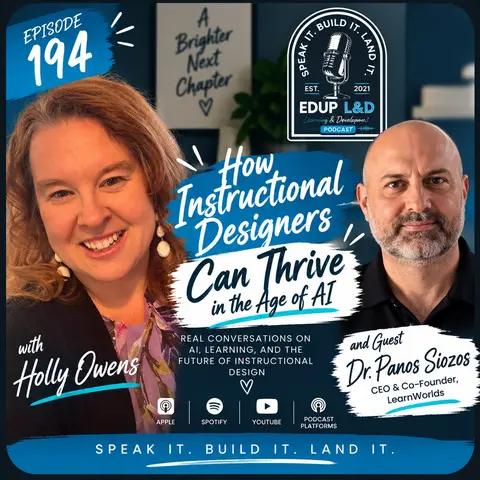
In this episode, Holly sits down with Dr. Panos Siozos, CEO and Co-Founder of LearnWorlds, to explore what the rise of AI means for instructional designers, L&D professionals, and the future of learning. Together, they unpack the opportunities and challenges AI brings to the field, and why the future isn't about replacing instructional designers, but empowering them to focus on the parts of learning that matter most.
In this episode, Holly sits down with Dr. Panos Siozos, CEO and Co-Founder of LearnWorlds, to explore what the rise of AI means for instructional designers, L&D professionals, and the future of learning. Together, they unpack the opportunities and challenges AI brings to the field, and why the future isn't about replacing instructional designers, but empowering them to focus on the parts of learning that matter most.
Together, the discussion explores:
- How AI is changing the instructional design process
- Why AI can take on some of the repetitive work without replacing instructional design expertise
- The difference between generating content and actually creating learning
- Why learner experience should be at the center of instructional design
- Using AI to create more personalized, interactive, and engaging learning experiences
- Why organizations need to make learning a strategic priority in the age of AI
- Moving beyond "click-through" training and annual compliance courses
- How L&D teams can create an operating system of learning within their organizations
- Measuring real learning outcomes instead of relying solely on completion rates and activity metrics
- Why instructional designers may become even more important as organizations adapt to constant change
- The opportunities AI creates for instructional designers, trainers, and subject matter experts
The big takeaway? AI may change the work instructional designers do, but it doesn't eliminate the need for instructional design. As AI makes content creation faster and easier, instructional designers have an opportunity to focus more of their expertise on learner experience, meaningful practice, strategic learning design, and creating the friction that actually helps people learn.
If you're an instructional designer wondering how to thrive in an AI-powered future, trying to figure out how to use AI in your work, or simply thinking about what's next for L&D, this conversation is for you.
Shoutouts and resources shared:
- LearnWorlds — Check out the platform for creating, delivering, and selling online learning experiences.
- Dr. Panos Siozos— Connect with Panos and follow his work in AI, educational technology, and online learning.
Connect with US
💼 Follow Holly on LinkedIn — Connect with Holly on LinkedIn
📹 Subscribe to our YouTube Channel — Watch EdUp L&D on YouTube
📰 Subscribe to the Newsletter — Get It’s Not Just One Thing in L&D delivered to your inbox
💃 Check us out on TikTok — @ihollyo
💌 Connect with Holly — Schedule a conversation
Thanks for subscribing, listening, and supporting our show! 💙
Thanks for tuning in! 🎧
Holly Owens: Hello everyone, and welcome to the EdUp Learning and Development Podcast. My name is Holly Owens, and I'm the host of this show, but I'm also a higher education professor, instructional designer, entrepreneur, and a proud helper of humans. I've worked in the L&D space for almost 20 years, and I'm here to share what I know, what I'm learning, and what's happening in our industry. We'll talk about instructional design, L&D AI, technology, careers, and the humans behind it all. Along the way, I'll bring in some friends to share their stories, experiences, and expertise too. Because at the end of the day, L&D is all about humans helping other humans. This is EdUp L&D. Hello everyone and welcome to another amazing episode of Ed Up L D. My name is Holly Owens and I'm your host. And today I am so excited because we have an awesome guest on the show. We have Dr. Panos Siozos who is the CEO and co-founder of Learn Worlds with us. If you haven't learned heard of Learn Worlds, you're going hear all about it now, and it's going to be everywhere in the show notes for you to go check it out. So Ponus, welcome to the show.
Panos Siozos: Hi, Holly, thanks for having me.
Holly Owens: I'm really excited to jump into everything we have to discuss today. But before we do that, why don't you tell us a little bit about yourself, about your journey to becoming the CEO and co-founder of Learn Worlds? Tell us a little bit about you.
Panos Siozos: Sure, happy to. So, as you said, Panos Siozos I'm Greek. I studied computer science in the university and I did postgraduate studies in educational technology. That's where I met my co-founders. We worked together in the academia, we published several papers, we built lots of applications in the in the educational setting, but we always had in mind to create something for real users, for real trainers out there for something that we could where we could have an impact in on on thousands of people. And that's how a few years after we finished with our postgraduate studies, we came together and we ended up creating Learn Worlds a platform for creating and selling online courses. we got together about end of 2011. We launched the business in 2014, and ever since we are serving customers all over the world in helping them create Build and launch amazing educational businesses. Right now we are serving more than thirteen thousand businesses in more than one hundred and fifteen countries.
Holly Owens: Wow, that's that's amazing. Congratulations. I love that. you've done so much. And I love that you have like your doctorate in ed tech and all the different things and like you know about learning. So that is a huge plus. So let's talk a little bit more about Learn Worlds. So Learn Worlds really has this unique approach to how it combines like AI and instructional design into the platform. Tell me what is different about the way that you do it.
Panos Siozos: f first of all, I have to say that always our focus when we first built the platform before AI was there, at least in a mainstream way, with the way we have it now, it was always about a focus on the learner experience. we we while traditional platforms or learning management systems they mostly deal with the management of learning, how to keep the professor happy,
Holly Owens: Right.
Panos Siozos: how how to keep the admin happy or HR or whatever. We try to focus on the real learners. their needs, the learning journey, and how they can they can achieve the learning outcomes they they they desire. So for us now, AI makes this so much more interesting and so much more it gives us so much more power to to achieve the the same the same goals. I'm I'm seeing out there many applications that are just you know sprinkling some AI on top. You know they throw a chat bot here and there and say you know we have
Holly Owens: Absolutely.
Panos Siozos: we we have some AI, you know, you s something that you see at the side of your course or something l like that. And okay, in some cases it can be useful. it can give you some some instructions, it can help the the learner, it can answer some of the the the questions. for for us the the the the importance is the experience that we are trying to build along with with AI. We're bringing together the content. And now with AI it's so much easier to create your content or to repurpose your content. That's something that is much more easy for for everyone. But also combining interactive learning activities, simulations, interactive objects and AI learning agents that can help you have a coherent, directed learning ex learning experience. So the f for us, the important is not to replace the instructional designer with AI, but to enhance them. How we can empower we can empower teachers, we can empower trainers to really direct the learning and really to create all these learning activities that can help their their learners reach their their their objectives. I think that's for us the the most important part. That AI is not here to replace instructional design, it's something that can make good instructional design more important, more responsive, more impactful. More personalized so that learning in the end can be more more effective.
Holly Owens: Yeah. so first of all, let's talk about what you just said there. I love the focus on the learner experience. I think that's one thing that a lot of companies or a lot of vendors miss is that it's about the learner. You talked about just managing pe managing the system and like the LMS and things that do that. So I love your focus on the learner journey, the learner experience. That's really a top priority. And also, too, what stood out to me is how you are saying that AI is not going to replace instructional designers. I know there's a lot of people in our industry that are worried about that. And I know there's people just in general worried about like what's happening in AI, what's it doing? What's it what jobs is it going to place? Is it going to help us with things? Is it going to hurt us? So if you can talk a little bit more about that, I would love to hear your perspective on, and I know we have a lot of instructional designers in the audience that might have a little bit of a fear of even like touching AI for Certain purposes, so I would love it if you can give them some confidence and/or your perspective on how it's not going to take our jobs.
Panos Siozos: Yes. Happy to chime in. I think it will take part of our jobs, but
Holly Owens: Yeah.
Panos Siozos: hopefully some of the things that shouldn't be our core job in the first place. So we know, for example, that AI can be great in developing content and producing content, repurposing content, translating content, personalizing content. These are things that it can do quite quite easily. And if somebody Makes the mistake of confusing content production or just content distribution with learning, then it's easy to see. Okay, I I can do that now so much easily with a with an LLM. I can just ask prompt something and I get something that looks very polished, fluent text, it looks great, it looks amazing, but this is just content. Instructional designers and teachers know that the real learning is not just consuming some content is is friction,
Holly Owens: Yes.
Panos Siozos: is when you have to battle with the things that you don't know. It's where you're you're facing problems, where you have to to double down, where you have to spend a lot of time. It's like going to the gym. You know, in many cases, if you if you confuse you know I'll get a pill or whatever, some some kind of magic pill and magically everything will you know I'll get whatever I'll I'll be in shape. it that's How some people confuse AI that you know it can produce the content. And if it produces the content, why do I need the learning designer? This is where the instructional designer can really shine, because you can really direct what is happening. You can get your content easily, which means that as an instructional designer, you can be much more efficient, you can be much more productive, you can do so many more things, but you can all which also means that you can direct all these. Thousands of little interactions that can get a user or thousands of users into the learning outcomes that you that you can that you desire. So, in effect, if we use them wisely, we can take away a lot of the grant work, lot of the lots of the things that were making us spend months in order to create a course. You we can we can really gain gain some efficiencies there so that we can focus on the direction of learning, on really understanding what is happening. Where the friction has to take place, where if if we if we just use AI to hide friction, we're probably harming learning. Learning doesn't happen because learning happens through this friction. But where to place it strategically, where to create it, where to to to to induce this this friction so that you can l lead to this transformation of the learner and to a new state and a new learning learning outcome. So some
Holly Owens: Got.
Panos Siozos: of the things will not be the same. Some of the things AI can take over, but we need to preserve the the space for the judgment, for the expertise, for the real instructional design that it can work along with AI in order to to create more results for a business, for a customer, for a use case that we have.
Holly Owens: Yes, absolutely. And I just love the fact that AI has allowed me it freed up my time. Like I can't tell you how much time I've spent on like course descriptions, learning objectives, putting the content in order, just all those different things. Like that would take weeks and months pre-AI, but now it takes seconds or it takes minutes to actually put those things together with the help of AI. And of course you gotta evaluate what it's doing. But I love what you're saying here. and how it's going to continue to support instructional designers. So you've been quoted as saying treating learning as an afterthought wasn't good enough before. Now it's existential. So that adaptability is how we survive. And the only tried and tested way to increase the adaptability is to learn faster. What makes learning an existential priority in the age of AI right now?
Panos Siozos: I think we are seeing around us how we are all in a new speed. the half-life of knowledge is shrinking, tools are updating every day, models are updating almost every other day, and they they gain new new capabilities. Job roles are shifting continuously. I I like I I d even looking in in inside Learn Walls, we have about 200 people inside. I don't think that the job descriptions under which we hired people even last month will continue to exist in in in two or
Holly Owens: Yeah, I can see that.
Panos Siozos: three months. I think we we are all reinventing our roles as we as we go along. So I I guess time has really accelerated. skills, knowledge, the established knowledge of an organization is becoming obsolete much much faster. so people need to keep learning. I I think it's also an inherent basic human need to keep to keep learning. it's
Holly Owens: Absolutely.
Panos Siozos: it and I I personally believe that this is the only real superpower that humans possess because by learning we we can adapt. This is our main adaptation mechanism. This is what allowed us to to become more than animals by accumulating experience and now is the time where we have to adapt faster probably than than ever than ever before. So whether it's a an individual person worrying for their job or how they will adapt in the in the current job market or an organization, we cannot have we cannot afford to have our capabilities fall behind. We we need to stay relevant, we need to keep to keep ha being close to to what is to s to what is to s what is happening. You need we need to understand what we have to unlearn. What are the things that are no longer relevant? Because I guess also our capacity is is more is more limited, so we need to be able to understand where things are are going and following along this this this trend. So we will need how my I my guess is and what how we approach it in in inside learn walls is that in the next few years, which let's say it's in the foreseeable future, we will need more learning rather than less. So even the role of the instructional designer, the role of the teaching function of of training is going to be more important than than ever before. We cannot treat learning anymore in organization as a you know as as a ritual, something that we do every year. We go through an assessment, we go through an a recertification, clicking
Holly Owens: Yep. Clicking through. Yeah.
Panos Siozos: through, making HR happy, just getting this checkbox out of there. That that can't it's not sufficient anymore. Learning needs to be on the job, where the skills are being used, where the knowledge is being produced and and applied every every day. So I I'm I'm seeing also the danger of a potential new underclass of people and businesses that are falling behind because they can't get access to this learning or they can't follow up with this with this learning. So it's it's our only coping mechanism, I guess. We need to become better at how we do it. It needs to become a strategic priority for a business, not just an afterthought, something that we do there, a little line in our budget, okay, let's do some some training. This is our potential for upgrading our skills, upgrading our workforce, making sure that we can keep up with the with the growing needs of every of every business.
Holly Owens: Yes, definitely. And you're kind of already answered the the next question that I wanted to ask is about like how organizations are definitely treating learning like it's something that's owned by like HR, like onboarding, that kind of stuff instead of like a part of what you know, like what Learn World says is part of the core business structure. So if leaders were to change the treated like learning as seriously as they treated like technology, growth strategy, security, all the different things that we prioritize, how might that how might that look? For l for leaders.
Panos Siozos: So f f first of all it's it it it really needs to be a top a top priority. the people that we have are the most important assets of a of a business and they will continue to be so even in the era of LLMs or or or whatever. And d definitely w your your highest valued an asset you cannot just keep you know letting to to fall. to fall beh behind. I think it's it's important that every organization and every individual I guess, but it also scales up to the level of organization of organization, we need to be now even more alert and aware of where the changes are happening in in the work, in the skills, what are the things that are that are becoming obsolete. We need lots of signals to understand what is happening Within our departments, within our business, where our business interacts with our with our customers or or our competitors or everything else. And we need to convert this little problem solving that happens here and there into into learnings, package these things into into learnings, even into microcourses, and then keep them in place, not as permanent artifacts that we revisit every year. But are as things that are growing along with us, that we probably even every month, every week keep updating because our jobs keeps keeps shifting. So right now I I th I don't think it's any organization has the luxury of just getting some off-the-shelf training that was developed a couple of years ago and just
Holly Owens: Yeah.
Panos Siozos: go going through this ritual. It already felt meaningless you know, a couple of years ago or a few years ago. Now there is absolutely No sense in doing that. We need to be aware of the changes within the organization. We need to be able to get the learnings and allow people within the organization to create their own courses and their own microcourses
Holly Owens: Yeah.
Panos Siozos: and disseminate that. So the the the role of an L and D function, for example, in organization is no longer to create the learnings for the entire organization, create courses and just Distributed here and there, but it is to create an operating system of learning within an organization. An operating system and the and the structures and the and the processes that will allow an organization to become a bit more self-aware. It sounds a
Holly Owens: Yeah.
Panos Siozos: bit like I anthropomorphize a bit, it sounds a bit like like AI. Yeah, yeah.
Holly Owens: That's fine. I think that's good. No, I I totally agree with that.
Panos Siozos: To to allow the organization to understand where value where knowledge is being created, where knowledge skills are becoming obsolete, and to be able to create in-place quick artifacts that will help people to to to acquire the new knowledge. Not necessarily in the form of traditional online courses or seminars or whatever. It can take any form. Now we can create so many more things. We can have our our simulations, we can have our chats, we can have our our agents, even AI agents on the on the side. Let's say little interventions that will allow the organization to keep learning, keep realizing how change where change is coming from and adapting to that to that change. And we believe that this is this is a self correcting mechanism for every organization. If you don't have that, you will very, very quickly become obsolete, especially in a time of that
Holly Owens: Absolutely.
Panos Siozos: of of of fast change.
Holly Owens: Yes, 100%. And you were talking about some of the experiences, like those yearly trainings that we have to do. And I just did some of those trainings, and all it was was clicking through and listening to videos. It wasn't very impactful to me. And you know what? It's the same content every year. It's the same exact stuff. It's the same exact thing. And I know lots of organizations like Pay Money, these corporations or these vendors, they design these experience. I don't even know if I should call them experiences because they're really not experience. It's just like they took a PowerPoint and they put some clicky stuff along with it. so that again, going back to what you're saying about the learner experiences and what we should do and how how it should be, and that can take the form of anything. I feel like some of these trainings definitely need to be updated. They're so outdated and it's not it's not a good experience for anybody. I'm sure it's not a good experience for the instructional designer creating it and then
Panos Siozos: I agree. For no one, I think I think for for no one. It's it's just a like a ritual that we are doing to ourselves and we can't afford to keep you know keep sustaining these kind of rituals. And even if the content itself isn't obsolete, because in some cases legislation doesn't change every year. So it still might be great content in in terms of of the substance, but We as trainers, as learners now we can't tolerate, you know, s going through the same thing every year, you know, like like it's it doesn't it doesn't it doesn't feel right, it doesn't keep us ready, it doesn't it doesn't help us double down. And and now it's easy to get the same content with some AI perhaps on the side, and an instructional designer can direct it in order to repurpose it, in order to personalize it, it in order to make it relevant. It's not that much of an effort if you have the original knowledge. It's not a big jump to get into something that
Holly Owens: Sure.
Panos Siozos: can really capture the attention of the of the student, of the learner, and really keep them engaged throughout this this process. A human mind and human attention are very precious things. We shouldn't just you know throw them away or just waste them on on on activities like this.
Holly Owens: Yeah, I one hundred percent agree with you. So in follow up to that and kind of elaborate a little bit more, once AI is being used to create like the richer learning experiences, how should L and D teams kind of determine whether those experiences are building rich, you know, like real capability rather than simply just generating content, engagement, or competencies? How do you feel about that? What do you think?
Panos Siozos: the the this is a very a very important question and very relevant. It's also close a bit to my to my PhD because my PhD was about educational assessment and how we are able to to measure to measure things. It it's clear that this in this new world we we can't just measure this something like this on a basic report. Like the courses that you mentioned you know you can get some kind of completion rate, some checkboxes, some time spent and all this the these are
Holly Owens: N P Squares, all the different things yeah that people are trying to get
Panos Siozos: act yeah activity KPIs that tell us remotely if something happened but we have no way of knowing whether real capability was was involved. what I was saying before is if we can convert this type of experiences into real engaging hands-on Activities that happen next to you, realistic scenarios that you can apply, then that's also our answer about how to measure these these things. What is the real change that happens on the job? Am I taking better decisions? Do I make fewer mistakes? Whether it's something practical that I'm doing as I'm as I'm using some kind of machinery or by I don't know, getting Becoming better at selling, applying a certain methodology, or I don't know, creating Excel files and and doing taking accounting decisions. So that's if we are bringing learning into the closer to the real world, that's also what we should measure, whether we manage to to change real world behavior, where whether we are able to see the the difference in in in in what people do and also whether their capabilities are able to be applied and to be transferred into new into new s situations. I guess that's that's what we have to do. This isn't a qu a quick fix. We have to think again about this. We have
Holly Owens: Yeah.
Panos Siozos: to to think where this learning needs to happen and how it needs to be measured. It definitely needs to be measured because if you're not measuring something You really can't can't i improve it or or prove that it's that it's working, but definitely it's pointless to measure just the activity that took that took place. This is part of the ritual of the of the previous world. Now we are talking about the outcomes and the list. Yes, it's not enough
Holly Owens: It's a checklist. Check it off the list. Yeah.
Panos Siozos: anymore.
Holly Owens: It's definitely not enough anymore. And I I agree with you on that. So as we're wrapping up the episode, I have two final questions for you that I want to ask. First, is there anything else that you wanted to share that you haven't got to share? You've shared a lot of great information and got a lot of great tips and advice. And then what are three pieces of advice you have for like L and D teams or people in this industry as we continue to walk into this world and walk with AI. So any three pieces of advice you give people, anything else you'd like to share and what are three pieces of advice for people, you know, something for the
Panos Siozos: Yes.
Holly Owens: listeners to take away from this episode.
Panos Siozos: Yes, ha happy to. as for me, as I was saying, we will need more learning than ever before. It's it's it will be and and we need to also gain the confidence that we will need, especially for instructional designers. I'm talking with with hundreds of people every every month in the in the industry, and there is this existential dread that you know AI is coming for our job. I believe
Holly Owens: Yeah. Right.
Panos Siozos: that that These roles can be really catalysts in in the in the new types of knowledge-based organizations that are being that are being created. So I really believe that we will need more learning than ever before. And instructional designers who ride this wave, we are not in denial and understand what role AI can play next to them and what should be reserved for them, I think they can they can they can be. amazing contributors in every organization. I'm also seeing tons of new knowledge-based businesses being created. People now amazing experts who didn't have the expertise in the past to create an a success and a successful online course.
Holly Owens: Yeah.
Panos Siozos: There's lots of work there. Now, tools like Learn Walls make this so much easier to really capture your knowledge.
Holly Owens: Absolutely.
Panos Siozos: And create some kind of artifact, some kind of learning experience that you can share. So I really believe that we'll see a as we because we will need more courses, there is also going to be more, there's going to be demand, but there's also going to be a lot of offers. So many people that will jump into this into this wave. And really the experiences that will survive there are the thoughtful directed experience and not the AI slope that will come out of some GPT that doesn't understand what is what is happening. So we will need the genuine learning, the effective learning, which is the difficult one. It's the one that creates friction, not the just the slope that will be the new version of the clicking
Holly Owens: Right.
Panos Siozos: or the checking of the of the previous
Holly Owens: Yeah.
Panos Siozos: kind of courses. So I I think I I think it can be a a really great opportunity for for instructional designers, for professional trainers, for experts that want to share their knowledge and perhaps create thriving businesses on top of this. And this is what LearWalds does. This is what we are trying to, with our experience, having worked with with with thousands of creators who've l who've launched some extremely successful businesses. We are evolving the platform to make it even easier for people to create. and distribute their courses and create business models and and revenue around
Holly Owens: Love that.
Panos Siozos: their their online courses.
Holly Owens: Love that. Well, that this episode has been full of great knowledge. And I'm so grateful for you for taking the time to come up on EdupLND and talk to the audience and share your experiences. absolutely love the advice you gave. Everything that Pon has talked about, where to find Lirmworlds, where to connect with him is going to be in the show notes. And thanks again for coming on the show and sharing your expertise. I really appreciate it.
Panos Siozos: Thanks for having me, Holly. I really enjoyed it. I hope the audience will find it useful.
Holly Owens: Absolutely. All right. Well, that's a wrap on this episode of EdUp Learning and Development. A huge thank you to our guests for joining me and sharing their experiences, insights, and expertise. Be sure to check out more great episodes at eduplnd.com Until next time, keep learning, keep sharing, and keep helping other humans. Speak it, build it, land it. See you next episode.