

 Apple Podcasts

 Spotify

 Amazon Music

 iHeartRadio

 Pandora

 Castro

 RSS Feed

 Audible
Episode Overview
What happens when organizations expect employees to embrace change without the support they need? And how can experienced learning and development professionals stand out in an increasingly automated job market?
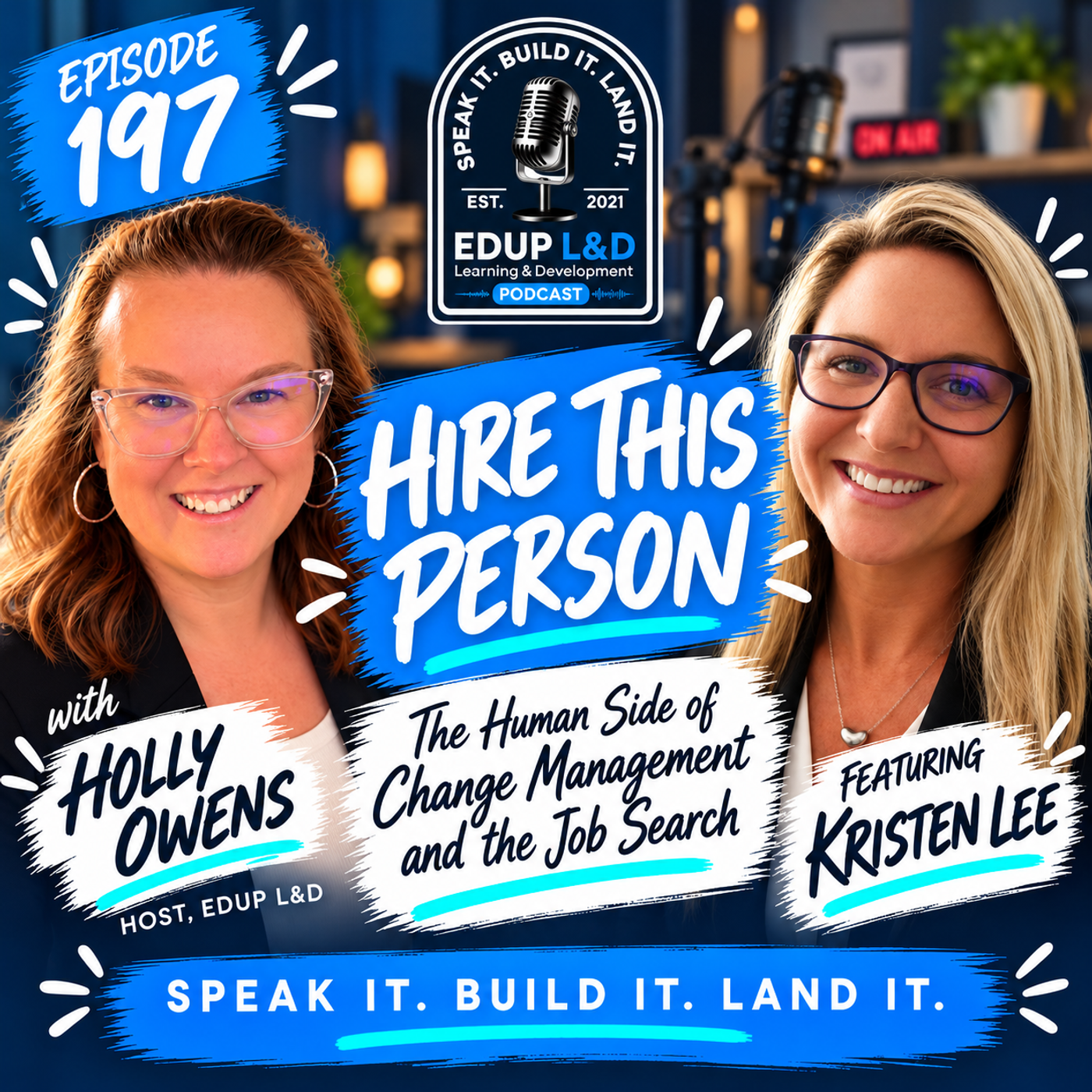
In this episode of EdUp L&D, host Holly Owens sits down with Kristen Lee, a learning strategy and organizational change leader, to explore the intersection of L&D, change management, AI, and the future of work.
With nearly 20 years of experience across financial services, pharmaceuticals, and veterinary healthcare, Kristen shares how transitioning from learning and development into change management transformed her approach to learning strategy and measuring success.
They discuss why successful change requires more than a training course or company-wide email. Leadership buy-in, consistent communication, employee incentives, and practical support all play a role in helping people adapt to new technologies and processes.
The conversation also explores today's challenging job market, including AI-powered applicant tracking systems, the need for more human-centered hiring, and how experienced professionals can remain adaptable and discover new opportunities.
Whether you're an instructional designer, an L&D leader, or navigating a career transition, this episode offers practical insights into leading change, building relationships, and growing professionally.
In This Episode, You'll Learn- How change management connects to learning and development.
- Why training alone isn't enough to drive successful organizational change.
- How leadership, communication, and employee support improve adoption.
- How AI and applicant tracking systems are changing the hiring experience.
- Why expanding your skills and professional network can open new career opportunities.
Change management is bigger than training. Successful change requires leadership involvement, clear communication, and support that addresses employees' needs.
Employees need more than a mandate. Organizations must explain why change matters, provide resources, and give employees meaningful reasons to participate.
AI should support human judgment, not replace it. Hiring automation can improve efficiency, but organizations must ensure qualified candidates aren't overlooked.
Career flexibility creates opportunities. L&D professionals can expand their impact by developing skills in change management and business transformation.
Your network matters. Alumni groups, former colleagues, and professional communities can help you uncover opportunities and navigate career transitions.
Connect with Kristen LeeConnect with Kristen Lee on LinkedIn for insights on learning strategy, organizational change, and professional development. Check out her Down and Dirty Thursdays posts for practical workplace perspectives.
Connect With Us💼 Follow Holly on LinkedIn: Connect with Holly
📹 Watch EdUp L&D on YouTube: Subscribe here
📰 Subscribe to the Newsletter: It's Not Just One Thing in L&D
💃 Follow on TikTok: @ihollyo
💌 Connect with Holly: Schedule a conversation
💙 Thanks for subscribing, listening, and supporting EdUp L&D!
Thanks for tuning in! 🎧
Holly Owens: Hello everyone, and welcome to the EdUp Learning and Development Podcast. My name is Holly Owens, and I'm the host of this show, but I'm also a higher education professor, instructional designer, entrepreneur, and a proud helper of humans. I've worked in the L&D space for almost 20 years, and I'm here to share what I know, what I'm learning, and what's happening in our industry. We'll talk about instructional design, L&D AI, technology, careers, and the humans behind it all. Along the way, I'll bring in some friends to share their stories, experiences, and expertise too. Because at the end of the day, L&D is all about humans helping other humans. This is EdUp L&D. Hello everyone and welcome to another amazing episode of Ed Up L D. My name is Holly Owens and I'm your host. And today I have a very, very dear friend of mine on the show. I have Kristen Lee, who is a learning strategy and organizational change leader in corporate America. Kristen, welcome to the show.
Kristen Lee, MSIT, CCA, LSSBB: Thank you for having me and what a wonderful introduction that was. You
Holly Owens: Ha.
Kristen Lee, MSIT, CCA, LSSBB: are a dear friend of mine and I'm so happy to be here.
Holly Owens: Well, I'm excited to talk to you about all the things you and I have we have some things going on in the in the background. We're we're both in the job market. We're gonna get into all that. But before we do that, I definitely want you to introduce yourself to our audience, tell us who you are, tell us about your journey, and then we'll go from there. Tell us, tell us about you.
Kristen Lee, MSIT, CCA, LSSBB: Yeah, sounds great. so I have my master's in instructional technology, and I cannot believe that was 20 years ago as of this year. so you know, that certainly lets you know what close to what my age is. but you know, I never thought that I would end up in corporate America, but I started in corporate right as grad school. And You know, I've I've pretty much stayed there the entire time. I've spanned from financial services to pharmaceutical work, and that happened all during COVID, which was completely insane. And I've also done Medicaid platform systems and veterinary health care. So I've really branched into from that learning and development perspective. I morphed into change management. And that was just a natural part of the progression of the of what I feel is a career in L and D, because L and D is one part of the of the larger picture, which is making sure people adopt what it is that you're teaching them. And I received my certification in change management of about 15 years ago. And it it did change the way that I designed and developed and implemented strategy for my training programs because I got much more specific on the adoption metrics that I was using and ensuring communication was in place and that there were change champions and a network. And you know, before earlier in my career, I didn't truly think that broad. So being able to incorporate change management into my L and D work has completely Morphed the way that I approach train learning strategy and just being able to ensure that at the end of the day, I'm providing the the best outcome for people to be able to improve their job quality and their performance
Holly Owens: Multi imperial.
Kristen Lee, MSIT, CCA, LSSBB: support within within their work and just being able to, you know, make sure they're bringing home a paycheck and it's not that. Of a difficult of an of a situation for them to bring home a paycheck 'cause they know what they're doing.
Holly Owens: Yeah, and I I definitely think like every maybe every instructional designer or person in learning development needs to s take some sort of change management, especially how often things change in in our roles depending upon what we're doing. the dogs, you probably hear them. You won't hear them on the final episode, but they're in the back they always make an appearance in the podcast episodes. So you might see them running back and forth. Yeah.
Kristen Lee, MSIT, CCA, LSSBB: If I if he wasn't, he'd be right here in my lap joining us.
Holly Owens: Yeah, we we're both pet parents. So but one thing I wanna dive a little deeper into when you're talking about change management, can you tell the audience like what that is and how that impacts like an organization overall and why it's important to pay attention to that? Why you know, I think people they say change management, but they really don't what is that? Like what does that mean? Does that mean like we're You know, we're building new systems or we're incorporating a new technology. What is what is change management and how is it impacting organizations?
Kristen Lee, MSIT, CCA, LSSBB: That is one of my favorite questions. So change
Holly Owens: Yeah. Good.
Kristen Lee, MSIT, CCA, LSSBB: management can span anything from behavioral change to attitudinal change to technology change. It's you can think of it as any change that is impacting your end users. the example that I like to use that really seems to drive to hit home with people is, you know, you're an Android user and you've been an Android user for the past 20 years, and suddenly Your your mobile carrier says we're no longer carrying Android phones, you have to become an iPhone user. And we we won't let you out of your contract. It's gonna cost you way too much to get out of your contract. So for the next year, you are going to have to switch from Android to an Apple platform. And then you can make the choice after that year whether or not you choose to stay with. The with the new platform because it's gonna be your new normal at that point, or do you revert back and go to Android? Or do you take the best of both worlds and implement what you've learned? And that's really what change management is. It is dealing with the the change curve, which if you think about it is is grieving. you you understand that something is changing. And no one likes change. Adults particularly do not like change. So older adults,
Holly Owens: Yeah, order knots particularly.
Kristen Lee, MSIT, CCA, LSSBB: the older we get, the worse we we push against change. And so it's really thinking about how can I help someone, you know, understand the change that is impacting them. Why is it impacting them? What is that going to look like? Help them accept that whether I like this or not, this is happening and move through that change. So it's it's kind of the larger umbrella where learning and development is one of those spokes. So change management for me is the overarching concept of what happens within L and D. You have to have training to be able to do whatever it is that this change is going to present. You have to know how to use it because if you don't have training, then you are gonna fail. You're not gonna be happy. It's going to be a huge pain point in your life.
Holly Owens: Right.
Kristen Lee, MSIT, CCA, LSSBB: so that so training is one part of change management. And then there is communication. People have to communicate to you what's happening, why is it happening, when is it happening, where do you go for support? That's another huge piece of this. And then you have that that just general support spoke of your umbrella, which is, you know, your trainers, your support staff, your help desk, your resources, you know, and that kind of spans across all three. of those areas. So, you know, change management is just it's really important because it helps you figure out exactly why you have to make this change, but how are you going to do it? And the more success successful your change management approach is, the more successful your L and D solutions will be.
Holly Owens: Yeah. It's very hard to like, you know, especially when it comes to technology, to get people's buy-in or a new process when they've been doing things the same way for so many years. It's like, okay, now we're gonna sh you know, some of us have been in these roles for ten, fifteen years and now we're gonna shift to a completely different philosophy or like a completely different process. And nowadays, you know, in the age of AI and all the different things we're experiencing there, it's it's probably created more friction with change management companies when it comes to like getting people acclimated. You know, there's like there's different theories and things and stuff out there. I like the diffusion of innovation theory, you know, like the people that like I'm one of the people at the beginning. I I delatch on from the beginning, but then at the end of that, that's the laggards. so I think across organizations you see all of them. You see all the people in the middle
Kristen Lee, MSIT, CCA, LSSBB: Yes.
Holly Owens: and everything. I think where I'm going with this is like I want to know like your approach. What do you think some of the best approaches are to change management when it comes to like getting people on board with stuff? And you know, it could be top down, it can be from the bottom up, it can come from the middle. That sort of thing. So what are some of the best approaches there?
Kristen Lee, MSIT, CCA, LSSBB: Yeah, so I I do think top down is important, but it's not just a leader saying, hello everyone, you are now required to do this. As of this date, it it's more complex than that. Those emails are
Holly Owens: I don't like those emails.
Kristen Lee, MSIT, CCA, LSSBB: not helpful. They they actually reduce the acceptance rate of
Holly Owens: True.
Kristen Lee, MSIT, CCA, LSSBB: any change. So the leaders have to model the behavior. That they are expecting of their employees. The leaders have to, they have to be an early adopter whether they want to be or not. They need to know, they don't have to be a SP. They don't have to be able to answer every question, but they need to know the ins and outs of the change that they are asking their employees to take on because that is going to affect their everyday life. Which their everyday life is going to affect that leader's overall growth and their numbers. So they have to show the investment in the change. The other thing I think a lot of businesses are missing out on these days is this you need a little bit of a budget, not just for your trained change strategist, not just for your change management team. You need a budget for your people that are going through this change. A $5 Starbucks gift card, which will no longer get you a coffee at Starbucks.
Holly Owens: Right.
Kristen Lee, MSIT, CCA, LSSBB: Will will still go a really long way. You know, that that gift card will, you know, get those, get your people to complete the training course. It'll get your people to attend a couple of sessions. It shows that little bit of appreciation. a half day off, a Friday, a half day on a Friday. That is not coming out that much from your bottom line, especially if it's scheduled. That's where your change team could come in and help you with that scheduling and working with your, you know, with your leaders, HR, whoever it is. There's gotta be there's a carrot and a stick, or there's just a stick and absolutely no carrot. And when you don't offer your people anything, any sort of present, if you will. to to accept the change, then they are naturally going to push back against it. So thinking about a very small budget, you know, even a a scrap a stress ball, you know, that's something.
Holly Owens: I mean incentivizing, we intrinsic, extrinsic motivation. The intrinsically motivated people are going to do it anyways 'cause they want to do well.
Kristen Lee, MSIT, CCA, LSSBB: Anyway.
Holly Owens: Yeah. But there's some people that need that extrinsic motivation. They need a reason to do that, whether you know, like I also think about like money to professionally develop or the support that you're going to get in in the pursuit of this whatever is changing in the in the space. So I think it I think that's very important. Especially like for myself working with higher education faculty and when we want them to let's say they've been teaching face to face or hybrid for I don't know twenty years. And then a lot of these programs come in, you know, an instructional design team and they're like, we're going to re this program is going online. So you have to learn everything about online. You have to learn the LMS, you have to learn the tech tools you can incorporate, you have to learn the pedagogies, you know, adult learning theory, because you're mostly teaching adults. You have to shift your thinking. and that's a lot of work for people. and that's not necessarily included as part of their job description. This wasn't when they initially signed on. So I think it's important. And when I used to work at UNBC, we used to pay people to redesign their courses. 'Cause it does take a lot of effort on their end. It's it's hours and hours of like thinking about how to map it out and how to put it into the LMS in a way that makes sense and refining and iterating constantly. So I think that's also important for companies to think about too, is how can they support their workers in professionally developing. We just sometimes leadership just sets this expectation like you're just gonna do it because you wanna keep your job. But we're humans, like Give us something. Give us something here. Give us some support. And I think great leaders do that. They really they really motivate people. And, you know, maybe it's like I always reference sports, like when a coach is giving a motivational talk to the players before a game. Like we need that kind of stuff. We need those kind of leaders to do those things.
Kristen Lee, MSIT, CCA, LSSBB: It has to be consistent as well. You can't just send that one message and think that it's done. You know, town town halls are Yeah, everybody's on board.
Holly Owens: Right. Everybody's on board.
Kristen Lee, MSIT, CCA, LSSBB: Like there needs to be town halls and there needs to be, you know, manager toolkits that help the managers talk to their teams and there needs to be support sessions. But, you know, to your point about, you know, colleges, I was when I was in graduate school, I was the graduate assistant at the School of Nursing. And that was when there was, you know. that kind of mid-outs age, you know, that was when a lot of things were transitioning from, you know, face to face to online. And part of my job was to help the professors transition all of their PowerPoints and all of their materials into something that could be consumed in an online format. And you know, some of them had a pretty good attitude about it. I but definitely that was the younger end of the professors to your point about the diffusion of animation, you know, usually your younger audiences are gonna be more apt to be accepting of it. And then, you know, as you you go up the scale, you're gonna have people that are pushing back. And it was all about You know, yes, it was a mandate, but nobody explained to them why this was important, how it was going to save money, how it was going to impact learners and actually make them more engaged because of students coming in and being more technology focused. Nobody explained that to them and that ended up being my job. So, you know, a lot of instructional designers I think are naturally put in the place of doing change management. It's just that we
Holly Owens: Yeah.
Kristen Lee, MSIT, CCA, LSSBB: don't really doing it at the time.
Holly Owens: Yeah, absolutely. I've you know, us we have to explain like why this is happening. So if we're not getting what we need, it's gonna be more difficult for us to explain to the faculty or insert whoever stakeholder here why the change is happening. We could talk about change management all day. So yeah,
Kristen Lee, MSIT, CCA, LSSBB: That's one of my favorite comics all day long.
Holly Owens: it's a great topic and I think it's really pertinent to the conversation today and what's happening in learning and development just in our world in general. but I wanna ask you another question. What's what's a problem we're seeing in the world of work and learning that makes you think there has to be a better way to do this? Like what is there something like you're like, well, there's It's it's been going okay, things are happening, and this probably relates to that to change management, but there has to be a better way to do blank.
Kristen Lee, MSIT, CCA, LSSBB: a really good question. I mean I the immediate thing that came into my head when you said that was the job search. you know because you say what's one you know you're
Holly Owens: yeah, let's get let's get into that.
Kristen Lee, MSIT, CCA, LSSBB: like what's one thing that could be working better and it my mind didn't go immediately to this and L and D or this and change management because the big thing that is hitting me right now is is the job search. And you know AI is a Wonderful tool. I am not anti-AI, but I worked a lot with robotic processing automation at TIAA as well as my tenure at PPD. I was actually on the RPA team. And where AI has its place is taking up the repetitive, almost basic tasks that I don't want to say waste humans' time, but waste humans time. Because it doesn't require complexity. It doesn't require higher level thinking skills. You're not, you're not having to use the HOTs, if you will, you know, from the education days.
Holly Owens: Yep, I love the hots. Yep.
Kristen Lee, MSIT, CCA, LSSBB: you're you're giving AI something to do so that you're freeing up space for humans to do what humans do best, which is taking their expertise, taking their understanding, taking all of these pieces together and putting together a bigger puzzle. And that's where I feel the challenge in our job market is today because AI has been put into a place where it's making those type of decisions. There's not, I know when I was in the job market back in 2023, from my as a result of my first layoff ever, I was getting interviews left and right for jobs that I wasn't fully qualified for. You know, those Like, hey, that sounds cool. Let me apply to that to make sure, you know, because let's cast a wide net and see what falls out. And I've I had a ton of interviews. And now I've been looking since the June, July timeframe, and I've had an interview with one one organization. And I'm overqualified for some of the roles that I'm applying for. I'm perfectly qualified for others, but I am getting kicked out of the system. And this is where AI is, I think, getting a little too much credit because the you're taking that human factor away.
Holly Owens: Yeah.
Kristen Lee, MSIT, CCA, LSSBB: and also it's just the the market is generally hard right now for a lot of people and it seems to be that place where you have to know somebody. if you yes
Holly Owens: Yep. It's very traditional, as I say. You have to know somebody that knows somebody. And they can vouch for what you do. And I always tell people that in the top of my resume, I include video references of people who've worked with me in the past and they talk about what it's like to work with me. Not sure if that's working because I've been searching since September. not not as long as you, but we're both in the struggle is real in this job marketing. And I know a lot of our listeners. are in the same boat. And I'm wondering like a lot of these jobs like I see appearing on LinkedIn and are they're getting promoted, the promotions of the jobs, the the whole process, it seems like it's a game that we can't figure out. It's it's it's a game that the rules are always changing and the person that's applying
Kristen Lee, MSIT, CCA, LSSBB: Okay.
Holly Owens: for the rules is not on the winning end of that. I mean I've spent gosh. I don't know. On some job applications, 20 to 30 minutes to never get an interview or to never get a response. I think companies need to make it more simplistic. I love the I love the applications that you submit your resume, you tell how to contact you, they maybe ask a qu a couple questions related to the job or if you have these requirements, and then you submit it. The job advocate. where you have to go in, you have to put the resume in, and then you have to put all your j Yeah. Yeah. You have to put all
Kristen Lee, MSIT, CCA, LSSBB: Work day.
Holly Owens: your you have to put in all your experience and then re put in your education. The j what I'm trying to say is it's it's okay that you have to do this, but the there's a mental health aspect to continuously having to do the same things over again and feel like Why can't there just be like a system that's all connected? And then beyond that, and I'm sure a lot of our listeners would agree, the feedback, the generic feedback that you get. I understand, because when I was at Ed Carter, like we had an instructional design remote position and we had twelve hundred applicants. And we, you know, it's hard to do a good job to give that specific feedback, but Just give me something to work on. Give me something to like work towards. Like tell me why. I because like you, I'm applying to jobs I'm I'm definitely qualified or overqualified for and I'm not even getting interviewed. They're just throwing me out like right away. in this and the again, the same jobs keep coming up and I'm like, you know, who's actually getting hired for these roles? Who's who's in these? So those are just some of my observations.
Kristen Lee, MSIT, CCA, LSSBB: Well, and I I'm not gonna throw any company under the bus here, but I have a friend who just got promoted. And, you know, when I when I congratulated them, I said, you know, well, you've been with the company for a very long time. You deserved this. And their response to me was, The only reason this happened was not even because I was internal. It was because somebody above me that is internal. pulled my resume or else I would have been lost in the AI ATS chaos that everyone else is going through. It is impacting internal employees at some companies as well because
Holly Owens: Yeah.
Kristen Lee, MSIT, CCA, LSSBB: it it's clogging up the the flow. It's it's getting in the pipeline and it's actually being less effective than more effective. And that that was really shocking for me to hear that even internal it's infecting internal employees because up until that conversation I really thought, well, you know, at least at least internal folks are getting promoted and apparently it is impacting them as well.
Holly Owens: Yeah, I I think we just need
Kristen Lee, MSIT, CCA, LSSBB: Mm-hmm.
Holly Owens: to like kind of wipe out the whole the whole system and kind of start fresh. you know, I could sit here and like think of creative ways we could, you know, interview people. I see the AIs, like we're doing videos. I use that with LinkedIn. That was pretty cool just to see the person. Because the resume, as I always say, is such a static document and it doesn't fully it it you t you have to tell the story with the resume and the cover letter. And I'm not a fan of cover letters, although I've done a million. recently. it it doesn't tell who you are, her your personal what about your personality and you can't fully explain. so how do you catch their eye? And like there's some statistic out there. Like they literally take point eight seconds and read the top the top of your resume, not the rest of it. So it's like The struggle is definit definitely real and I know this is resonating with a lot of our listeners is that if you're sitting here right now and you're thinking, like, why the hell am I not getting interviews when I have over fifteen, twenty years experience in this position and I know there are people out there who are accepting less salary just because they're offered a position. it it's just a lot right now. The job market completely sucks.
Kristen Lee, MSIT, CCA, LSSBB: Well, you know, to your point about how do you make your resume stand out, you know, ten years ago when I was just dipping my toes out there to see like I've been in this position for a while and I'm just curious what's out there, you know, you had the the flexibility to spice up your resume.
Holly Owens: Mm-hmm.
Kristen Lee, MSIT, CCA, LSSBB: If you will, you know, you could create I created my own template, you know, and and my my portfolio matched the color scheme that was on my resume. And I had made, you know, almost like a logo, if you will, or didn't have my initials or anything on it, but it was my consistent pattern. And it was something that you would see across my portfolio, but I included it within my resume as well. And that did differentiate me. It also showed that I'm not just a piece of paper, I got a little personality.
Holly Owens: Yeah.
Kristen Lee, MSIT, CCA, LSSBB: going on and and I know that that helped, but now thanks to ATS, you you better not put anything in your resume that, you know, because it it's where it reads it, that point eight seconds is gonna kick you out because it doesn't see the the keyword that it's programmed to look for. And
Holly Owens: Right.
Kristen Lee, MSIT, CCA, LSSBB: you know, it's I agree with you. I feel like we kind of need to go back to the beginning and I'm not saying AI doesn't have its place. Absolutely has its place when you have 1200 candidates for one position and the position's been open for two hours. But that
Holly Owens: Mm.
Kristen Lee, MSIT, CCA, LSSBB: also speaks to the fact that you know our market is struggling right now and that you know we we have to expect there's gonna be delays because there's so many other people looking for jobs too, but when you're highly qualified. And you have twenty years, fifteen, twenty years of experience, you shouldn't be getting kicked out from everything that you apply to. So where's the happy medium?
Holly Owens: Yeah, one hundred percent. And I think the best advice is that that I could give our listeners is that it's important not to give up. I know I'm in that place right now where I'm just like I and I'm sure you are too, where you're like I'm just done. But everybody keeps it's kinda like when somebody passes away and they say they're in a better place. When somebody says to me your job is coming, I'm like, but when? You know.
Kristen Lee, MSIT, CCA, LSSBB: It's on the horizon here.
Holly Owens: Yeah, it's on the heart, it's right around the corner. It's kinda like when you're looking for when you're single and you you're they're gonna turn up when you least expect it, right? th those kinds of things. And those don't necessarily help me feel any better because I'm sitting in a position and I know a lot of people who are listening are where y you need that money and you need that that stability again. Now I willingly put myself into this job market because a lot of different factors that I won't go into in this episode, but it's just it's like you should be able to have the freedom to pick a job where you feel or find a job where you feel appreciated, where you feel like your experience is honored, where you feel like you have the flexibility to still live your life because we're not here to just work and pay bills. There is a whole bunch of life out there to be lived. And I think that's one thing too. I'm reading some of these job descriptions and I'm like, this is like a two to three person job. Is this really something that can be done in like 40 hours a week? To me, it's like no. It's like it's got all these like the the job descriptions are becoming long as the resume.
Kristen Lee, MSIT, CCA, LSSBB: There's so many bad. Yes. Yes. And that has concerned me as well because it's like, well, I really do need something the beginning of the year. But at the same time, when I went to go print out this job description to, you know, keep it in my file, I've had some of them that were almost 10 pages long. And, you know, granted that had to do some with the formatting and and that type of thing because of the site that it came from. But it wasn't all formatting. It it definitely wasn't all formatting. That's a lot to expect one person to do. And you should really be hiring.
Holly Owens: better have a plan, an onboarding plan and tell me what I'm doing thirty, sixty, ninety, hundred and twenty days a year, whatever, out. because that just is already overwhelming my ADHD brain.
Kristen Lee, MSIT, CCA, LSSBB: Well, and you know, back I think this was pretty popular in the the beginning of the 2010s was, you know, do more with less. Cause I
Holly Owens: Right.
Kristen Lee, MSIT, CCA, LSSBB: I definitely heard that a lot. that was during my my time at TIAA. And we heard that a lot, do more with less. And some things you can do more with less. You absolutely can. and a lot of times if you pick the right things, that quality can even be increased from what you had before. But there are some things you cannot do more with less. You need to do, you need to do less with more. And
Holly Owens: Right.
Kristen Lee, MSIT, CCA, LSSBB: but nobody wants to look at it from that perspective. So it's it's just it's wild because the the the the pay scales also don't seem to be matching you know the requirements of of these jobs and the job descriptions. It's it's just they're asking for a lot. And and you know, if you were to break down, you know, an estimate of all of the tasks. That you know are part of the responsibilities of this job and do the math based on the salary that they're offering you, you know, it kind of makes you scratch your head a little bit and go, is yes, I mean, the overall number is probably worth it. But do I have any work-life balance? Can I, you know, can I take my dog for a 15 minute walk in the middle of the day? Or am I gonna be in overlapping meetings where I'm I've been in that situation
Holly Owens: Right.
Kristen Lee, MSIT, CCA, LSSBB: where I've been triple booked before? And it's it's not it's it's nobody can function that way and function that way for long and be able to to produce good results. Nobody can.
Holly Owens: Yeah, I think this is this is all really resonating with people right now is is the things that we're saying. But let's shi let's shift the perspective a little bit. You know, we talked about like what's what's challenging, but when you think about the future of work, what what gives you hope in terms of what we're doing and you know, what do we need to rethink? So tell us about what gives you hope.
Kristen Lee, MSIT, CCA, LSSBB: say that based on from where we were in the you know I would say like the 2018-2019 phase almost 10 years later a lot more companies are coming around I think they understand they may not be putting the money into it but I think that's to come they do understand that learning and development is is a critical need they do understand that that change management is something that if they want success, because you know, turnover is a cost. Turnover is an absolute huge hit to your bottom line. if you have if you keep your employees happy that you currently have and you spend a little more money on getting them to your point professional development or getting them that gift card or giving them a half a day off here and there.
Holly Owens: I like the half a day off.
Kristen Lee, MSIT, CCA, LSSBB: I I love the half day off idea because as long as it's scheduled and you make sure you have coverage and those other people that are doing the work the days that you have the half day off, they know they're getting the half day off too, as long as they met the requirements. because if they're not doing that work, I guarantee you they're already looking for another job. They're already looking. Like they they don't plan to be there anyway.
Holly Owens: How are you keeping your employees happy?
Kristen Lee, MSIT, CCA, LSSBB: How are you keeping your employees happy? And I do feel like that has been a bigger shift. And I see that continuing to be a bigger shift as we move into the future because, you know, the at PPD, I worked on a on a huge initiative. and it they were planning to expand it not just within PPD, Thermofisher Scientific, but to offer this service to other. you know, pharmaceutical companies and and other transcription companies. And they were very intentioned about making sure they had the training, that the communication was there, that the leaders were modeling the behavior and the leaders were down in center in front of these groups and able to ask, you know, answer questions, ask questions and receive, you know, constructive criticism. And be able to take that feedback and help them. And I I do see that that I think has changed and that does give me some hope that when things do finally start to calm down you know, across the job market and just, you know, the end of the year is always a crazy time. I mean, we are, you
Holly Owens: Yeah.
Kristen Lee, MSIT, CCA, LSSBB: know, in the the fourth quarter of the year, this is just a rough time in general for businesses because you're most of them are coming up on the end of that fiscal year.
Holly Owens: Right.
Kristen Lee, MSIT, CCA, LSSBB: I I do think that that's what gives me hope is that there's more value seen in what we bring to the table than there was before.
Holly Owens: Yep, absolutely. Just the the being more human part gives me hope because there's a there
Kristen Lee, MSIT, CCA, LSSBB: Yeah.
Holly Owens: are a ton of great leaders and people out there. And I've encountered many of them and I know they want the the my best bosses are the ones that made me feel like I could do anything. And they the and I knew I felt a a certain sense of security with them that they were going to protect me and protect my job. you know, and not micromanage me and trust me. Like there's this whole like thing. It's it is like relationship where I just felt so supported. And I kind of wish I stayed at some of those places. but yeah you know the human aspect of it definitely gives me hope because there's a ton of amazing people out there. We know there's amazing people in L and D space that that can definitely bring us hope and encouragement. All right. Coming up on the end of the episode, it goes fast when you're having fun.
Kristen Lee, MSIT, CCA, LSSBB: That's right.
Holly Owens: you're in the job market right now, so I want to know final two questions. Anything else you'd like to share about yourself, get get it out there to the world because this goes out to a huge audience. And then the final question if you could give three pieces of advice or resources or whatever to tell people that will help them as they navigate. their careers, what would you say? So anything you'd like to share and then three pieces of advice.
Kristen Lee, MSIT, CCA, LSSBB: I would say from what I like to share, you know, is and this is also advice, so I'm gonna tie the two together,
Holly Owens: Great.
Kristen Lee, MSIT, CCA, LSSBB: you have to be flexible. You have to be able to see yourself outside of your LND space. I was able to do that by adding on change management, but I also
Holly Owens: Mm-hmm.
Kristen Lee, MSIT, CCA, LSSBB: see myself now. What does all of that mean? It's business transformation. That's really what we do, is transforming business. And so I am flexible. I am willing to to grow new muscles while I can, you know, flex some of my strengths that I currently have. And that's part of being an L and D professional as well, is you you always want to keep learning. You you're never happy with the status quo. You always want more. And so I would say that that for me, you know, I loved my I actually loved my time in financial services. Never in a million years thought I would have said that. But Venra and I became
Holly Owens: Yeah.
Kristen Lee, MSIT, CCA, LSSBB: friends and it was great. And, you know, I I loved my time with pharmaceuticals. I I never dealt with one single drug. I never dealt with one single medicine. I supported the people that do the testing. That saved the lives by creating those medicines. And that was extremely rewarding for me. you know, now I'm in veterinary health care. you do not want me taking care of your pet unless it's playing with it or giving it treats. But, you know, that means that it's it's it's constantly learning and and being able to learn new technology, even when it it feels a little overwhelming. you know, that that would That would be again, I'm tying the two together. Those are the things that I bring to the table is flexibility, continuing to wanting to learn and even doing those things that that feel uncomfortable. I might complain a little bit while I'm doing it, but I'll I'll still do it because at the end of the day, I want to do it. and as far as resources that are out there, I know my graduate school in the past maybe five or six years, ended up with their own Facebook page. Now, do
Holly Owens: Night.
Kristen Lee, MSIT, CCA, LSSBB: I know anybody that left at my graduate school from 20 years ago? No, I I do not. But I am part of of the Facebook page as an alumni. And it helps me stay on top of what's new, what's coming out, what are the the new software development tools that they're that they're using, what's the what's happening in the space because now that I'm so far removed from higher education. What is it that they're learning? What are the challenges that they're seeing?
Holly Owens: I can tell you.
Kristen Lee, MSIT, CCA, LSSBB: you can tell me all day long, and that's why I come to you. But if that's also another another resource, you can find a friend like Holly. If you don't have a friend like Holly, get you a Holly. But
Holly Owens: Ha
Kristen Lee, MSIT, CCA, LSSBB: you know, it's it's finding those resources that don't feel like work to go and look at. You know, it's there's there's great articles out there and there's great journals and there's, you know, but sometimes that feels too
Holly Owens: Tons of noise.
Kristen Lee, MSIT, CCA, LSSBB: Yeah, and it it feels like it it it feels like it's too much work. So you need to find something that is easy for you, that is easy for you to consume, whether that's I am not a great audio learner. I am a very visual learner. So like books on tape do not work for me. Absolutely do not work for me. But if it's a book that I really want to read, I'll sit down and go through it in a few hours. I don't, you know, I mean a few hundred pages in a few hours is nothing for me because I read really. So it's finding where you can get your updates and where you can stay abreast of things in the medium that you prefer that works for you.
Holly Owens: Yeah, absolutely. Flexibility. Find a friend. Phone a friend. Find a friend.
Kristen Lee, MSIT, CCA, LSSBB: Found a friend. Yeah.
Holly Owens: And definitely find find the resources that work best for you. And I love that your alumni group has like a Facebook page and they send out stuff. I I remember being a part of like an email from my master's degree and it's been mine's been ten I've been out ten years for master's degree. but I haven't seen much come across, which is interesting. Maybe I need to email them. Maybe the people who are doing it have like probably moved on from the institution or stuff like that. But I always forget that you can go back to those groups because there's tons of people who have graduated from those programs and they're and they're in the field and they can definitely give advice and support.
Kristen Lee, MSIT, CCA, LSSBB: definitely reached out to and leaned on those folks, especially during my stint and unemployment back in 2023 that lasted eight and a half months. You know, I I was leaning on those resources that
Holly Owens: Yeah.
Kristen Lee, MSIT, CCA, LSSBB: they graduated before me, you know, in the in from my graduate program. And, you know, so they they've been in the journey longer than I have and found out that they worked at a couple of local companies, you know, and they, you know, they did what they could, but you know, most of the time, those businesses weren't even hiring for those roles. so, you know, but it it is it is all in who you know. And sometimes you have to remind yourself, who do you know? or who has that connection that can help you network to find the right people. So
Holly Owens: Yeah.
Kristen Lee, MSIT, CCA, LSSBB: I I do think people overlook their graduate program. And so making sure that if there is something like a newsletter, a Facebook page, somehow to to keep involved with them. that's really the easiest place to start, or it was for
Holly Owens: Yeah.
Kristen Lee, MSIT, CCA, LSSBB: me.
Holly Owens: Great advice, great resources. so everything about Kristen is gonna be in the show notes. So where to connect with her out on LinkedIn, please connect. She does Down in Dirty Thursdays where she talks about different topics on LinkedIn and the post are really, really good. So be sure to go out there and follow her. And thank you, Kristen, for your time and coming on the show and just sharing your experiences. I'm I appreciate it and I know the audience does as well.
Kristen Lee, MSIT, CCA, LSSBB: Well thank you for having me. This was so much fun. So anytime you you need to, you know, have somebody chit-chat with you, you know I'm always available.
Holly Owens: Yeah. If I ever need to fill a spot and we can talk about we can talk about more the job market, all the different things. Cause there's definitely more to get into there. So that will possibly be a future episode.
Kristen Lee, MSIT, CCA, LSSBB: We can also use a down and dirty topic too. That's that is my methodology that you
Holly Owens: yeah, that would be cool.
Kristen Lee, MSIT, CCA, LSSBB: know that that I feel should be put in some sort of instructional design methodology book somewhere that the one that they don't teach you. So
Holly Owens: The w yeah, the one of th the things they don't teach you.
Kristen Lee, MSIT, CCA, LSSBB: Sorry.
Holly Owens: Well, that's a wrap on this episode of EdUp Learning and Development. A huge thank you to our guests for joining me and sharing their experiences, insights, and expertise. Be sure to check out more great episodes at eduplnd.com Until next time, keep learning, keep sharing, and keep helping other humans. Speak it, build it, land it. See you next episode.