
 Apple Podcasts

 Spotify

 Amazon Music

 iHeartRadio

 Pandora

 Castro

 RSS Feed

 Audible
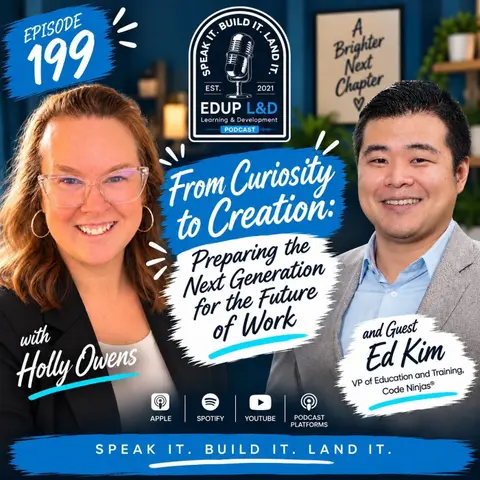
What happens when we give the next generation access to powerful technology before they've developed the foundational skills to use it?
In this episode of EdUp L&D, Holly Owens talks with Ed Kim, Vice President of Education and Training at Code Ninjas, about the future of learning, AI in education, and preparing young people for the world of work.
From coding and STEM education to critical thinking, creativity, and learning through failure, Ed shares why foundational skills matter more than ever in an increasingly AI-driven world.
In this episode, we explore:
- Why coding and STEM education should be foundational learning experiences.
- The opportunities and risks of introducing AI to younger learners.
- Why critical thinking and foundational knowledge must come before AI acceleration.
- The importance of resilience, problem-solving, and learning through failure.
- How hands-on, project-based learning encourages creativity and ownership.
- What educators and organizations can do to better prepare the next generation for the future of work.
Connect with Ed on LinkedIn
Learn More About Code Ninjas: https://www.codeninjas.com/
Connect With Us
💼 Follow Holly on LinkedIn: Connect with Holly
📹 Watch EdUp L&D on YouTube: Subscribe here
📰 Subscribe to the Newsletter: It's Not Just One Thing in L&D
💃 Follow on TikTok: @ihollyo
💌 Connect with Holly: Schedule a conversation
💙 Thanks for subscribing, listening, and supporting EdUp L&D!
Thanks for tuning in! 🎧
Holly Owens: Hello everyone, and welcome to the EdUp Learning and Development Podcast. My name is Holly Owens, and I'm the host of this show, but I'm also a higher education professor, instructional designer, entrepreneur, and a proud helper of humans. I've worked in the L&D space for almost 20 years, and I'm here to share what I know, what I'm learning, and what's happening in our industry. We'll talk about instructional design, L&D AI, technology, careers, and the humans behind it all. Along the way, I'll bring in some friends to share their stories, experiences, and expertise too. Because at the end of the day, L&D is all about humans helping other humans. This is EdUp L&D. Hello everyone and welcome to another amazing episode of Ed Up L D. My name is Holly Owens and I'm your host. And I can already tell you tell you today's guest has a lot of energy and is going to be a lot of fun. Today I have Ed Kim with me, who is the vice president of education and Training at Code Ninjas. Ed, welcome to the show.
Ed Kim: Hi Holly, hi everybody. Thank you so much for having me. It's exciting to be here.
Holly Owens: Yeah, we're gonna have a great time and I know if you don't know about code ninjas and you don't know about Ed, by the end of this show you're going to know all you need to know. You definitely need to go out and follow them on LinkedIn and learn more about it. So Ed, I wanna know more about you for the audience, for those people who don't know you, tell us about your journey. How did you become the VP at Code Ninjas?
Ed Kim: Yeah, yeah. it's I'll do the short version of it, but I appreciate the first question. I I hope this resonates with a lot of parents and maybe fellow educators you know, who listen to this. I I grew up as a very typical student, you know. I'll say had a tiger mom, tiger dad. So my my days were structured. I had all kinds of activities, subjects, tutoring, all kinds of stuff going on. But it eventually got me to Georgia Tech where I studied biomedical engineering and finance. But I quickly found out why people said, Yeah, I don't know if it's still true now, but at that time, because I'm an old millennial, they said seventy percent of people yeah, okay, that's awesome. Yeah, yeah, we'll relate.
Holly Owens: Me too. Yeah, yeah, 100%. Elder millennial.
Ed Kim: Well, right, really well. Yeah, yeah. And so like, you know, we we were the promise generation, right? Like we we had the the track the college and then you know, we're supposed to have all these set career paths. But I among many others quickly found that what I studied really wasn't even my true passions. So I started tutoring on Saturdays, you know, to make some money because I was struggling at the time. and I fell in love with it. And I met one of my longest time, longest running mentors, David Kim, who's actually the chairman of the Code Ninjas board currently. and so I've worked with David Kim in a number of different companies and opportunities, but really in the education curriculum side of things. So I kept getting deeper and deeper into it. and that
Holly Owens: Yeah.
Ed Kim: journey started with my first job with David where at a company called C two Education, which is like kind of an after school test prep SAT A C T admissions kind of environment. They were in startup mode. They needed a whole series of curriculum built. And, I had been tutored all my life. So I was super familiar with what kids needed to learn and then
Holly Owens: Yeah.
Ed Kim: how best to teach certain things, especially in like chemistry, physics, you know, calculus, things like that. so I wrote a lot of curriculum. And then, you know, year after year I started to move more into strategy, into more product management, things like that. and so I landed at Code Ninja's. about three and a half years ago. I was looking for an the next opportunity to kind of make a even stronger and deeper impression and to meet kids where they were. And Codenja
Holly Owens: Yeah.
Ed Kim: was a great opportunity to be able to do that kind of work. So that's where I am today. I became a vice president really young. I think I was twenty-seven back in twenty seventeen. So I went really young. So I was really fortunate to get a lot of that higher level management experience at a much younger age. So now I I can really do a lot more with that, you know, experience and knowledge. So that's my career story in a short version.
Holly Owens: It I I love it and I love how you know the thing about I think about the job market and like when I'm looking at like job descriptions and stuff and people say they want you to have this experience, but they don't want to give you the opportunity to actually have that experience. So I'm so glad
Ed Kim: I've got
Holly Owens: you were able to get that top level experience. Like, you know, it age doesn't matter. It's about, you know, you're supposed to be training somebody and you're supposed
Ed Kim: It's yeah.
Holly Owens: to be helping them develop and grow, right?
Ed Kim: I wish there was more coaching for young people. that that's something I try to do with my spare time too is mentor a couple of younger kids in like high school and middle school. but I wish there was more of that because yeah, I I love it and I don't say I love it, but the irony in seeing a job description that says it's this level job, but we need like 15 years of experience in that job already. But you've
Holly Owens: Right.
Ed Kim: posted the job like it's a first time attempt at the job. Yeah. It wasn't quite out of
Holly Owens: It's an entry level, right? Yeah. And it doesn't it doesn't quite add up. I
Ed Kim: though.
Holly Owens: I also love that you found tutoring and you're like, this is where I need to be, even though you have that degree from Georgia Tech. I think that like, you know, we talk about language and we talk about music are universal languages. I think learning is a universal language too.
Ed Kim: Hundred percent.
Holly Owens: Because we just if we we're just teaching each other and we're just supporting each other and just helping each other. I mean Who knows what can happen. it it just I just love learning. I was a high school teacher and I still teach
Ed Kim: Yeah.
Holly Owens: in higher education. So I'm like I'm an educator at heart.
Ed Kim: Yeah.
Holly Owens: so yeah, I absolutely love your journey and that's going to r definitely resonate with some people in the audience. They're probably thinking, like, I'm doing this little side hustle or a thing on the side. This might be so Yeah, this might be something I can
Ed Kim: Pursue it. Yeah, yeah, yeah, yeah. Pursue it.
Holly Owens: do as a career. Awesome. Well well that was that's a great story, even though it's a short version. I'm sure there were Were a few bumps in the roads or things that happened, but I'm so glad that you are here now and telling
Ed Kim: Yeah.
Holly Owens: us what's going on. So let's dive into it. What is Code Ninjas for those who've never heard of it?
Ed Kim: Yeah. Code Ninjas, we are the premier company and center based business you wanna come to to teach your kids how to code by building games and building things. you know, more recently code ninjas has been shifting a lot to STEM education, doing more things with robotics, VR, AI, just trying to be a more holistic, you know, service for teaching kids how to be engineers, innovators, creators. Yeah, yeah. it's it's all about empowering them. I I
Holly Owens: cool. I wanted this when I was younger.
Ed Kim: yeah, same here. I wish we had this when we were younger. Like we I
Holly Owens: Yeah.
Ed Kim: I Our after school activities was either sports, art, music, very traditional avenues. so
Holly Owens: Mm-hmm.
Ed Kim: seeing kids do this is amazing. It's for kids as ages five to fourteen. we're now in five countries. I actually just brought Egypt into the company myself. so we're opening our first centers in Egypt, right in Cairo, really soon. we're also in Lebanon, US, UK, and Canada, and we're still looking at other countries to expand to. So we're becoming a global presence when it comes to teaching kids how to code. but we're finding that Yeah, we we treat coding a core subject in school, like math, science, other things. So, it's pretty
Holly Owens: Yes.
Ed Kim: cool we're able to do with the kids.
Holly Owens: I really feel like it should be a core subject. I really feel like it should be a part of the process, like I remember when I was in high school, my grandmother made me take what was called then keyboarding, so learning how to type. And she 'cause
Ed Kim: Yeah, I I remember that.
Holly Owens: she had like some sort of premonition that I was going to need to be
Ed Kim: Right.
Holly Owens: on a computer all the time and have to be an expert at typing. So this is kind of that. Like they need to have this stuff in order to be successful in the careers that await them. tell us a little bit more of like and I wanna get your perspective too on how you feel about AI and coding and all those different things and how that truly impacts learners nowadays.
Ed Kim: Yeah.
Holly Owens: what does it do for them?
Ed Kim: I I think it's a double edged sword. And I speak from personal experience too where I I see any technology or any disruptive technology, and for us, for you and me it was Google, the search engine. Yeah, yeah, it's being able to download something without having to like and not having copies
Holly Owens: Yeah. Yeah. Yeah. Yeah. No more encyclopedias in the basement.
Ed Kim: of Encyclopedia Britannic or trying to trying to find a copy at the library. You know, I think the the benefit is an acceleration. Or it's acceleration and enablement. It enables and accelerates our kids so their outcomes a lot faster. But the the other side of that is a massive risk and danger to their ability to get to that point because they've lost the structural learning they need. So AI to me is it should be time locked. It should be age locked. I I appreciate AI companies and tools that say you have to be thirteen or older to use it. I think from Even from five and I'm gonna sound like an angry old man when I say this, but from five all the way to eighteen, we should limit the heck out of technology our kids use. 'Cause they need that time to build the the structural rigor in their brains, the the the the rote memor they have to go through rote memorization. They have to go through certain processes to lock in their basic knowledge so that when they get to use AI and technology, they can really accelerate out of it. Right. What we already see at Code Ninjas and what I mean I went through this when Google came out was I spent time to Sit down, learn the full power of search engines, learn how to use plus signs, parentheses, colons, semicolons in my search strings. Just how what AI does for us now, right? I learned how to do that
Holly Owens: Right.
Ed Kim: with Google. And that made my 15 years thereafter so much easier to navigate, right? So that's the same mindset we have to apply to the kids is AI is so cool and it can do so. I mean, I'm using AI a lot more often in my job, but it I when I reuse it, I'm like, yeah, the only reason I can use this to maximum capabilities because I've gone through school. I've gone through all the rigors of, K through 12 life, all the book studying and writing and all that. So then I can synthesize and strategize and use AI to the fullest. So it's a double-edged sword, I think.
Holly Owens: Yeah. You have to you you have to learn the long division before you learn the short division, right?
Ed Kim: Yeah. You gotta memory I hate how they don't teach the multiplication table anymore. This common core multiplication thing they came out
Holly Owens: I know. It's
Ed Kim: with. Ugh.
Holly Owens: I have a stepdaughter and she's gonna be sick soon and she's in kindergarten right now and I'm just like, I don't know. It's just crazy some of the things and the way that the the curriculum
Ed Kim: What they do, yeah.
Holly Owens: and the the ideology of education has changed. Like what you're saying is so important that you have to have the foundational knowledge in order to be able to operate the technology properly.
Ed Kim: Right.
Holly Owens: Like in order to be a v be able to evaluate the artificial intelligence and what it and what it's
Ed Kim: Evaluates a good part.
Holly Owens: saying. It's like you can't take those things at face value. And if you don't have that, certain mistakes are going to be made that could be, detrimental to your job or I different things have happened with AI, I won't mention the bad things. but I think it's so important that you're saying like you have to you have to completely understand the analog nature first before you get into the digital space. So that you can, sift out what's good and what's bad.
Ed Kim: And we're having to teach that at our centers too. So
Holly Owens: Yeah.
Ed Kim: our intro modules for our AI Academy, because we have a hundred and twenty hour course on it. We we w we want aggressive with building content. And so even in
Holly Owens: I love that.
Ed Kim: that, the first two modules are so heavily focused on how do you tell what's lying to you or hallucinating, how do you come
Holly Owens: Yeah.
Ed Kim: you know, it's it's a lot of building blocks that we're like, wow, traditional school's gotta do a better job taking care of this, but that's also a losing battle. They keep getting resources taken away, you know, at the school level. So
Holly Owens: Yeah, that's it's not and again I'm not saying it's not their fault. It's like and they have to have there's so much structure in the school, things you have to do for to meet the expectations of the district and things.
Ed Kim: yeah.
Holly Owens: Yeah. So I love like so let me ask you a question. This is like off the docket a little bit. So can
Ed Kim: Yeah, yeah, yeah. Yeah.
Holly Owens: code ninjas like the curriculum itself be actually integrated into school districts? Yeah. I just started thinking about that.
Ed Kim: I'll thought you asked that. So well, so to any principal, superintendent, district district t tech teacher, anyone STEM decision maker listening to this later, reach
Holly Owens: they listen.
Ed Kim: out reach out to us because you know I'll I'll say a couple things with this. One, we've seen our school partnership arm grow significantly. So I kicked off an official school partnership process back in twenty twenty four where we
Holly Owens: Great.
Ed Kim: could deploy mobile units to schools to do an after school program. Right. and so first year it was like maybe fifty schools. Now we're getting close to like a hundred and thirty, hundred and forty schools across the US alone and some in Canada. We're able to offer you what any one of our programs, whether it's our coding core program, whether it's our virtual reality coding program, AI program. We are IST accredited. I know that's gonna resonate with the educators on the call. We're
Holly Owens: Passing. Yes.
Ed Kim: IST accredited and we're as soon as C STA opens up for their new AI based standards, we're gonna apply. My director, Bill Marslin, sat on the review standards committee. So we're all about being check marked off for schools. So that
Holly Owens: You got all you got all the bases covered.
Ed Kim: we wanna plug and play, right? Yeah, yeah.
Holly Owens: Yeah.
Ed Kim: and so that's where Egypt, our opportunity Egypt came in. So our private business in Egypt, if it goes well the first year, we're gonna begin expanding into the public schools across the whole nation. In Egypt as a curriculum standard. So I will say yes, absolutely. We're all about supporting schools. We have the ability to do so. and it's really just plug and play for the educators. We have the bodies, the technology and the content. You just give us the space and communications to the kids. We're all good to go. So
Holly Owens: That yeah, that question that that popped into my head. I'm like, this would be so valuable if the schools could just use this as a part of their curriculum and they can. Right. It's just a part of it.
Ed Kim: Mm-hmm. Yeah. Without taking out a block in their regular schedule. it can be done after school, one hour, super easy. and we have a curriculum map, a progression. It goes aga we have a standards map too. So all the things that administrators might need from a you know, admin standpoint, you know, we got we got that covered. So yeah. Yeah.
Holly Owens: Abs that's wonderful. So you've been in learning for a while.
Ed Kim: Yeah.
Holly Owens: can you tell me like what's a problem like you're seeing in the world of like work or learning? you can go in either direction. Something that
Ed Kim: Ooh, that's a great question.
Holly Owens: made you think there has to be a better way to do this. There has to be a better way.
Ed Kim: That's a great question. I I go on a lot of these podcasts and I I haven't been asked that yet. so you guys are prepared.
Holly Owens: Well, we like to ask the fun, exciting questions here that are fully loaded.
Ed Kim: I'll say i for one thing for work and for for learning. For learning. The instant gratification effect is has gone past the point of allowance. I don't know if that makes sense. Like
Holly Owens: Yeah.
Ed Kim: the allowable limit that me personally, in terms of how quickly kids expect the answer without appreciating the journey,
Holly Owens: Yeah.
Ed Kim: that that type of lesson is has dying out completely in school. It's
Holly Owens: I know.
Ed Kim: And it's it's either getting on the struggle bus, kids used to say, I don't get this subject and I gotta work through it and really lock down, or it's even saying, it's okay to get something wrong and let me go on my own learning journey really quickly for the next 15 minutes to figure out why I got it wrong. It it it it's like for you and me, getting right or wrong was like, it's it's great. It's like, slap on the wrist, bad, we gotta do better. The kids
Holly Owens: Yeah, right, right.
Ed Kim: now feel like it's an emotional win. I
Holly Owens: Yeah.
Ed Kim: failed, this means that I am nothing like this YouTuber I follow or this influencer wanna be or whatever it is. the influence on their personality and how they set their outcomes has changed. And that bled that bleeds into their lack of opportunity to appreciate the journey. So that's on
Holly Owens: Yeah.
Ed Kim: the learning side. On the work side, I fear for the young grads right now because I I am starting to see the disconnect between the social skills and their intellectual skills and being able to merge those two together to present their opinion in a certain effective way. It it's it's more so than like the awkwardness you or I had when we were probably 22, 23, trying to conquer the world, you know, and say too much.
Holly Owens: There was there was definitely an awkwardness there.
Ed Kim: Yeah, yeah. So it I think that's changed. And so For me, that's the undercurrent of behavioral things that we have to do something about to help prepare the kids for the future better.
Holly Owens: Yeah.
Ed Kim: so it's something I try to insert in in more tactical ways at Codeninjas. It's like, teachers, you're gonna have to you gotta ask a c the kids this question in a group, you know, or pause them at this point to to make them think about this, right? So it's it's an interesting problem to tackle, I'd say.
Holly Owens: in the too critically think. And also too, I was just thinking about how quickly my stepdaughter wants something when she asks. She wants it instantly. And I'm like,
Ed Kim: Right. Right.
Holly Owens: dude, you you need to chill out. I I
Ed Kim: Amazon next day shipping is not gonna be fast enough, I feel, for these kids.
Holly Owens: know they're gonna want it. Well I know Amazon Amazon does same day stuff now, but it's gonna
Ed Kim: Yeah.
Holly Owens: be it's gonna be instant. And I think in a world where all this exists we're gonna lose the traditional sense of building something and
Ed Kim: Mm-hmm.
Holly Owens: re building something really meaningful. Because nowadays, in my opinion, our culture doesn't honor doing things the slow quality way. It honors how fast you can do it. Efficiency efficiency
Ed Kim: Correct. Efficiency. Yeah, yeah, efficiency.
Holly Owens: is huge. and I don't know if that's the right way, you know, with AI and stuff. I also as an instructional trained instructional designer I like to have that creative time to think.
Ed Kim: Yes.
Holly Owens: beyond looking at the computer every day or putting something in the cloud, I wanna I wanna think critically about it because sometimes my brain really comes up with some interesting things that I need to put like I'm analog. I wrote down stuff and I'm digital. But I
Ed Kim: Yeah.
Holly Owens: need that space to think, you know?
Ed Kim: Yeah, yeah. But I think even that that practice itself has gone away. And I'm I'm I'm sorry, Common Core standards writers. I hated, you know, those standards the second it came out when I read them. I was like, none of y'all taught in classroom. And so the
Holly Owens: Yeah.
Ed Kim: common core standards and things like that that kind of it it it and altruistically did the right thing to try to standardize and upgrade what our kids can do. But that stuff I think has locked us down because it it it just prevents kids from going through that journey. yeah, it's Say my I some of my some of my cousins have kids now and I see it in their behaviors and I'm like, no. I a and it's interesting how you can't shift away with a different opportunity because everything around the kids follows that same model, you know.
Holly Owens: Right, right. They're being constantly like this
Ed Kim: Yeah.
Holly Owens: is what this is how it's going to be. yeah, it's definitely a a difficult situation and I think we're we're gonna be our grandparents soon. I'm gonna say we're gonna be the Yeah. My actually my grandfather
Ed Kim: Yeah.
Holly Owens: who passed away this past fall, he was a huge technology
Ed Kim: sorry.
Holly Owens: person. He was in his eighties, he had he had an iPad, he had a smart TV, he had a smartphone. He he did all the things. there's times when he would call me because I was his number one tech support line and I wouldn't be able to answer. So I called him back and he's like, I figured it out for myself. That's what I want for this generation is like
Ed Kim: Wow, that's impressive. Yeah.
Holly Owens: they have the opportunity to work through things and figure it out for themselves. And I imagine with code ninjas, that is an opportunity.
Ed Kim: encourage that a lot. Yeah. So we and so when we bring it back into like one of our centers, the w one of the main lessons we teach about ten key intangible skills like resilience, problem solving, you know, cooperation, coordination, things like that. But we get our kids accustomed to failure because that's coding. Like very
Holly Owens: Yeah, one hundred.
Ed Kim: few coders, even AI, gets it right the first pass. Right. you gotta go through it, debug it, you got you're gonna get rid of errors. So I think the nature and why I love coding as a core subject is we see this in the centers, our kids get used to failure, but not in the wrong way, where failure's bad. Failure's like, no, I'm just not there yet.
Holly Owens: Right. There's another path.
Ed Kim: Right. The whole yet mindset. Right. There's another path. I this my employer companies, there's a better path to f adding value for cuts consumers than faster delivery times. And we teach our kids
Holly Owens: Yeah.
Ed Kim: that. especially in our programs too, even though certain our code our code has to be a certain way because we want kids to get the syntax correct and all that. So but we love seeing our kids submit. code that challenges the way we want them to write it. So
Holly Owens: Nice.
Ed Kim: we see these these these opportunities of creative creativity to come out. I think at our centers too, because I think we benefit from not being a school, but we're set up like a classroom. So
Holly Owens: Mm-hmm.
Ed Kim: kids don't treat our teachers like teachers. They treat them like like mentors more so. and so yeah
Holly Owens: Yeah. that's so amazing.
Ed Kim: it's so we we just got lucky I think with the way we set things up and how we've built this environment of, hey, we're not a school but you're learning something really hard, but we're tricking you 'cause you're making games, you you're flying drones, you're putting your that's the key. That's
Holly Owens: Mm-hmm. And it's fun. That's the key to learning. I always said that.
Ed Kim: the key.
Holly Owens: Having fun. When you're having fun and you're learning at the same time, you don't realize that you're encoding in your brain. Yes.
Ed Kim: It's the umbrella to gamification, right? It gamification was a good avenue for it, but if you helicopter back up, it's really and then w the way we see it is get our kids to produce something with their own hands so they actually have ownership baked in. It's not us saying, you did my work worksheet and my exercise and you got it right or wrong. No, you built something. Yeah, we told you what you w had to build, but we told you very general rules, but you built it. It's yours. So that Tactile connect I think carries us really, really far with the students.
Holly Owens: Absolutely. What what I, as a teacher, what I always would something that would bother me is that the students would be like, you didn't tell me that was going to be on the test. And I'm like, you know, when even in higher education,
Ed Kim: Fantastic.
Holly Owens: when they say you wouldn't tell me that was going to be on the quiz or you didn't tell me, it's like they just want they want to check like you we were saying earlier, they want to check everything off without doing the the grunt
Ed Kim: Yeah. They want the map. Yeah.
Holly Owens: work to actually understand it. But that comes in turn two to the people who are teaching it, that you
Ed Kim: Yes.
Holly Owens: need to create these authentic assessments. You need to create these things that actually make people think, I love, and I'll admit this, I started a d doctoral program and I got all the way through, and I'm A B D because I would not write the dissertation. Writing is not the boring writing of a dissertation that's going to sit on my bookshelf and collect dust for the next century. is not something that I want to do. Right. I want to build something. Let
Ed Kim: All for the stake of your PhD. Yeah, it's like it's like your degree.
Holly Owens: me build an instructional design program for you. Let
Ed Kim: Right.
Holly Owens: me build something that can be accredited. Let me build, you know, and I imagine that's what Code Ninjas does for students too. Like they they come away. They could have a portfolio piece that maybe they use later on in high school or college or be in and kind of iterate on that and beyond that they're referring back to because they learned it at CodeNinjas and they were given the opportunity to use their minds and make that artifact.
Ed Kim: Yeah, I love how you said that because that reminds me of all of our kids who graduated our program. So, we we did a new color shift to, really pizzazz our colors a bit more. So at the end of our journey is the gold belt now, going gold, what in the gaming
Holly Owens: Yeah.
Ed Kim: industry. So kids at that level, they're storyboarding, conceptualizing, coding, debugging, and shipping their own full 3D game. Right. And we have it on our black belt and gold belt website. We have a blog website that just showcases the eight hundred, nine hundred kids that have gone to this point. It's like a five, six, seven journey. Yeah.
Holly Owens: Be in the show notes.
Ed Kim: So yeah, it's it's seeing this creation and I've also heard that some of our students are now old enough where they've gone off to take the Unity Company's level one certification exam for programmers and they pass it because of what they went through with us. So our kids are are competitive with adults in terms of what we're able to teach them. So to your earlier point. It getting it into the kids' hands and letting them really create something with it, it's not about age, right? It's not titles and all it's not about age, it's about just how you structure someone to take full advantage of it, right? and so we do that at our centers is hey, here's a technology, we're gonna teach you how to use it, but we're not gonna lecture you about you can and can't do this and this is this. It's like go explore. Here's your objective. We need you to create this, but go figure how to do it. And so
Holly Owens: My luck.
Ed Kim: Early engineering mindset is big for us, at every center.
Holly Owens: Awesome. I love that so much. All right. So let we, we've said some things maybe negative or neutral, whatever, about the the future of work and learning and all those different things.
Ed Kim: Yeah, yeah.
Holly Owens: But I I want to know when you think about the future of work, what gives you hope about it? Like or learning? What gives you what gives you hope at this point of what's going to be happening?
Ed Kim: I two things give me hope. One is the reality of humanity and what actually falls through for our society. And two, it it is it is the power of what AI can do at our fingertips. So I'll go through I'll go through the more negative one first and then the positive, I guess. Yeah. So just to add them
Holly Owens: Yeah, perfect.
Ed Kim: on the high. So when I talk about the reality of humanity, I mean we tend to limit our own potential for destruction. We create our own potential for destruction, but we tend to limit that as as well. this might be a bad example for me. It's the wealth generation aspect of AI. No one's talking about it. Of course, everyone can go create stuff and not need jobs because they can be their own company, but what money are you gonna have to pay for everyone else's stuff if you're not working for a company? So that's gonna stop any whatever buzz AI companies talk about. Second thing, data centers. Until they figure out how to get them into space or where there's real estate, that doesn't get in the way. Of everyday society. I think
Holly Owens: Yes.
Ed Kim: the data center is the next bubble for AI where it's like, no, you're getting active resistance in towns, in areas, conservation groups, stuff like that, where you can't use this land for more data centers. And I don't see six billion humans being able to use AI, at least not for the next hundred years. And I say a hundred very loosely, right? imagine trying to get infrastructure set up in Ethiopia or another third world country, right? That that needs to Google got there because the mobile device was our avenue, but I don't I mean I can't imagine mobile devices running AI for six billion users without like entire cities of data centers, you know what I mean? So
Holly Owens: Yeah.
Ed Kim: there we we face a lot of uphill battle and I love how I see that with the tech. Search engines, same thing happened. it's gonna take over the world, you're not gonna need to know anything. It's a tool. there's that.
Holly Owens: I learn something new every day without a search engine.
Ed Kim: Right. I learned something new more through people as I get older, even just by observation more than I do, technology. I and so this that leads me to the second part of it where I I think it's such a beautiful thing because as long as we as a society approach it not as AI human AI as a sandwich, but human, AI, human as a sandwich, I think our s that this is what our society needs to get to that next level. personally. I miss the space race. I I'm a sci-fi geek. I wish
Holly Owens: Yeah.
Ed Kim: if if all of Earth's attention was focused on outer space, resources, colonization, you know, exploration. I'm I'm doing a Star Trek line here. But if we were like
Holly Owens: I got
Ed Kim: that, I I'm not saying we wouldn't have problems, but like that's where AI, that's where innovation
Holly Owens: As long as we don't go on the upside down. Yeah.
Ed Kim: Go to the upside exactly. Like exploring what other energies and worlds are out there. Like what what frequencies have we not discovered of light? Or things like that. If we could focus on more scientific discovery, that's what AI really enables us to do. And I think it also lets us really entertain the stuff that we felt limited in life by. Like for me, I can't draw worth my life. With AI.
Holly Owens: Me either stick figures all around.
Ed Kim: I can finally create the images and backgrounds, like my computer backgrounds are like, I can finally visualize this because I have AI,
Holly Owens: Yeah.
Ed Kim: right? And so I think instead of making it so black and white, we as a society have to we have to find the gray. You know, it's it's so black and white today that, you know, people sh shy away from the gray, but the gray's where the fun is. Yeah. Right, right.
Holly Owens: Yeah, the gray is like where all the problem solving happens. There's not a definite yes and there's not a definite no. There's this might work or it might not work. That's where the failing happens,
Ed Kim: Right.
Holly Owens: absolutely.
Ed Kim: Yeah, yeah.
Holly Owens: All right, well, we're coming up on the final two questions. This has been fun. I'm not gonna lie. I'm gonna I'm gonna ride this high all day because
Ed Kim: That's the great.
Holly Owens: I've just been really enjoyed talking to you. So final two questions is there anything else you like to share about yourself, code ninjas, otherwise? And then for our listeners, I always like to wrap up with this. Three pieces of advice that would help them navigate the world of learning, the world of work, their you know, their careers. whatever angle you want to take. So anything else you'd like to share and then Yeah, yeah. Three pieces this is what people wait for. I know the audience they anticipate this question.
Ed Kim: Here we go. Full full for we should lot
Holly Owens: three things they could three pieces of advice from you.
Ed Kim: I guess last thing I want everyone to know is you look code ninjas, we're here for you guys, especially educators, anyone who's struggling with this concept, even as a parent, check out your local center. if you're a homeschool coordinator, I'm actually we're actually just starting up one of our homeschool stuff here in Georgia so we can do something remote for you guys. We know that there is a gap that keeps increasing for STEM education. And I'll be one of the first and senior execs to say in the industry, technically we shouldn't exist. If we did the right job supporting schools and supporting our parents at home, there should
Holly Owens: Right.
Ed Kim: be no reason for private education to exist. But we unfortunately do. We're that company and that brand that's not looking to cut an arm and a leg off of you. We got low prices. Our prices are probably, you know, bargain prices, two fifty a month, two hundred a month for like four to eight hours of instruction, right? So very good
Holly Owens: Yeah.
Ed Kim: hourly rates. But I think stepping away from that, you need resources, you need bodies, you need content. We got you. contact us at dot kim at con Holly's gonna have my contact information but yeah and we're we're global, We're global and and we are kids first. Yeah, the podcast is global. Okay, great.
Holly Owens: Yes, all your stuff is gonna definitely be in the show notes. Yeah, I love that. The podcast is global. one of our one of our one of our biggest like I always check my analytics, Singapore.
Ed Kim: That's that's awesome. that's fantastic. Right, right.
Holly Owens: Singapore I wanna shout out to the people in Singapore who found my podcast and are looking to it. I I need to learn more and target that audience more, but I love it. I love it that we're
Ed Kim: And we're international too, guys. we can do, language translation. We c we we're really good about adjusting to your country standards and a lot of experience on my team and myself for that. So that's what we're for. I'd say three pieces of advice or some advice. I guess I'll share what forms the core of my dry because I I I went through a lot of tragedy when I was younger. And so that made forced me to learn how to survive on my own. So these are these are life lessons for those of you out there, either for your kids, especially young men, you know, the the dumb 15 to 18 year olds who are still you know trying to help to figure out what they want to do. You know, don't worry. They they need to about 25, 30 to figure that out.
Holly Owens: Yeah.
Ed Kim: but my first piece of advice is my mindset about life is we have one life. I remind myself of that almost every day. We have one life. So I have a tendency to go to the extreme with a lot of stuff I do. If if I go do a sport, I'm gonna practice it to the extreme. It it takes me a lot to say yes because I know how much I'll put into it. But for
Holly Owens: Right.
Ed Kim: right now, I'm in gym mode six days a week, two and a half hours every single day. I'm not, you know, sacrificing anything. But for me, it's like we have one life, so why not go all the way to the end so you don't have any regrets if you truly fail? Right? I think that's a mindset to have two.
Holly Owens: Great one.
Ed Kim: I think remind yourself that everything does work out the way it's supposed to. It's and I I know that's so generic. it's so such a it's so it's all about timing. Life is timing.
Holly Owens: Yeah, but it's so true, it's all gonna work out. It it definitely is. Yeah.
Ed Kim: And so for young people on the call who are young educators, you're like in your twenties, thirties, and you're like, I got the world figured out. Trust me, every seven years your life is gonna change. But you know, you you just have to be ready to to take it in.
Holly Owens: Yeah. I'm gonna be forty three
Ed Kim: And the last one.
Holly Owens: soon and I I still don't know what I wanna be when I grow up. Yeah.
Ed Kim: Yeah, what am I gonna be in two years from now? I don't even know. the the third and final thing is I'm gonna take a line out of Jim Carrey's movie, be a yes person. Don't be a no person. You only hurt yourself by being now, don't get me wrong. You have your no's for your boundaries. Stuff that makes
Holly Owens: Right.
Ed Kim: you uncomfortable, you can say no to. But I love the Navy SEAL mindset. I love I I I I wish my calling was in the military because I wanted to be like a special forces warrior. because they have a mindset of it's problem solving and it's also like you just don't give up. You just go do it, right? Because it's on you. It's always on you. So I I love that type of attitude. And it puts a lot of pressure on yourself, but then i that that fortitude you you build over time and
Holly Owens: You grow out of it.
Ed Kim: you grew out of it. Yeah. Yeah. truly truly yeah, yeah, truly
Holly Owens: grow out of the pressure, not grow out of the Yes.
Ed Kim: grew out of
Holly Owens: Yes. I feel like that was a therapy session for me. I love those three pieces of advice. I think I think all too often we forget that the there is just one time to do this
Ed Kim: Yeah.
Holly Owens: and there's a clock ticking that we can't see.
Ed Kim: Yeah.
Holly Owens: You know, I listen to Mel Robbins a lot and there's a clock we can't see the clock. We don't know when that clock's gonna end. So I love it.
Ed Kim: We do not. Yeah. And and I I the funny thing is for those young people who listen to this, it's your body that will tell you this. when you hit about forties, you start discovering new injuries and pains that and muscle groups you didn't know existed. And
Holly Owens: Yes.
Ed Kim: then that starts to tell you how much little time you have. So we would love it if I guess more young people could, you know, realize and even if you're older than us now, older than millennials, you still have time to conquer, do things. Yeah. Yeah.
Holly Owens: Yes, yes, yes. Ed, this has been an amazing episode, and I'm not joking. This has been
Ed Kim: It was a lot of fun, Holly. Yeah.
Holly Owens: so much fun and I know this is going to resonate, especially with the educators in our audience, and that's the majority of who listen to the show. and the instructional designers of people in the L and D world who care so deeply about learning. So thank you so much for coming on, sharing about you, sharing your expertise and talking about code ninjas. Everything to find Ed, to find Code Ninjas, to get in in touch is going to be in the show notes. I appreciate you so much. Thank you for coming on at a B L and D. Yeah.
Ed Kim: This is fantastic. Yeah. Thank you so much. Had a lot of fun.
Holly Owens: Well, that's a wrap on this episode of EdUp Learning and Development. A huge thank you to our guests for joining me and sharing their experiences, insights, and expertise. Be sure to check out more great episodes at eduplnd.com Until next time, keep learning, keep sharing, and keep helping other humans. Speak it, build it, land it. See you next episode.