
 Apple Podcasts

 Spotify

 Amazon Music

 iHeartRadio

 Pandora

 Castro

 RSS Feed

 Audible
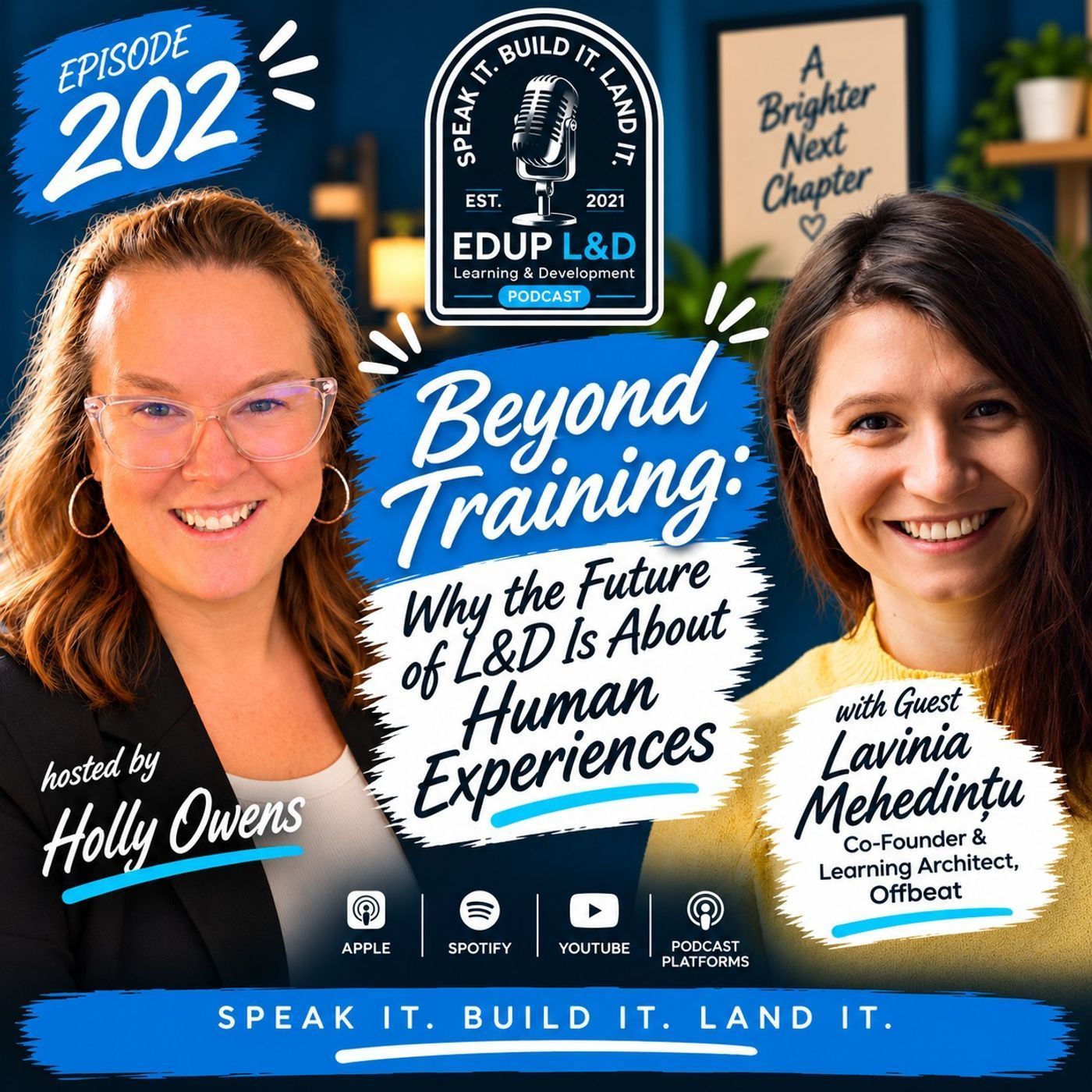
What if the future of learning and development isn't about creating more content, but about creating better experiences?
In this episode of EdUp L&D, Holly Owens talks with Lavinia Mehedințu, Co-Founder and Learning Architect at Offbeat, about rethinking traditional approaches to learning and development, embracing experimentation, and finding the human connection in an increasingly AI-driven world.
Lavinia shares how a failed collaboration training initiative changed the way she thinks about solving organizational problems and why learning and development professionals need to look beyond training as the default solution. She also discusses her new book, L&D Rewired: How Learning and Development Professionals Are Breaking Their Own Rules to Stay Relevant, and why the future of our field is being shaped by the experiments we're making today.
In this episode, we explore:
- Why organizational challenges don't always require a training solution.
- How to use data to evaluate whether learning initiatives are actually making a difference.
- Why learning should be an experience focused on emotion, connection, and community—not just content.
- How AI is expanding the L&D toolbox and making good judgment even more important.
- Why instructional designers need to keep accessibility and learner experience at the center of what they build.
- What human skills like facilitation, emotional connection, and systems thinking mean in an AI-driven workplace.
- How communities can help L&D professionals find inspiration and courage to experiment.
- Why looking outside traditional L&D disciplines can help us become better learning professionals.
Explore Offbeat: [Offbeat Website]
Get the Book: L&D Rewired: How Learning and Development Professionals Are Breaking Their Own Rules to Stay Relevant
Connect With UsFollow Holly on LinkedIn: https://www.linkedin.com/in/hollyowens/
Watch EdUp L&D on YouTube: https://www.youtube.com/@EdUPLND
Subscribe to the newsletter: It’s Not Just One Thing in L&D
Follow on TikTok: @ihollyo https://www.tiktok.com/@ihollyo
Connect with Holly: Schedule a conversation https://calendly.com/holly_owens
Thanks for subscribing, listening, and supporting EdUp L&D!
Thanks for tuning in! 🎧
Holly Owens: Hello everyone, and welcome to the EdUp Learning and Development Podcast. My name is Holly Owens, and I'm the host of this show, but I'm also a higher education professor, instructional designer, entrepreneur, and a proud helper of humans. I've worked in the L&D space for almost 20 years, and I'm here to share what I know, what I'm learning, and what's happening in our industry. We'll talk about instructional design, L&D AI, technology, careers, and the humans behind it all. Along the way, I'll bring in some friends to share their stories, experiences, and expertise too. Because at the end of the day, L&D is all about humans helping other humans. This is EdUp L&D. Hello everyone and welcome to another amazing episode of Ed Up L D. I am so gracious and so excited for the guests that we have today. I was recommended to this guest by one of our close friends, Nicole. So shout out to Nicole for recommending this guest. So I want to welcome to the show Lavinia and I'm gonna say this right, Mehedintu Did I no I said it wrong. I said it good. Okay.
Lavinia: No no no it f it was okay, yeah.
Holly Owens: Yay. Yay. So and she is the co-founder and learning architect of Offbeat. If you don't know about Off Beat, you're gonna learn all about now. And she has a new book out. So we're gonna learn all the s things. Lavinia, welcome to the show.
Lavinia: Thank you so much for for having me, Holly, and thanks to Nicole for recommending me. I listened to her episode as well in in preparation for for this episode. so yeah, thank you. Thank you so much for having me. It's a pleasure.
Holly Owens: Well, I'm so excited to get into I've been LinkedIn stalking Off Beat and all the things that you're doing. But I'm excited to share Off Beat and your new book with the audience. So before we get into all that, tell us a little bit about yourself, your journey, what how you came to be the co founder of Off Beat and all those different things. We want to learn more about you.
Lavinia: Perfect. Yeah, for sure. So about the name, it's always like w what's with the name? I'm from Romania, I'm from Bucharest, Romania, so that's why the the name is a bit more complicated to to pronounce. so I my background is in HR and and L and D. So I started first in some general HR roles, like so many people do, I guess. And
Holly Owens: Yeah.
Lavinia: then transitioned into into L and D, which I love and didn't ever leave again. I think it's
Holly Owens: Ha
Lavinia: it's so many it it's so many people's stories. but I guess the most most interesting part is that in 2020 I started posting on LinkedIn, which I I wasn't necessarily used to do. It was right when the pandemic started. I was sharing a few resources with with my network which was very small at the time. And then someone said, Why don't you turn this into a newsletter? I would really like to receive these resources in my inbox. And then, I was like,
Holly Owens: Right. Yeah. That makes sense.
Lavinia: Yeah, sure, I'm I'm gonna do it. And I had no idea what I was getting myself into. And I guess, I was thinking about your podcast, it has so many episodes, and I guess the level of consistency you need to, put things out
Holly Owens: Absolutely.
Lavinia: there on a monthly, weekly basis, so yeah.
Holly Owens: It takes so much motivation to get yourself jazzed up to post on LinkedIn and talk to people and all that. But once you start doing it, you're like, I really, really just love this aspect of it.
Lavinia: Talking to people is also my my favorite part. Writing it's debatable still. But yeah, that's how that's how Offbeat started. I called it offbeat because I I wanted to talk about the off-beaten paths of L and Dings that we should learn that maybe are not necessarily traditionally in the L and D discipline. And
Holly Owens: Right.
Lavinia: then it grew limbs, and now we have live events hosted with volunteers all over the world, including in the US. We've had New York, I think it was last week. We had Seattle, we're gonna have Washington DC as well next year. So
Holly Owens: Nice.
Lavinia: yeah it th those events are free for for L and D's to attend and and come together as a community. We have our online membership, we have conferences here in Europe in in London and Bucharest. And now we also have a book because you mentioned it, we we also have a book. Yeah.
Holly Owens: Yeah. I'm gonna mention all the wonderful things you do because you seem like the type of person you're like you're very humble and you're not gonna say all the great things you're doing, but I'm gonna I'm gonna spotlight you and make you the star of all this stuff because I I love what you're doing and what Nicole was talking to me about. I'm like, she's like, you're gonna love her. And I was like, I started reading your your posts and I started reading offbeat and was like, my gosh, I can't wait to have her on this episode to talk about all the things. I think it's really interesting that you start an HR because sometimes learning and development departments fall in the HR division because they do a lot of the training and a lot of the workshops and things for staff. Not necessarily maybe like the faculty if you're in higher education, but I think that's a really cool place to have a learning and development department is in HR. And I think it fits nicely there for sure.
Lavinia: Mm-hmm. Yeah. Yeah, for sure. what's also interesting, I'm interesting. I'm not sure exactly if it's the same case in the US, but here in Europe, specifically where I'm from, I can say that it's pretty hard to get into L D like in a junior role, you know, like with with little experience. Yeah, yeah. So
Holly Owens: Yeah. Same Z. Yeah. Yeah. It's really difficult. It's really difficult. And I'm I'm I'm not like you're saying it's the same. Like the jobs that are listed on the market say entry level, but they say two to five years of experience. That's not entry level, folks. That's like more like end
Lavinia: Yeah.
Holly Owens: end of entry to going towards the mid range. So I I think it there's something to be said in what you're talking about that there needs to be more true entry level roles and we need to mentor people to come into this space.
Lavinia: Yeah, yeah, exactly. So that's how somehow I found my path through HR, which I still think it it's a it's a good path to have to learn some things beforehand. Basically the the fact that I knew the business relatively well at that point made
Holly Owens: Yeah.
Lavinia: it easy for me to transition into L and D.
Holly Owens: Absolutely, for sure. So tell us a little bit about if you're thinking about the world of work or learning and and since you've done so much over the years, when you look at these areas, specifically with L and D, what made you like kind of think or look at and be like, there has to be a better way to do this? Can you talk to us about that a little bit? There, you know, all the time I see different things and I'm like, I'm questioned 'cause I have that L and D mind. I'm like, why did they set up this training this way? Or why did they do this process this way? So what's something for you or you had a a problem? there's gotta be a better way to do this.
Lavinia: Yeah, I have it's interesting because I have a very specific story. I think it it's the moment that my my world went a bit upside down when it comes to L and D. Because when I when I first joined the team, we were doing a lot of training, like a lot, a lot, a lot of training. And one of the problems that were put on our table, and it came from different sources. First of all, our engagement survey showed that. collaboration wasn't very good between departments and in inside teams. And then when we were doing
Holly Owens: Yeah, lots of silos.
Lavinia: lots of silos. Yeah, it's pretty common, I have to say. I thought it was just us. It it's definitely not. Yeah.
Holly Owens: Yeah. No, it's very common here too.
Lavinia: And then, you know, when we were doing our needs analysis, managers were also pointing out that they they have issues around collaboration. So we said, okay, maybe
Holly Owens: Wow.
Lavinia: we need to treat this more seriously to invest a bit more in this. And
Holly Owens: Yeah.
Lavinia: what we did was pretty looking back now, it's pr pretty traditional. So we looked in the market, we found this strength deployment inventory survey. basically people would take a survey and and they would see what are their collaboration preferences and it's I I wouldn't say it's similar necessarily to this, but it it falls under a very similar category to to disk and and other such such surveys. And as a follow-up, people would get workshops, right? And we ran that for around a year and a half. And it was like workshop over workshop with lots and lots of teams. And then when I got a new manager, she came from the people analytics department, and of course she Asked us to look at the data. what is the data
Holly Owens: Yeah.
Lavinia: saying? Did collaboration improve? it's been a year and a half since we've been doing this. Can we see any changes? And the answer was no. So
Holly Owens: my gosh.
Lavinia: it was like, okay, there something's wrong in how we approach this. Is there another way to do it?
Holly Owens: Yeah. I working a year and a half and then the data saying nothing changed, that would be like Off putting to me a bit. It's like figuring out my gosh. But I'm glad she came in and kind of gave you that perspective to take a look at the data. So what did you do like after that, after you started like collecting the data and finding out that things weren't working? Did you change like how you shift did you like shift or what happened?
Lavinia: We scraped the the entire program. So we
Holly Owens: You started over.
Lavinia: you know, it it's interesting because there was there was a big budget involved in in running those things as well. Like in running those workshops, we were paying for, you know, the survey and then quite a few people in our team were running workshops. So a lot of our time was invested in this. So it yeah, it it was so Such a profound question. We just said, okay, it it seems like it's not working, we're gonna stop doing it. and and then it's it's so interesting because in thinking and analyzing why collaboration wasn't working, we realized that it had nothing to do with learning. And maybe that's one thing that I kept with me over time, the fact that a gap
Holly Owens: Mm-hmm.
Lavinia: that we're seeing in the organization. and that we might quickly try to fix with training actually has nothing to do with the with the skills gap.
Holly Owens: Yeah. I always think people have a misconception and learning and development that it needs training when it could be something like a job aid or something simple or it might be something that's changed management and somebody else needs to be involved in that process. But I think when training or something becomes a checklist item, people don't value it as much as they would if it was it was more meaningful to them and their work and they were connected with it. and maybe they might get a micro credential or something like that. But when it's just like you like the trainings we have to take every year, here in the States, I don't know if over where at the sexual harassment training, the don't
Lavinia: Yeah.
Holly Owens: don't click on weird links, email,
Lavinia: Yeah.
Holly Owens: all that stuff. It's like it's ex it's interesting 'cause when I look at it, it's the same exact training. Maybe it has a few tweaks. Every now and again, but it's the
Lavinia: Mm-hmm.
Holly Owens: same exact stuff, and I'm like, this is just a checklist item. So, what am I really trying to accomplish here? What is the learner taking away from this? all they're doing is just, and my husband tells me he does this all the time when he does e-learnings for his work, he just clicks stir to get done, and I'm like, that's not learning. That's like the opposite
Lavinia: Yeah yeah yeah yeah.
Holly Owens: of what we're trying to do here.
Lavinia: Yep, yep. And now, you know, because we have AI, at least engineers, my husband is is an engineer and they just like develop these agents that just click for them. They they don't even click anymore, you know?
Holly Owens: I know, isn't it crazy? And people applying for jobs, they have these sites that just apply for them. And I'm like, I
Lavinia: Yeah.
Holly Owens: wouldn't first of all, I love AI and I incorporate it into a lot of different things I do, but I am one hundred percent not letting AI apply for a job for me. I'm that's kind of where I draw the line right now. I don't think it's
Lavinia: Yeah. Mm-hmm.
Holly Owens: sophisticated enough. And like some of
Lavinia: Mm-hmm.
Holly Owens: these applications too, they require you to say you're human. So how does it get past that part? but yeah. it's just like when he says he's just clicking through, I'm like, my I start to cringe and I'm like, I this as an instructional designer, I can't I can't this bothers me. Like, and then I say, Okay, who's in your L and D department? I need to talk to them. He's like, I don't I don't know. I have no idea. So but yeah, those kinds of
Lavinia: Yeah.
Holly Owens: things, it's important to always question, and I always come back to Kathy Morbes map it, does this really need to be training? Does this really need to be training? And you have to question those things because the SMEs and things will come in and they'll be like, Well, I just want a 20 minute e-learning and that's that's that. And okay, so who are we training? What's the purpose? How are we backward designing? What's the goal? like I said, it becomes a checklist item. I'm sure we could talk about this all day. I definitely could.
Lavinia: Forever.
Holly Owens: But I I do think it is changing and shifting because of AI. And I think it's people I I hope this is what I'm seeing is people are looking to be more creative and maybe doing some vibe coding and building different things and learning experiences. I know myself recently I've been doing some vibe coding and kind of figuring out how like where is there a gap in my heart's in higher education. So I love, you know, post secondary education. where is there something I could fix something? and I think people are starting to think more along those lines.
Lavinia: Yeah, for sure. I see it's so interesting though. I I d there are two thoughts that that came to mind because it does feel like with AI our toolbox of of solution is definitely expanding. So we don't
Holly Owens: Yeah.
Lavinia: necessarily we we don't go to training first anymore. I wonder if we we should go to AI first, you know, it's like are we slipping into into another era that
Holly Owens: Yeah.
Lavinia: and we're gonna push it too far? No.
Holly Owens: Yeah, yeah. The balance. Like the balance. We have to
Lavinia: That's on my mind. Mm-hmm.
Holly Owens: find the balance. And I think that's you're right, that's what people are looking for right now. Yeah.
Lavinia: Yeah, yeah. And and the second thought I I have is that because with AI building becomes so so easy right now, and so many people say this, I think the judgment of what needs to be built and understanding the problem we're solving for is becoming even more important because just putting things out there and I've I talked to so many L and D teams and they were so excited, you know. creating these chatbots for onboarding, for performance management, for all sorts of use cases, and then realizing that there's real work in main maintaining whatever products, learning products you build, in marketing
Holly Owens: Right.
Lavinia: them and making sure that people actually use them. So yeah, I think there's always a balance that we need to achieve.
Holly Owens: Yeah, definitely. One of the things I love to do now is to create learn interactive learning experiences and then put them in the LMS.
Lavinia: Mm.
Holly Owens: And I do that with Claude, but I'm noticing something,
Lavinia: Mm-hmm.
Holly Owens: and this this kind of makes me, you know, think a little bit about what I'm doing when I'm building the interactive or the experience. Cause I I think learning now should be an experience. It we have
Lavinia: Mm.
Holly Owens: the tools and we have the capability to make it an experience. We have the capability to make it accessible, personalized, all those different things. so I'm building something and say like I'm putting it in Canvas and Canvas has a great accessibility checker. And I noticed that when I'm coding and putting the code into Canvas, like the accessibility checker, it it goes Off, like the alert goes Off. I'm like,
Lavinia: Mm-hmm, mm-hmm.
Holly Owens: hmm. So that's that's another reason too. Like you can build these great things, but you also have to be sure that you are checking it and making sure it is
Lavinia: Yeah.
Holly Owens: accessible, making sure that you're the learner is experiencing actually what you want them to experience. it's fast to build it, but you're gonna have to
Lavinia: Yeah.
Holly Owens: continue to iterate on it. So it gets to the point where it meets expectations.
Lavinia: Yeah. Yeah. For sure, for sure. And I love I love your point about learning being an experience. I think honestly, I think that's the edge that L and D professionals can have, or one of them, in a future that's dominated by AI. and and to why why I think that when I think about experiences, and I've learned this from others who are way smarter than myself. The focus is less on content and more on the emotion that people have when they're learning and the connection that we facilitate among them. And you know, it's it was so interesting to me to like understand a bit how L and D kind of professionalized itself. And it makes sense, you know, we're we're part of like corporate L and D, we want to be very serious, but it seems like we forgot.
Holly Owens: Ha ha
Lavinia: that learning is not just a transactional process, it's also a very emotional process. And it it feels like we're not addressing this enough and we can definitely do so.
Holly Owens: Yeah, and I think that's why some trainings like that ultimately they fail is because people are making
Lavinia: Mm.
Holly Owens: them transaction or people like I was just talking about those yearly things and people are like grunt and moan and like just my husband, just click through it. And I think we're really just doing a disservice to our learners, whether that's in K to twelve, higher education, adult learners, like I always think about things like when I'm thinking about an experience, I think about what Disney does. how do they make an experience where they get people
Lavinia: Mm, mm.
Holly Owens: addicted and they want more and they're
Lavinia: Mm-hmm.
Holly Owens: connecting, not addicted in the bad sense. Some people say like an addiction is a bad thing, but it's not. But it leaves
Lavinia: Mm-hmm.
Holly Owens: them wanting more, but also makes them feel
Lavinia: Mm-hmm.
Holly Owens: very connected. And they've built communities of people through this. So just thinking about those
Lavinia: Yeah, yeah.
Holly Owens: things and learning can go there. We can do that.
Lavinia: Mm-hmm. Mm-hmm. Yeah, have you read by any chance the experience economy?
Holly Owens: No, I need to though.
Lavinia: You'll love it. I'm telling you, you'll love it. You gave the Disney example, so I know you're gonna love it. And it it has so many parallels to
Holly Owens: Yeah.
Lavinia: L and D and how we should be progressing. You're gonna love it.
Holly Owens: Okay, I'm putting that on my list. Thank you. Speaking of books,
Lavinia: Of course.
Holly Owens: me and you could talk about this stuff all day. I know we can, but I wanted you to talk about your book that you just came out with recently. It's called L D Rewired: How Learning and Development Professionals Are Breaking Their Own Rules to Stay Relevant. Talk to us about the book. Tell us like I did you ever
Lavinia: Yeah, yeah, yeah.
Holly Owens: first of all. When people like I wanna write a book too, but did you ever think you're gonna write a book in your life? You're like, maybe Yes.
Lavinia: I when you make those bucket lists. W at one point early in my relationship with my husband, we made a bucket list and we wrote down writing a book. I never thought I'm gonna do it. I was like, What am I gonna write a book on? Come on. And
Holly Owens: Like this is never gonna happen. Right.
Lavinia: then yeah, it it it happened. It was a a very interesting process. I could talk about that. Quite a lot as well. But I think there were two things that kind of came together for me to finally decide to write it. I think we I I was getting quite a few questions and we were having so many conversations about what does the future of L and D look like, given you know
Holly Owens: Mm-hmm.
Lavinia: how many things AI can do at the moment. And I was also getting quite a few answers from from the community. that's like one thing, and then it felt like after six years of running Off bit almost seven now, I did a lot of empirical research. It wasn't my intention, but I I had so many case
Holly Owens: Right.
Lavinia: studies and and I I had so many newsletter issues and it just felt like okay I could put them all in in one one place. So that's how I ended up writing the book. And it is about it it is about the future of L and D. It's also about the present of L and D because Something that I've learned while while writing it is that while we are waiting for answers from others to tell us what the future will look like, in reality the future is written right now by the small
Holly Owens: Yeah.
Lavinia: experiments that people are doing. So I wanted to showcase those experiments in in the hopes that people will get some inspiration on what they can they can apply as well.
Holly Owens: Yes. And I think that's so important that you mentioned the future is right now for us. w I don't like the like what you're saying, like like we wait to see what other people are gonna do, but the innovators like ourselves, we want to innovate right now and we want things to to happen right now. Like especially with AI and the the different tools and things that we have access to. Like instead of waiting for somebody to say like this is you know, the Elon Musk and the Bill Gates of the world saying like what the future is. And,
Lavinia: Mm.
Holly Owens: I'm not gonna go into when they talk about AI is gonna be our demise, that kind of stuff. I don't necessarily believe that. but I think it's important that people understand that this is not going away. And especially those of us in the L and D sector, that we need to embrace it. And I can tell you for the longest time, when I learned about chat. One of my friends texted me back in twenty twenty two when it first came out. It was two days in, and he said, Check this out. And I was like, my God. I was like, What is this? This is crazy.
Lavinia: Yeah.
Holly Owens: it wasn't as sophisticated then as it is now. And then then it was getting to acquaint myself with chat and using chat. And then they're like, There's Claude and there's co there's Claude Co-work and there's Gemini and there's Copilot. And I'm like, my gosh. So it took me a minute to go from
Lavinia: Mm-hmm.
Holly Owens: even though I love technology, go from chat to Claude and all the different ones and exploring them.
Lavinia: Yeah, yeah, yeah.
Holly Owens: So
Lavinia: Yeah, yeah, I totally I I feel you and I also stuck with with a chat for a long time and then Claude became so much better and yeah, yeah, yeah, yeah for sure.
Holly Owens: I was like, it knows me. Yes. Like you use it's kind of like the tools we use in learning development. They they have different strengths and different weaknesses. So Claude is great for like building stuff and like I said, co-working and coding, all those different things, refining it. I feel like it does a better job refining stuff. Like for me,
Lavinia: Mm-hmm.
Holly Owens: chat is a the purpose it serves is it takes the words that I want to say and it makes it sound logical.
Lavinia: Mm.
Holly Owens: And it makes it sound it makes it sound better. it it does,
Lavinia: Mm-hmm.
Holly Owens: stay with the theming of what I'm trying to say. But sometimes I'm like looking at old LinkedIn postings, pre-AI, I was like, phew. And it sometimes it took me forever to write some of those postings. And I'm like, these aren't really good. They need to be refined.
Lavinia: Yeah. Yeah, for sure. You know, and what was interesting for me when when thinking about the book was that we hear quite a lot about the fact that AI saves time. Like that's one of the promises of AI. And then the the the other side of the question is okay, what are we gonna spend this all all this saved time on in in the future? Are we just gonna lay around? Probably part of it will be spent laying around. I have no problem with that. But then there are some things that we might be doing as humans that the AI cannot do or yet, I'm
Holly Owens: Emotion.
Lavinia: not sure if it will and emotion is definitely one of them and systemic thinking and facilitation and there there are so many things that that we can spend our time on and I I wanted to put a light like put a light on Those as well.
Holly Owens: Yeah, well everything about offbeat and your book is gonna be in the show notes of this episode. So people go get it. Go get it. All
Lavinia: Thank you.
Holly Owens: right. So my next question for you is when you think about the future of work and or learning, what gives you hope? What what kind of hope comes from thinking about the future? Or the future's now or what's happening? I'm just r I'm ready to see like in the next even two years what it's gonna look like. So what gives you hope?
Lavinia: my god, that's that's such a deep question.
Holly Owens: I know.
Lavinia: I would say maybe just going back, I think this episode will have a thread about experiences. I think I I I can see people going back to experiences. I can see this new generation that that's joining the workplace or has been joining the workplace for a couple of years now, going back to some of the things that Bring us joy because we maybe okay, technology is amazing and we're gonna use it to do our jobs better, but at the same time finding ourselves in experiences, I think it's so important and reconnecting a bit with our humanity. I think we need a lot of intention to do that as
Holly Owens: Yeah.
Lavinia: well. But I know that if we do that, if we go back to connecting with each other, if we go back to feeling things powerfully. I think that that's amazing. And for me is like and I think I w I read that about art, because okay, like Chad G PD and Claude can do you know, make mimic human art, but that
Holly Owens: Right.
Lavinia: makes human art premium, you know, so human experiences will be the premium and it's it's both about the workplace and and about learning and about life if you if you ask me.
Holly Owens: Yes, I agree with you 100%. So yeah, I'm excited about that future too. And making I think AI is put potentially forcing us to be more connected to each other. Which like you we started
Lavinia: Mm-hmm. Mm-hmm.
Holly Owens: at the top of this episode talking about silos. And now we're talking
Lavinia: Mm-hmm.
Holly Owens: about like I'm a part of the there's an event going on this week with She Builds by Lovable. And I'm building
Lavinia: Mm.
Holly Owens: something you get access lovable and you're building your an idea, an app or whatever you want to do. And I love that it's connecting women in this space. And w there's so many different ideas that we're coming up with that are problems we want to solve. I think somebody wanted to build an app that talked about the differences, simple things like between Medicare, Medicaid things that we have in the United States, like health insurance plans.
Lavinia: Mm. Mm-hmm.
Holly Owens: somebody else is building something that I think she was doing menus at different restaurants and locally in her area and her friends were like inputting it's just it's just cool stuff. you you know, that and we can do this now. Like I think a barrier before was coding. Like I was like, my god, how am I ever gonna learn how to
Lavinia: Mm mm.
Holly Owens: code? And I have a really good friend, Collier, and he's he's been a coder forever and he's like, Yeah, now I put my stuff in to AI and it it helps me find the bugs and all that stuff, but That that this kind of stuff and what you're talking about really it gives me hope too. So,
Lavinia: Mm-hmm.
Holly Owens: believe it or not, we are coming up on the the end of the episode. It has been so much fun talking to you, and I could talk about this
Lavinia: Yeah.
Holly Owens: forever. So I have two final questions for you that I want you to respond to. The first is there anything else that you'd like to share? And you're definitely coming back, Luminia. Anything else you like to share, tell the audience. And then I like to leave the person listening with could you share three pieces of advice, resources besides offbeat, where it's because we're gonna have that in the show notes
Lavinia: Yeah.
Holly Owens: that will help people as they navigate an L and D. So, you know, anything else you'd like to share and three pieces of advice andor resources that will help them navigate this space.
Lavinia: Yeah, I think I I can somehow answer both of them in in one. I think community
Holly Owens: Perfect.
Lavinia: because we were we were talking about people connecting and she builds and they they are actually building a community of women who are vibe coding. I think community is becoming so so important. First of all because it it inspires us, but I think there's also something to be said about courage. Because I feel like L and D right now is at this moment where we need to embrace things that are quite new for us and to step outside of these traditional boundaries does require quite a lot of courage. And I think courage can be built in community. I think
Holly Owens: Yeah. Yeah.
Lavinia: and I think Brennan Brown was saying this in I think it was there to lead that courage is contagious. So we need community too, and we need to come together to gain inspiration and courage. So if there if if I would have one advice and or three, I I will think of three more as well.
Holly Owens: Yeah.
Lavinia: for people, it would be to join communities, to to come together with with others. And there there's a really a really good community and it's also worldwide. It started here in in Europe, in the Netherlands. It's called L and D shakers. and people love it. So I would definitely recommend everyone to To join it as well. And then the other thing that I would recommend is again going outside of your boundaries, looking at things that are not LED related, learning about systems thinking, learning about behavioral science, experience design, marketing, product management. I think there's so much that we can learn when we like cross-pollinate different in different disciplines.
Holly Owens: Yeah.
Lavinia: It and it's it's amazing. We're learners in L and D, so I think that that comes natural to us and it's it's an amazing source of growth.
Holly Owens: I 100% agree. Like joining the communities, there's no like everybody it's sometimes my brain like needs it like structured, but it it really doesn't need to be. You just need to be like a part of something. And I'm just gonna say this. We've never met in person. We didn't know each other, but through a community, because I knew Nicole, we have now met. And listening to
Lavinia: Yeah. Yeah.
Holly Owens: this podcast episode, I know people are gonna think we probably talked before, but this is the first time. we've ever talked. So the opportunity and it's global. You're you're connecting with somebody else in the States. I'm connecting with you. Like the community is global. It's not just within our borders now. It's everywhere. So that's great that's great advice. That's great advice. Well
Lavinia: Thank you, thank you so much.
Holly Owens: thank you so much, Louina, for coming on the show, sharing your experiences. Nerding out with me about learning and development, sharing about your book. Like I said, everything is gonna be on the show in the show notes for where to connect with you, find your book. I'm gonna definitely put L and D. Shakers in there as well and go join myself. So I can't thank you enough for your time. I really, really appreciate it.
Lavinia: Thank you so so much for having gain with having me. It's been lovely. Honestly, I was a bit nervous because it was the first time we we met, but this
Holly Owens: Yeah.
Lavinia: went like 30 almost 35 minutes went by in in so quickly. So thank
Holly Owens: I know I knew it was. I knew
Lavinia: you so so much.
Holly Owens: Well, that's a wrap on this episode of EdUp Learning and Development. A huge thank you to our guests for joining me and sharing their experiences, insights, and expertise. Be sure to check out more great episodes at eduplnd.com Until next time, keep learning, keep sharing, and keep helping other humans. Speak it, build it, land it. See you next episode.