

 Apple Podcasts

 Spotify

 Amazon Music

 iHeartRadio

 Pandora

 Castro

 RSS Feed

 Audible
Overview
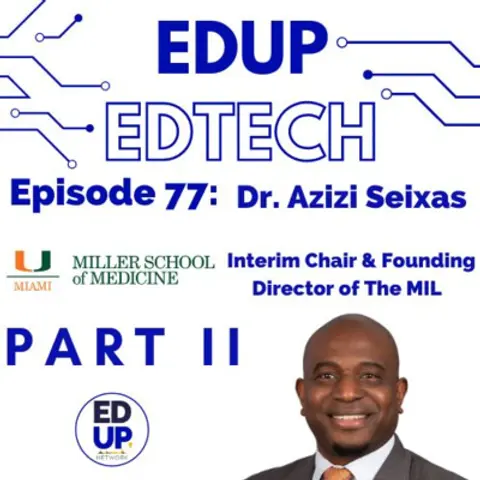
In the second part of this two-part episode, Dr. Seixas and I talk about the future of tech and how we're going to be bold and strive for excellence. Enjoy the second part of this episode.
More About Dr. Azizi Seixas in his own words
Innovator. Scientist. Thought leader. Technologist. Sleep and Circadian Sciences expert. Creator of Precision and Personalized Population Health. Voted top 100 most inspiring Black Scientists in America by Cell Press. I believe in health and wellness for all through disruptive and scalable innovation.
How to Connect Connect with Dr. Seixas on LinkedIn & Follow The MIL on Social Media LinkedIn | Facebook | Instagram | YouTube | Twitter
____________________________
Connect with the host: Holly Owens
Audio editor: Daniel Stein
EdUp EdTech - We make EdTech Your Business!
Thanks for tuning in!
Thanks for joining us on today’s episode of EdUp EdTech! If you enjoyed today’s episode, please head to our website and leave us a rate and review to help us reach even more fantastic audience members like you. Don’t forget to check out our website, visit us on LinkedIn, or hang out with us on Facebook or Instagram to stay up-to-date on the latest EdTech happenings.
Thanks for tuning in! 🎧
0:01 Hello, my name is Holly Owens and welcome to Ed up edtech the podcast that keeps you. In the know about all the latest edtech happenings. We interview guests from around the globe to give you deeper insights into the Ed tech industry, the field of instructional design, and more, we're proudly a part of America's leading podcast Network the Ed up, experience. It's time to sit back and enjoy. Enjoy the latest episode of Ed up attack.
0:41 Welcome to part 2 of the episode with dr. Seiches founding director of The Mill. And this part of the episode. We talk about things that have to do with the future, enjoy. We're not just doing it alone. We're not beating our chest saying that we have got it. Figured out what we are saying is that we're going to be bored about striving for more that we cannot just think of this as business as usual and just operate as if we're trying to satisfy the lowest common denominator.
1:24 No, we need to strive, we need to find ways in which we can find Benchmark. Whereby we Strive for excellence. But if Excellence that that is not just a boat. Hey, look at what we're doing because smart we are but it's look at what we're doing for others and to me that's that's the greatest thing its service. And to me that's what we're focused on is why we're Unapologetic a boat we recognize that there is this common denominator that you need to bring people into hock to hospitals and Healthcare. Skin. But particularly for us at the University of Miami, we are situated in a very important historically, important community in the entire United States all over tone.
2:17 It's one of the first predominantly black neighborhoods in Florida and in the United States. But unfortunately based on years of policies, bad policies on the light that there have been disinvestment. I'm so for me, as one of the leaders, at the University of Miami, and I know this is shared by our Dean on others is, we can't just be in that Community. We have to be for the community with the community, right? And so, how do we do that? We can't just do it through lip service. We have to be doing it similar to how technologists build Solutions human-centered design. How do we create programs that our community? Enter designed individually based design. And that's what we're trying to do. That's our Holy Grail of innovation and technology. So if it only works for a few then, okay, let's find a way how it can work for more people.
3:15 Yeah, 100%. That's that's fantastic. I'm sure within all these pillars, you have a lot of different projects that are going on right now. Is there anything that you have that you can share and talk about for the upcoming year? Yeah, thank you. Thank you so much. Things of what you're doing? What are your goals? Yeah. And the roadmap that I'm about to share, it's really more of an invitation to your audience. As I said, we were very humble. Oh, we're bullish about it. But we're also very humble, we can't do it by ourselves. And this is an invitation for people to join this movement. Let's turn this moment into a movement. So for example, education we are galvanizing about 30 to 40 different startup and technology companies where we're to be having apprenticeships for, or students. So my request is many of the innovators on Founders and leaders out there, come talk to us because we believe that the next MDS and scientists will be Chief technology officers are going to be the chief medical officers or if not Founders, help us to train these fools.
4:23 Help them help us to build old on ecosystem, where it's not just technology train, folks, who are part of the development of Looks with everyone, so that's education. So we're really not that program. So we're very excited about that. In terms of research, we have several studies from rolling out our Mill. The mill boxes are remote, Health, monitoring solution with 1,500 participants, African-American black individuals and Latinos in rural, and urban areas because we got to have to get rid of this urban-rural divide as well. And we're providing this remote Health monitoring solution collecting data over a seven day period. And creating digital twins working with companies like Amazon on this project.
5:08 This is critical that you mention that because I work in a Pharmacy Watson, here you go. So they did. So we got to connect because that's one of the things that I know some of those folks there as well too. But I think this is weird. We have to provide this wraparound supports and I know big tech companies like on Amazon. They've tried to get into health care and haven't done so successfully. It's not too bad, you know, it's not your fault. It's not Amazon spoil because Amazon, the DNA of Amazon is not to take care of patients. That's our job, but if we partner together, where we amplify our respective strengths and that's where we have something special, right?
5:49 And so that's kind of one ear that we're working on. Plus, we're really not some really nice projects that provide maternal mental health, to Mom's you in a particular. Black-on-brown, mom's using VR working with a company called Behavior doing that type of work as well as some other companies. I don't want to leave anyone out and really trying to find some new digital biomarkers as well too. And making Healthcare more frictionless contact list and dare I say deviceless. And so that's kind of what we're aiming for and really building on our digital therapeutic. We want the my vision is we want the University of Miami to be one of the first digital Therapeutic Health assistance, It doesn't mean we're getting rid of doctors.
6:34 It just means that many of us as clinicians. And my friends who are currently seeing patients, they want to be there for their patience beyond the 15 minutes that they get with them. So maybe we can build digital Solutions and Therapeutics to provide this wrap around 24/7 support for patients, right? When patients need us and this is, you know, can be asynchronous or synchronous or on-demand whatever. / modality, we want to choose. That's what we're trying to build out as well. And and in terms of service, I know Reach digital literacy program, and we're very bullish about. It were about to finalize a partnership.
7:16 We've built our own digital literacy program, but I know others have been doing this and, you know, there is one company that has been doing some good work. We want to ensure that any patient anyone who comes through our hospital system. They get the digital literacy training that many we can't expect our assume lets people know how to log on and sign up for a username and password. Now we got to train them, we got to have to educate and provide support. So even at that Elemental level, that's where we can help to demystify and destigmatize data, you know, data and Technology as well and how can we make it more private? I think regards to digital twins. That's all we want to focus on Precision medicine and And I want it too much.
8:03 I don't want to take my hat too much. But what we're trying to build a roadmap of how we can make Healthcare more personalized through the use of digital Solutions. I can't wait I can't wait either I'm so looking forward to that because I'll tell you my grandparents are still living and they have navigating all these patient portals for every single doctor I know like oh my gosh and 40 year olds that's hard. It's hard for me. Well, that's was about to say, I was like mean, it's tough for anyone? Yeah, because we lead busy lives, like, who has the time like, people have to realize, and I said this all the time.
8:44 I said it's to our team, especially, when we're recruiting, participants to studies or seen patients, like no one wakes up. Thank saying I want to be part of a research study so how can we make it inviting? But how can we make sure people realize that they are the most important? A lot of research studies without them. There is no Legacy. There are no findings. They are literally helping to change the trajectory of our histories by participate in my studies. And it's not hyperbolic, but this is what we believe and that's what we try and share. And that's what we not, try, but we share with participants. Like they are literally changing the trajectory of our histories by participating because their data will help us to understand how to cure cancer. So no help.
9:32 How to cure heart disease to help to cure demential, how to tackle mental in? Exactly, yeah. Yeah, so we got to have to make it community and a partnership and I know others are doing excellent work as I said we're not the only ones doing this. I think what we are very proud of this whole comprehensive, we want to do it. It stopped our team works extremely hard because it's a very ambitious vision and plan but it's not a plan that we know. Or we believe that only the mill can actually satisfy an accomplished. We need an army. We Need a village. We need an entire ecosystem. Everyone needs to get their proverbial hands dirty. Yes, agreed.
10:20 Oh my goodness. All right, we're coming up on the end of the episode means you have to come back on the show. I'm right. Well you know where to reach me holly? Yes absolutely. So final questions. Is there anything else you'd like to share anything that we missed? And then I want to know, what does the future of Ed Tech? Look like tell us anything. We missed. Yeah. So I'll just take the laptop I think the future when I discuss the future I'll talk about some other things that were currently doing so or group not just our group, but University of Miami's part of a large group of schools throughout the entire United States that are leading this fantastic initiative. That the National Institutes of Health has pushed its called. Am ahead.
11:06 The goal of a my head is to tackle Health disparities and to achieve Health Equity and it is doing so by way of including and seeing how they I machine learning Big Data. Can help us to better understand Health disparities, and to find solutions that can achieve Equity. What we have done is that we have started out trying to build a regional Network. It just in Florida, that doesn't mean that we're only focus on Florida but this is open to the entire United States, by the way. But what we are doing here at the University of Miami's that we have partnered with few institutions that are minority serving institutions, hbcus historically, black college and university. First, it is Hispanic serving institutions and tribal colleges.
11:56 And essentially, our vision is this. If we want representative data to, for research purposes, and to improve our clinical operations that large academic institutions are not necessarily all the time. At the front lines of tackling Health, disparities for a wide, variety of different reasons. I don't want to get in trouble. The quantity is the point is the folks who are at the front Lines are community-based clinics federally qualified Health Centers, urgent, cares. And many of these places are in impoverished under resource locations. So, here's the vision that we we said, what if we partner with an academic institution that's in those communities, where Health disparities are high, we build up the research AR machine learning infrastructure of those institutions either be in terms of research or clinical care. And Like and then in a hub-and-spoke model they then get to train and he'll the local clinics. So here is it know that the reason why people come to our University of Miami or a Harvard, or an NYU, or a USC is because of all the superb talent that they have in terms of clinicians and the like, which is just the infrastructure that you can do.
13:15 Several Imaging on it, you can get the results in no time. You can do blood work on the results. Come back in no time. You don't have Have that in local community-based clinics and that's what in many ways, from a Health Service perspective. That's what drives Health disparities. So what if we build infrastructures eliminating excess issues, eliminating smallness in processes in these settings whereby we can provide may be as good if not better because these smaller places might be more. Well resource with, I did infrastructure and they can be a little More Nimble than these big ship like types of brick and mortar academic Health Centers. That's what we're building.
13:58 And so that's just one method in which you need to stop the talking that Health. We need more trying to solve Health disparities. What we're trying to do is, we're all about that action. I know that someone's very vernacular, what we're all about that action in many ways. That's what we're trying to do. And we're trying to make this a pathway and a national model as whole to do that. And and so that's how we're committed from a future standpoint to tackle technology, the digital divide an exclusion. And these are some ways in which we are doing. And just through this program, you know, and your other programs that we're currently doing that emanates and is a tributary of this main program as well.
14:42 Fantastic, I'm really looking forward to the future. Yeah, after talking to you, I'm looking forward to the future. Really excited about it. Really, really excited, you know, you know. So, I must be honest with you. I'm gonna try and avoid the chat GPT conversation and I will say this wonderful thing when we were teaching, we had a class the other day at one of the local hbcus and we were having a conversation around because, you know, I think many schools are apoplectic about the inclusion of chat GPT, you know, in schools because they're like well students won't get to learn. I was having this discussion with my mom. Mom, who is also a professor and she teaches a group of students who may be classified as you know, historically underrepresented in stem and the life. I'm of the mindset that inasmuch as chat GPT is not a Panacea for curing all but it's gonna be here to stay. Absolutely.
15:43 And what do we do? How can this revolutionize education? I liken it to rather to how many of us in education, Asian adopted, this new pedagogical framework called class flipping or a flipped classroom where the onus was on the students to come prepared to read. And then we can discuss. And the point that I'm making is this, that many people say, well, if you use chat GPT students, won't know how to think, and they won't be able to write. And all of that, we see the type of students that are Left Behind. These are the students who traditionally Additionally are going to school either part-time, and if you're going to school school, full time, they're also working full-time.
16:28 And so, they may also have a wide variety of different social demand. So what do we do for these folks? Do we say this one-size-fits-all Warehouse educational program must work for them. This is why so many of our students fall behind but what if we use AI machine learning, not just singling out chat, G, PT, or barred or any of these large language models. Because they have they have their issues, right? Particularly around this concept of hallucinations or stochastic parroting. I believe stochastic parroting where it will just make stuff up and people like to see it's no good no it's just been released, it needs to get better.
17:09 So I reckon I want to your audience to know that it has its limitations or what people call hallucinations, right? Or what people call confabulations where it tries to fill in gaps and it will make stuff up. It's no different from Someone who has a cognitive impairment on a track to fill in the gaps when your gas and that's what AI has been built to, it's a predictive model, right? So it has its issue. The problem though is that if we tell a group of students that we cannot use this, while the houses on the have mores, they have already benefited from years of privilege. And the one thing that could help to equalize the footing, these students can't use it.
17:51 I have an issue with that, so there's needs to be some ethics, our own data as to when it can be used, but one thing's are sharing with. My mom is what if we use chat GPT or any large language model as a way of helping kids to think critically to build an organized thought process because anyone who liked it for exactly saves time. Exactly. But don't you feel like Holly, don't you feel like it has forced you to ask better questions. Yeah it's right because You know exactly. Okay, this is where I want to go but how do I get there? You asked this question? And then that question leads to another question and here is it your research? Exactly.
18:34 That's what I'm saying. What if this we as Educators, we use this as an opportunity to help students how to think, critically and to develop arguments because you know, what happens, what happened before this, you would tell students to go do a research and students will spend Was a pun. Oh, was looking. I'm going down this rabbit holes to find information when they come back. It's not digested, it's not synergist, it's not synergized. So then, what if we can kind of speed up and accelerate the process of the search and focus on the critical thinking on how to develop persuasive argument because in many ways, what will happen? And I've said this previously, the type of students that we will likely have based on technology. These are students who have to be what we call information manipulators because we have a bevy of information so it's not like we're producing new knowledge every day but what could help to facilitate students to provide and to create new knowledge is if we can accelerate the information manipulation process so that they can learn the theory so that they can go ahead and create an Innovative. That is the full Focus up.
19:51 The media, Innovation lab because previously, we've taught kids, how to do research. We are just collecting a whole bunch of stuff and put it together and spit out. Some kind of regurgitated, version of whatever they just looked up. What if we provide it in a more synergized way? And that's kind of what we're thinking that Innovation needs to be. It all called point of all education from elementary all the way to professional. Love it, and that's going to happen. It's going to have to happen. It's going to be nice to. Yes. Absolutely has to absolutely absolutely through a lot here and I can't wait to share this episode with the audience and also, I will put all the information shared here in the show notes. So you can go grab information about The Innovation lab, and doctors say she has and his team. And what they're all doing.
20:44 I can't thank you enough for coming on the show. It's been fantastic. Holly this was the most fun I've had in a long time. So thanks to you and your audience for listening to us and follow us. We are across a wide. Variety of different social media from LinkedIn to Instagram Twitter, the mill. Hashtag the mill. Th e m, IL please find us followers. Let's create an engineer, the world that we seek excellent. Well, thanks again for coming on and all that information. Again, will be Be in the show notes, you've just experienced an another amazing episode of Ed up. Ed Tech.
21:27 Be sure to visit our website at edip edtech.com to get all the updates on the latest edtech happening. See you next time.