

 Apple Podcasts

 Spotify

 Amazon Music

 iHeartRadio

 Pandora

 Castro

 RSS Feed

 Audible
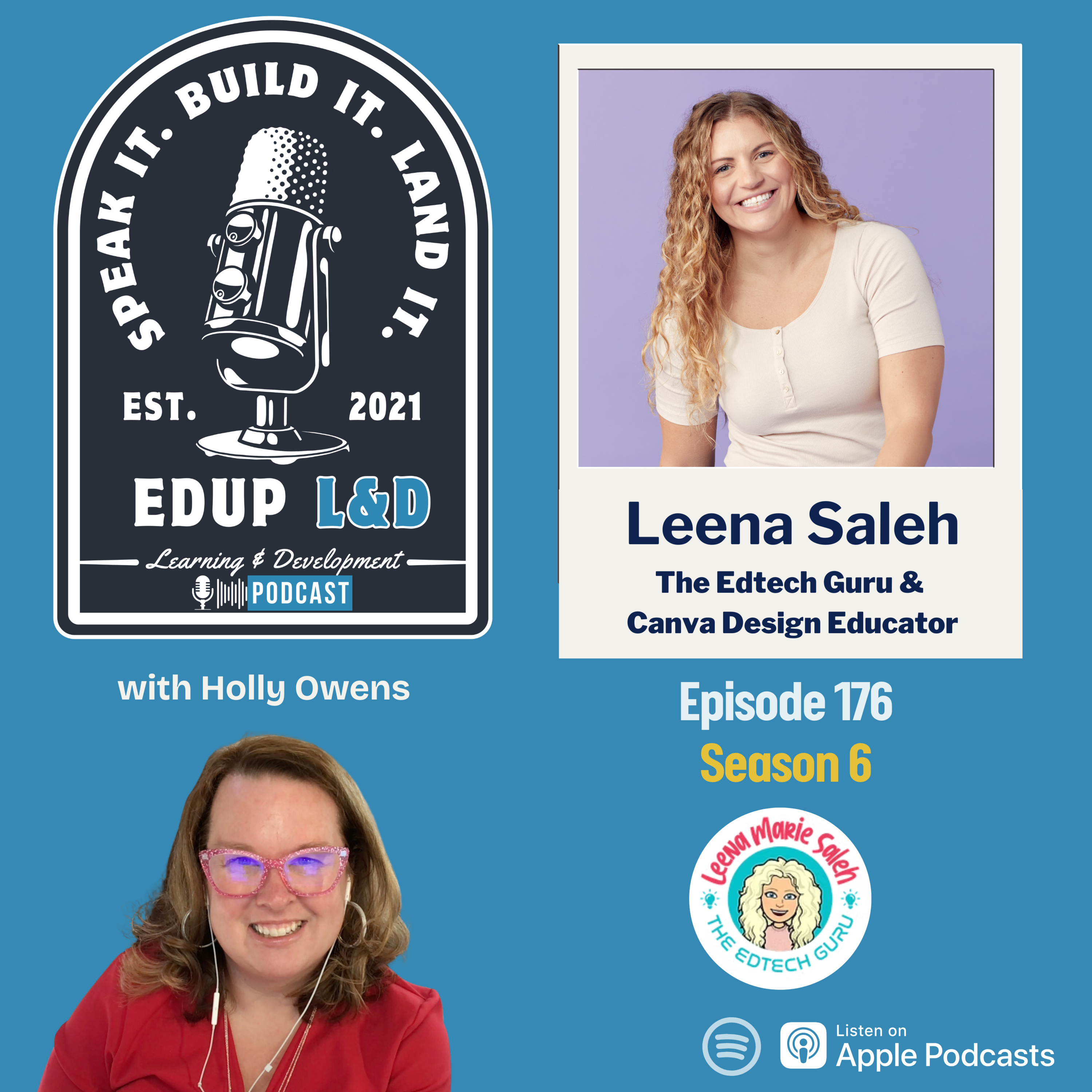
In this episode of EdUp L&D, host Holly Owens welcomes back Leena Saleh, a former teacher and current content strategist at Canva. They discuss the emotional journey of transitioning from teaching to corporate roles, the importance of networking, and actionable tips for educators considering a career change. Leena shares her experiences at Canva, the impact of educators in corporate environments, and the significance of building a personal brand. The conversation emphasizes the value of leveraging free resources and the importance of self-auditing in career transitions.
Resources mentioned in this episode:
Guest Contact Information:
___________________________________
Episode Sponsor: iSpring Solutions
🎙️ Huge thanks to our friends at iSpring Solutions for sponsoring this episode of the EdUp L&D podcast! 🙌
If you haven’t already, be sure to check out the iSpring Learning Exchange Community — a vibrant space for creators, educators, and L&D pros to connect and grow.
Grateful for the support and excited to see what our community creates 💡
Thanks for tuning in! 🎧
0:02 Welcome back to another episode of Ed Up L&D, the show where we talk about all things learning and development and career transformation. Today I've got a real treat for you, my friend and returning guest Lena Saleh. If you know her as the Ed tech guru, you already know she's a powerhouse in the education and technology space. She's the product educator and content strategist at Canva. She's a former teacher who's helped over 100 million educators and students unlock their creativity and a fierce advocate for teachers making bold career moves.
0:45 We first had Lena on the show over two years ago, back when this podcast was still at Up at Tech, and so much has changed since then for the both of us. In this episode, we dive into life after leaving the classroom and navigating that emotional shift, the inside scoop on what it's like working at a global company like Canva, and Lena's best advice for transitioning teachers who are ready to take the leap. This conversation is packed with practical tips, career inspiration, and some real talk about letting go of guilt and leaning into your next chapter. So whether you're a Canva curious in the middle of a career pivot, or just here for the LND inspo, you're going to get a ton out of this one.
1:33 Let's jump in. Hi, we're ispring, an international team of e-learning enthusiasts who help more than 60,000 clients across the globe succeed with better online learning. Our two flagship solutions are ispring Suite and ispring Learn LMS. Ispring Suite is an intuitive, all in one authoring tool for creating engaging e-learning content, and ispringlearn is an innovative online training platform for onboarding, upskilling, and certifying your teams. We also provide tons of free resources for aspiring and experienced e-learning professionals, conduct weekly webinars with top industry experts, and organize annual e-learning conferences, challenges, and championships.
2:21 We'd be happy to get to know you and pick a solution that fits your needs best. Go to www.icepringsolutions.com to learn more about us, download our resources, and connect. Hello everyone and welcome to another amazing episode of Ed Up LND. My name is Holly Owens, and I'm your host, and I am really excited and really grateful that Lena is here to come back to the show after almost over 2 years. It's been a long time. And actually, the podcast was at up at Tech back then. So now it's at up L&D. So there's been some evolution in our lives and evolution in some of our professional professional lives.
3:07 So, Lena, welcome back to the show. Thank you so much. I'm so happy to be here and to be back with you on this episode. I can't believe it's been 2 years. Like how crazy is? That I know I was like, I was thinking to myself when we were talking before, I was like, it's been like a year because with everybody it's like a year. And then I was like, Nope, it's been a really long time. So a lot has changed. So why don't you tell the audience about you, who you are, you, they probably know you from Ed tech guru and and all the stuff you do at Canva. So introduce yourself and tell us about it. Sure. I am obviously Lena. I work at Canva and I am a content strategist and product educator. Basically that means that my specific role at Canva is that we create content to activate our users. So not just onboarding, but basically activating our users. And so I specifically work with the K12 audience because I'm a former teacher.
4:05 So so I like to be able to do that. So that's kind of the work that I do at Canva. And then I also do podcasting, like Holly, just bringing on edtech founders or really focusing on teachers who are making a transition out of the classroom. And yeah, so that's. Just a little. Short snippet about me. That's great. And I, you know, I think it's important that you continue this work outside. I know you have Canva and canvas huge to everybody, but everybody knows Canva. But the work that you're doing, like with a tech guru and having the podcast and bringing people on and sharing some of your videos. I recently watched your one about teacher transition coming out of the classroom.
4:46 Love that one. We'll definitely put a link to the show notes in that. And as you know, our audience is made-up of mostly transitioning teachers. So we're both transition teachers. We've both been in a space where we've been considering like, Oh my gosh, I don't know if I want to do this anymore. This was something I thought I was going to do forever. I'm sure Canva wasn't on your bingo card for life, Amazon and Yellow Dig and all the different things that I've been doing weren't on my bingo card for life. So what can you say to the transitioning teachers who are listening right now and they're thinking like, should I or shouldn't I leave the classroom? Like what are some things they should consider? I think your thought is if you have already made that, like if you've already, if you're already wondering, your foot is already halfway, I think out of the door. I think you're already you're already there. And I think that the part that holds us back is guilt of leaving.
5:40 And I think a lot of times there's like this, it's like bit of mourning that we do of like, are we making the right decision? Are we letting people down? I think as a teacher, you have to think about what's best for you and what your longevity is. I think Holly and I can both speak to this that are I never thought that I would be in this other side of the space. I thought I would be a teacher, then I thought I would be an administrator and spend like a good amount of. Time, yeah, and. Then I thought I would be a policy change maker because to change the space and education. And then ten years in, I thought, what the heck am I doing? I got to get out of here. I need to have an impact from the other side. So I think there's that part like you're, you're already thinking about it.
6:22 So I would say start that process. Another thing I would say is, and I'm sure Holly would agree with this, is like start auditing people around you. I think you have a wealth of already resources around you. But as an educator, we only know education. We actually don't know business terms. We don't know anything. I didn't know what B to B was. I know when I started that career, I had no idea what they were talking about. BBC, which is business to business, which means Canvas sells to Amazon, that's business to business. And B to C is Canvas sells from me like they sell the product to me. Those are not terms that you would know as an educator and there's nothing wrong with that. But you just, if you're really thinking about making the transition out, you need to have an idea about what business looks like outside of that.
7:09 So whether that's an entrepreneur in your family, whether that's somebody who's doing accounting or who knows what they're doing, but like just get an audit about what they're doing in their lives just to spark that interest for you. Because as educators, you do 50,000 million things and it is really hard to pinpoint what you want to do. And I think what happens is I always tell teachers to make this like to do like a list of like an audit of everything that you do in your own life. And what I start to see sometimes when educators do it is they hone in on those negative parts of like not getting weekdays off or not having enough time. And that's just the reality of teaching. No matter if you stay in teaching for 100 years or not, you're not going to get more time. I wish that were going to be the possibility.
7:49 I think we can lean into like AI tools and things to help lessen that load. But I don't think your time is ever going to be given back to you in the way that you want it to be. So I think try to focus on the positive things like writing student newsletters or you know, the the specific things that you're doing in day-to-day. Because when you start to do that, you can actually feel yourself being pulled to like a specific direction. And I think that that will help you navigate that journey. The the guilt you mentioned, it's, it's there. I mean, like the first few months and it was a long time ago now out of teaching. Like I was coaching field hockey too. So I was just like, I cried.
8:30 I was like, I can't believe that I did this. I was like, what am I thinking? And this is back when transitioning out in the classroom wasn't a community thing. This was just I was doing it by myself. So there weren't wonderful resources like you and I are sharing or or support communities or even as big as LinkedIn has gotten at this point to support us. So I was really trying to figure it out on my own and that was difficult. I mean, I did it, but it was very challenging and like you said, and touching on like all the things that you do too with that list, list the skills and then you can totally transfer them into what it would be corporate or what it would be education. And I think sometimes maybe, you know, teachers, like you said something about the days off and and stuff like that, like they're, oh, we're not going to have a summer break. Well, I'd rather go on vacation when people are not when I want and not just be locked into like, you know, some of the two-month, two months, 2 month things. And teachers do other things during the summer. They're not just sitting back by the pool relaxing. They're preparing for the following year. They're doing professional development. Like I coached sports, so I had to go back earlier than everybody else.
9:45 So when you really think about it, it's not that much difference in the terms of the time that you're off. And some companies offer unlimited PTO. So a lot of them are are going towards that and there's conversations about like a four day work week. So I think definitely that that is changing too. But you really the emotional piece of is something that you have to deal with. Yeah, I think, I think as teachers, your identity is tied up into that. Like you are a teacher, right? That is your, that is your full identity. Like you could be a mom, you could be a coach, you could be all those things, but what you are at your heart is a teacher. And I think when you make the transition, it's kind of that identity shift of like, who am I? What, what would I do?
10:29 What? Would I do without it the? World could I do. I know I don't want to do this anymore. No idea. Yeah, You know, yeah. So. I think those are all up and down emotions, and I think it's safe to feel that space, to know that everyone else is feeling that exact same space when they think about transitioning. So give yourself the space to feel that and to mourn because it is a bit of mourning. But I promise you, I'm sure Holly can speak to this. I can speak to this. I feel like I have a way bigger impact now against students lives than I ever would have in the classroom. Whether that's talking to founders of startup companies, whether that's guiding them on, you know, how their product can be better or not be better. But bringing that teacher lens lends itself into way more pathways than like a regular person bring. You have such a knowledge base, Yeah. It's such a small community when you think about teaching, and then when you get to work with, like you said, different companies or different people like across the world and network with people across the world, that just opens up endless possibilities and opportunities for you. Absolutely, yeah.
11:34 And I think about me at Canva and working there and my role specifically is actually what I. Was just you're so you know, we're like on the same wave like because I was just about to say tell us about Canva because everybody is like looking to Canva like I should work at Canva. That's a great first role out of teaching or what you know. Yeah, you go ahead. So when I think about that and I just think about we just crossed our 100 million teacher students and teachers using Kampa, which is kind of incredible to think about. The products started like really at launch at the end of 2019, but really when teacher got in teacher's hands, it was really 2020. And if you think about five years, that's 100 million people all across the globe using it, I think is really great.
12:18 But the base of the work that I used to do, I used to create all of the workshops and resources that, like our facilitators or community or whatever, would go and teach other teachers how to use the product and how to. Train the trainer. Yeah, basically like that bit of peace. And I think about that and I always think about, you know, looking working with like our sales team, which is they're, they're called district engagement advocates and they're really like. I like that name. That's fancy. Yeah, it is fancy, right? So they all the all the sales rules they can have very like fancy. But when I think about, I think about that and I think about the workshops that I've created and how art districts who have been trained on these workshops have higher monthly active users. So we have more users using it every single month. Of the people who have been who have used these workshops, essentially, I think that's pretty cool because I think about how I just only touched 100 kids and now we're thinking about million, like millions.
13:22 I could have never done that if I stayed in the classroom. So I think that's something really special about that. And now my role has shifted away from just doing workshops. And now we've relaunched design School, which is like all of our like education type thing. So if you're ever looking, it's canva.com/design School, One word. But the we have all these resources there. And so now we've started creating courses. So I just created my first course called Transform Your Classroom with Canva Co teaching teachers how to use that. And then I'm currently writing another one that will launch. Well, we're working. On it will launch soon. Yeah, watch. Good. And so I'm just like trying my hand at that.
14:03 But I think, and I'm sure Holly could speak this too, but I've never actually written courses like this where I'm writing like full on scripting and screen recording. So I've had to stretch myself in new ways. So I think being a teacher has helped me be more adaptable and flexible to learning new things. I think if I weren't a teacher, I would be, I'd be screwed to be honest with you. Like I think it would be really to be able to make that maneuver. So as teachers who are listening to this, know that you will change roles often, whether it's you just staying in the same type of role, but the work that you do can change based on the company's goals and what they're thinking. So you'll you always need to continuously be upscaling. Yes, 100%.
14:49 And like we're sitting here doing a video podcast like you have to be comfortable with these sorts of things now in this world with AI and virtual and digital and all the different things that are occurring. And first of all, I, I love Canva. I could never do, I can't do anything without Canva. As far as the podcast is concerned, it's a great product. And you know, as far as like some of the things that you curate, I saw some of your videos for Cameron, they're getting like 10,000 plus downloads. That's pretty impressive. And it just kind of like it exploded. And I'm sure that the pandemic helped accelerate that. But beyond that, the product's so intuitive and you can do different things and then adding in the AI stuff and design school and it's like it's, you are thinking what the customer needs before they think they need it. So you're basically future proofing the product. It's a little marketing speak for you so that you can continue to, to grow things.
15:51 Like it just doesn't, it doesn't stay here as this, it grows as this and it keeps, it keeps growing and it keeps offering opportunities for people. So I love that about Canva. I think I think it's great. So what's it, what's it like working at like Canva, like a large company that has access to so many resources and all the different things. Sometimes the audience is like, my dream job is to, I'm sure Canva's on the list. So what's it like working for a company like that? I'm going to take a step back before I answer that part of the question. I worked at a small startup before right out of the classroom and there were 13 people.
16:32 It was and they were based in Israel and I was the only US based person I worked at. They called Code Monkey. Oh God, I remember Code Monkey. I've talked to their owner before. Yeah, go ahead. And so I worked there for 3 1/2 years. And I would say for me, I felt that was a better natural transition for me, moving out of the classroom to a much slower, smaller company where I could have a lot of influence. And I would say from moving from Code Monkey to Canva, it was a big transition for me because I went from working with 13 people. Like 13,000. You know, on sort of the same time zone ish to working to a global company where there is now I think we almost crossed 6000 employees now and we have we have offices now pretty much around the world and we touch so many people around the world.
17:23 So I'd say Canva kind of operates as like mini startups within the big organization. And so each one kind of has like its own mini startup, but I would say it's fast and slow at the same time where when something's coming, you got all hands are on deck and we gotta go right now. There is no time to think. You just gotta go. And then there's other moments where you kind of have a lot of decision makers attached to it and a lot of eyes and a lot of stakeholders are involved. So what it's like working at Canva, it's amazing. There's, I don't think there's not one person in any room that I've ever been in that is not nice and like kind, but also extremely talented, like everyone around you. It's easy to get imposter syndrome still 3 1/2 years later into people working with these people. They come from Google and Twitter and like, you know, Airbnb and they've been the heads of companies and they've been heads of their own, like startups. And then they come and they work alongside me. And sometimes I think, am I in this room? Is this the right Rd. for me to be in? And I have to realize all these accomplishments along the way. So like I am in the right space.
18:29 But I think I love working at Canva and I love that, you know, they listen to everyone and you know, the products are really founded by what people want, I think, but trying to keep it easy. And I think that's the, there's like a delicate balance between that because Canva is, I don't know, it has so many bells and whistles that a lot of people don't know how to use and navigate. And our job as product educators is to learn the product quickly and then figure out how to translate to the audience. That's going to make it easy enough. Like we just had a back to school webinar yesterday and it was like the highest amount of people. I think we had like 11,000 like attendees over the different time zones. And it's crazy.
19:13 And like, part of my work is developed like I lead those webinars and, and, you know, help write the strategy and things for those. But it's interesting because you have people that are coming in, you know, educators and educators don't have time. So how do we tell the story in the right way that's going to speak to educators? And if I wasn't a teacher, I would never be able to do that, right? Like I, you could people come in, trust me, people come in and try to tell the story. And we have to like gut check them and be like, hey. Yeah. There's are not actually going to appreciate how you're trying to do this at like such a high level. So we kind of have to really take it back because educators don't have time. So how do you tell the story and balance those like? Three. You know those those. Lines between it and probably you learn that at Amazon, right, like we are having balance so many different stakeholders from marketing to sales and everyone has an opinion and everyone has a voice and you have to figure out how to drown up the noise.
20:08 Yeah I definitely 100% agree. Like even though Canva is for education, it is run like a corporation. It is not run like you're in a teaching space necessarily. So you have to, it is as it is a corporate environment just like Amazon, even though we're working in the learning and development state space within Amazon pharmacy, like you said, different stakeholders, like people higher up and, and other places beyond pharmacy, we're, you know, talking to us or we're doing different like marketing things for them. And I mean, as far as I'm concerned, L&D is part marketing too, because you're doing that with the strategy and, and your workshops and your webinars and all the things that you offer.
20:52 So 100% you have to know how to function being in your own classroom where you control everything to then stepping outside where the control and the pivots are endless like T-shirts. I loved it. I could sit down, here are my lessons Monday through Friday set. I know that's there may be a little bit of tweaking throughout the week, but not anything compared to like a corporate environment where your priority on Monday could be changed by Tuesday because somebody needs something and it's on fire or something like that. Yeah, and I think that's the hard part sometimes. Like I'm a perfectionist and I like things to be. Really. Are you? Really.
21:34 And. We're friends, so she knows. I know, yeah. My husband always has to remind me, you know, done is better than perfect. And I really struggle. I really struggle with that. And I also sometimes struggle just like asking for help. Like even if I'm underwater, I think, oh, I'm a teacher. I gotta carry all this. And I have to be reminded that I need to lean and on other people. But yeah, the pivots come quick. Like you have a full thing, you've done so much work, and then somebody comes and like, actually, we realigned our strategy. We got to go a different direction. So I think that's where a teacher's mindset comes in. It's like, okay, I've had lessons that I've planned to a teen. They're so beautiful. They're the beautifulest things I've ever created.
22:15 And then you get to the students and they suck, right? Like it does not work. They do not care what you're saying. The words that you're saying are horrible. They don't even relate to what you're saying. It's not as beautifully planned as you thought. And so I think that's what I like to think about as like a startup, as like that lesson that like you planned, it's so good, so good. And then you realize that did not hit. We. Got to go back to the drawing board and I got to do it right now without thinking about it and figure out how I can get this across the line quickly. But well, and sometimes those are your best lessons you've ever created, right? Are the actual ones where you've pivoted quickly. I think teachers like what you're saying with some of the other stuff like where you have to simplify it down to accommodate, like they're they don't have a lot of time. They don't there's you need to, it needs to be actionable quickly.
23:02 Like teachers are great at taking very complex situations or complex topics and breaking them down into simple strategies or simple ways. I love that about my brain. It's like I can take something so complex and I can just break it down into pieces so that they're digestible, you know, doing all the scaffolding, whatever. I still use all that stuff in my current role. So I love that about teachers. Yeah. And I'd say, you know, to your point about like that part, I think that's why teachers are really good in a variety of like role sets, because we can break down complex things into simple thoughts. And I think, you know, sometimes people get really big jargon words, you know, and then they go in like, even if you're selling a product, if I come to the table and I'm talking to someone who's not well versed in what I'm talking about and I'm speaking really big jargon words, they're gonna look at you like, what do you, what are you saying? Get out of this.
23:59 Room like, I don't know why you're in here with me. And as a teacher, we can navigate quickly and be like, OK, I actually need to do ABC. And you know, I've seen teachers create some even like in our sales teams or marketing teams or wherever you go. I see teachers take these like really big complex things and break it down and think like, OK, what does the end user want and how do we figure out how we tell this story in the right way? And I think that's what makes teachers so great at any role that they decide to do, but specifically in L&D, because when you're teaching something like pharmacy, pharmaceutical stuff, that's like big jargon. So very jargon heavy, lots of acronyms. They can't just pick it up and be like, oh, this is such a good read.
24:40 Like, we're not reading college level textbooks. Nobody has time to decipher and like, you know, figure it out. They want something that's easy, digestible and engaging for them to understand. And that's like where teachers play the biggest. Role, I think yeah, 100% Oh my gosh, this is such a great episode for features. We always we always get on this topic and I love it. I want you to talk a little bit about at Tech Guru and tell how you started that and you know what you love about that position and all the things you're doing there so the audience can follow you and if they don't know already. About that, yeah. Thanks, Holly. I appreciate that. I started that. I started, I've always been like, you know, delivered workshops and like those kinds of things to like teachers and things. But what I realized is I had moved from Colorado, where I'm from, to Austin to a new place.
25:31 And I just realized that, you know, I started it right around the pandemic time. I actually started before the pandemic happened. I just like, you know, it just so happened. But during that time, you know, we obviously saw that networks kind of dissolved in like your regular area and that you could have a wider reach. Like, you know, Holly and I both have found on LinkedIn by being able to share my thoughts. And so I just started, I first just started sharing my thoughts on LinkedIn and then I started getting messages like, Hey, how are you doing this? Hey, how are you, you know, whatever. And I was also at the time at Code Monkey doing like some consulting for like some Ed tech companies. I'm like watching products and just, you know, all sorts of things that I've kind of learned from the classroom.
26:12 And I just started only first just talking about Ed tech and education trends and like how how teachers really need to be evolving and how we can support them. And then obviously switch to like COVID stuff and all of that kind of stuff. And then? Founders started wanting to like come on and share their stories and I was like, all right, great. And then also in the process, I started getting a lot of questions about like, how do you leave the classroom? How does this happen? It started first just like 1 message and then it turned into hundreds. And I was like, you know what? I'm not going to have any more coffee chats. I can't, I don't have the time I could pass through this anymore. So I'm actually just going to craft this narrative through like YouTube. And I remember the first time I ever recorded that my husband was out of town and I just used his space because he also does in a way different industry than we do.
26:57 And I just sat there. I probably recorded 45 times. It probably took me 5 hours to record 1 video. And I edited it, way over edited. And I put it up and I couldn't sleep the whole night. Oh no. The first video, nobody did, you know, it's fine, you know, And then over time, you just like get better at the reps But I think I just, I really just want to try to capture a story of both how we support teachers in the classroom and how we support them outside. Because, you know, I just had Ally Parrish on which episodes going live here soon about how a teacher. Yeah. And just like how she figured all of that out. But, you know, I think it's just something you just like have to do is kind of like start building like a personal brand in that like way.
27:45 But I. But I just want to empower educators. And, you know, I, I also got nasty messages like, why are you forcing people to leave? Like, what are you doing? So like, I always wanted to put like a disclaimer and I'm like, you know, teacher's been thinking about this for hundreds of years. This is. They've been looking for an out for a while. Yeah. And when we left and when you transitioned, like there wasn't any resources. There was like Lincoln was not what LinkedIn is today. You can find everything you did without ever paying for like a course or figure it out. Not at that time. There was nothing like nobody could really. There was not anything really available for you as, like, a transitioning educator. So I just wanted to give teachers a place where they could feel empowered to, like, make a decision on their own, whichever way they decided to go. Yeah. I love that and I I love the supportive community that you have on LinkedIn and all the things that you share. I think your videos are great.
28:32 Stop being a perfect perfectionist because I've watched many of them. I stopped being such a perfectionist. Your videos are great. So, you know, and wrapping up the episode because I knew you and I could talk a lot about a lot of different things we like to give the audience, especially transitioning teachers, crew like 3 actionable pieces or tips or advice that they could think about and do right now if they're thinking about leaving the classroom. So I'd love to hear your perspective on that as an expert in doing it yourself. And I just looked up the year LinkedIn was founded as 2002. Shoot off for a while. It didn't. It wasn't great in like 2002. No, Yeah, no. It was, yeah. It definitely wasn't that.
29:13 But like, I think right around I just like, you know, my husband is has been like a big contributor to like helping. He's kind of like my business coach. Oh, I love him. He. Like connect with whoever. Cuz like, you know, I started going to like Ed tech events and stuff like just connect with them and just send them a message and just say like, hey, how's this going? And then that's kind of how it started building. I just was like cold outreach, the scariest thing I've ever done. But so that's one piece of advice. Building your number. Yeah. Cold outreach. Don't be afraid to don't be afraid to say hi. I mean, this community is fun. That's what I Yeah, this community is very giving and and willing to point you in the right direction. Yeah, I would say. My sister actually called me. She's a high school teacher and she was asking me what do I do?
29:55 And I've had a countless of these conversations, obviously this summer, and I said this at the beginning and I'll say it again here, you have to audit your life. And what I mean by audit your life is, I mean, write down all the things that you do in a day. And I mean, cleaning the house, it could be organizing your trip to Europe. I don't know. It could be anything that you're doing. And then everything that you do within like your school, not maybe day, but like everything that you're responsible for throughout your role, take those and rate them like in a neutral, you know, like dislike category. Because if you're really thinking about leaving the classroom, you've got to have an idea and strategy of where you're going to go. And the only way that you can do that is by figuring out the things that you like.
30:37 And it's so hard to figure that out. It's very, very challenging. I have to sometimes gut check myself and do this to myself often and then I say audit your network and start like reaching out and networking. Get on LinkedIn. Your does not need to be perfect. Just put in a couple of details. Make sure you have a profile picture because nobody's gonna talk to you without a profile picture. We think you're a bot. And yeah, it's just just do it. Just put a profile picture and try to keep it like, like a professional headshot. You know, you don't have to do anything like fancy. Yep. OK, Just like take your head, remove the background on Canva, put like a cool, fun background up there and then upload it into LinkedIn. Like you don't need to get too fancy with yourself. And then just start reaching out to people whose roles you might be interested in.
31:23 And don't be asking us for jobs. OK? Don't to review your resume. That right? Away like I know. I know I did that a lot. I know you were thinking if I. Know, trust me, I think it's, I think it's amazing, but I need to know you first before I can put in a referral. And in fact, Campbell will not take it unless you have a personal referral and you can actually speak to how you know this person and why they would be a good fit. So it's, it's actually almost impossible for us to actually do referrals unless we have like a really good personal connection with you. But just like start connecting and just like being like, hey, I see you work in marketing at blah, blah, blah. I would love to just hear what a day in the life looks like for you and just just shoot your shot that way.
32:06 I think those are like, those are like the things that I think are really important and networking goes a really, really, really, really long way. And then my last tip is when you get on LinkedIn, you can obviously share your journey, but try to not over share too much because at the end of the day, you're still teaching and you're still in a contract with somebody. So when you're posting like, hey, I'm searching for ABC job, but I'm still in the classroom, they could come and look at that. They're probably not going to, but you could technically, it's possible that they could be deciding like, hey, you're not a good fit for us and they could just let you go.
32:47 And you don't want to have that as like your back, delicate at first. Yeah, just try to keep. It like professional and fun and like easy and there are like so. Many resources. And I was just going to say, I think, but there are so many resources out there following Holly, following so many people on LinkedIn, There's so much good information there. You don't feel like you need to post. You can just utilize the resources that they have and you know, leverage that without paying for anything first. Not pay for anything. Oh my gosh, this is the best. Piece of advice that you're ready. For right, because people you can just dump so much. It's just time is money and money is time. So think about that when you're like doing something and if something is not you're not sure about it, you think you should pay for it, don't.
33:34 There's so much resources out there for free YouTube videos, resources on LinkedIn, people share free PDFs, there's so much stuff. You do not need to pay unless you feel like it's going to be beneficial to you in the long run. We're on the same page there I. Tell everybody to exhaust the free resources first before you start investing in some of these academies or these workshops or other things that are not free. So when you find your niche area, then you can start investing some money into kind of learning the ropes there. But yeah, or like. Like a tool. Like if you feel like you really want to go into learning and development, you probably need to know how to use Articulate. Yeah, exactly. However, I don't. And I'm like in a different space. So like, I think it just depends on like where you're at. But if you feel like a tool is going to be beneficial, that's like a different thing than investing in like these academies and, and all the other things. Yeah.
34:27 Wow. This is a great episode, Lena. Thank you so much for coming back on. Let's make sure we don't do this two years from now. Let's make sure we do another episode soon. Agreed. Because things change pretty. Fast in our industry they they change so. Quickly, don't they? Yes. Well, thank you so much for coming back. On and sharing about all your experience with Canva at tech guru, all the things so appreciate you and being a part of this community. I appreciate you as well and. All that you do, so thank you. Thanks for spending a few minutes with. Holly, she knows your podcast queue is packed. If today's episode sparked an idea or gave you that extra nudge of confidence, tap, follow or subscribe in your favorite app so you never miss an episode of Ed Up L&D. Dropping a quick rating or review helps more educators and learning pros discover the show, too. I want to keep the conversation going. Connect with Holly on LinkedIn and share your biggest take away.
35:25 She reads every message. Until next time, keep learning, keep leading, and keep believing in your own story. Talk soon. Hi we're ispring an. International team of e-learning enthusiasts who help more than 60,000 clients across the globe succeed with better online learning. Our two flagship solutions are ispring Suite and ispring Learn LMS.

Content Strategist and Product Educator/ The Edtech Guru
Leena Marie Saleh, widely known as The Edtech Guru, is a former educator with over a decade of classroom experience and more than seven years in the EdTech space. She is passionate about integrating cutting-edge technology into learning environments to prepare students of all ages—from PK to adult—for the future workforce. A dedicated advocate for equitable access to quality education, Leena champions the development of critical skills that open doors for learners everywhere.
In her current role at Canva, she empowers educators through intuitive design tools and innovative learning experiences. From shaping professional development programs to creating scalable content, her mission is to help educators deliver meaningful, tech-powered instruction that inspires creativity.
Throughout her career, Leena has collaborated with educators, administrators, thought leaders, and EdTech companies to create forward-thinking strategies that center student impact and elevate educational excellence.
She also hosts a YouTube channel covering all things Education, EdTech, and teacher transition, offering insights and support to the entire education ecosystem.