

 Apple Podcasts

 Spotify

 Amazon Music

 iHeartRadio

 Pandora

 Castro

 RSS Feed

 Audible
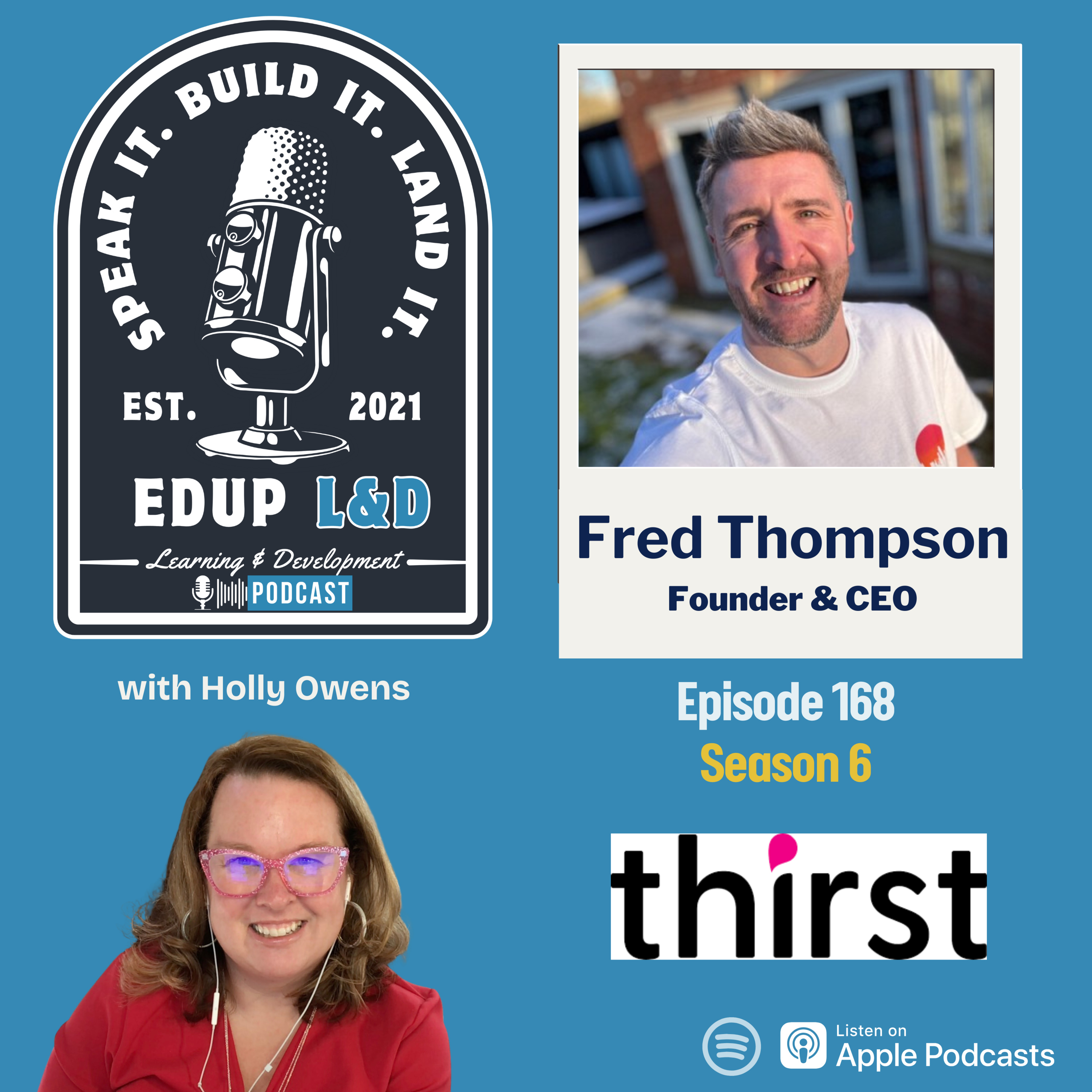
In this episode of EdUp Learning and Development, host Holly Owens interviews Fred Thompson, founder of Thirst.io. They discuss the intersection of technology, innovation, and learning, exploring the challenges faced by L&D professionals, the importance of personalization in learning, and how AI is transforming the educational landscape. Fred shares insights on building effective teams, the future of learning, and offers valuable advice for aspiring entrepreneurs.
Resources mentioned in this episode:
Guest Contact Information:
___________________________________
Episode Sponsor: iSpring Solutions
🎙️ Huge thanks to our friends at iSpring Solutions for sponsoring this episode of the EdUp L&D podcast! 🙌
If you haven’t already, be sure to check out the iSpring Learning Exchange Community — a vibrant space for creators, educators, and L&D pros to connect and grow.
Grateful for the support and excited to see what our community creates 💡
Thanks for tuning in! 🎧
0:00 Hi everyone, and welcome back to another episode of Edup Learning and Development. I'm your host, Holly Owens, and today we're diving into the intersection of technology, innovation, and learning with a truly inspirational guest, Fred Thompson, founder of Thirst dot IO. Fred's journey from software development to the world of learning and development is not only fascinating, it's packed with powerful lessons. In this episode, we explore the real challenges L&D professionals face today, why personalization matters more than ever, and how AI is rapidly reshaping the educational landscape.
0:42 Fred also gives us a behind the scenes look at how thirst is tackling these challenges head on. And if you're an aspiring entrepreneur entrepreneur, you'll definitely want to tune into the part where he talks about building teams, trusting talent, and leading with vision. So whether you're an L&D Ed tech or just curious about the future of learning, this conversation is for you. Let's get into it. Hi, we're ispring, an international team of e-learning enthusiasts who help more than 60,000 clients across the globe succeed with better online learning. Our two flagship solutions are ispring Suite and ispring Learn LMS.
1:28 Ispring Suite is an intuitive, all in one authoring tool for creating engaging e-learning content, and ispringlearn is an innovative online training platform for onboarding, upskilling, and certifying your teams. We also provide tons of free resources for aspiring and experienced e-learning professionals, conduct weekly webinars with top industry experts, and organize annual e-learning conferences, challenges, and championships. We'd be happy to get to know you and pick a solution that fits your needs best. Go to www.icebringsolutions.com to learn more about us, download our resources and connect.
2:11 Hello everyone, and welcome to another fabulous episode of Ed Up Learning and Development. My name is Holly Owens and I'm your host and I'm super excited today because I have Fred Thompson here. I'm going to let him talk about himself. So, Fred, welcome on into the show. Yeah, Thanks for having me here, Holly. Really excited about today. It's always strange when you're sort of prompted to to talk about yourself a little bit. You never know quite where to start. Yeah. So tell us your story. How did you get into like thirst, all the different things that you're doing? Give us the low down. Yeah, I mean, it's always strange. You look back as well and think, how do you get here? And you're never quite sure my background and history. Sort of we're going back, you know, a couple of decades, which is worrying, isn't it, when we think about it. Yeah, I know when we when we think about it out loud, software development has always been my thing. The background is my, I'm a programmer by by the nature and by trade.
3:05 But ultimately that's where I started building out and sort of fell into L and DA little bit in terms of building out Macromedia Flash courses and things in all the way back in the day. This was before the Adobe sort of bought it and then building into learning management systems, etcetera. And then just really branching from there. And over time, as we've progressed, it's been a case of, well, I'm not as good at the programme as I once was or I like to think I was started bringing in people to help me around, around and about as the businesses kind of grew and said, OK, we've got more to do here. And then as a result of that, we've sort of been done over 2 decades in the L&D space really assisting businesses to put together learning, but using technology to effectively deliver that. So anything training, anything sort of learning management system connected or learning platform connected, but we're talking about anything it connects to like API systems, external talking about the strategies around that. And yeah, we we focus, we are primarily sort of you know tech focused as a business, but with the background knowledge really of the space of knowing, but probably most things there are to know now in L&D really.
4:24 I mean, it's so it's, it's so nice to hear of a journey like you started out like in history, like a lot of us started in different places. Like I was a high school teacher and then you kind of found like where your passion, where your niche was and you just went for it because you're not just the founder of Thirst. And if you haven't seen Thirst, you're, you're probably not on LinkedIn a lot because their marketing is amazing. And you've, you've definitely seen Barry post a lot of stuff out there. He's their marketing director. And if you haven't heard of thirst, you need to go hear of thirst now. You need to go out to their site. So being as that, you know, the journey has been one that's been of different opportunities, different things for you.
5:04 When you think about the L&D space, what do you think are some of the, the greatest challenges for us? And like how it currently is like the things happening with AI and, and all those things that are kind of impacting our industry. I think it's kind of the same across many industries and not just L&D. And I think L&D has typically been a little bit historically behind in terms of just trying to make sure it moves forward. And you know, I touched upon Mac Media Flash there, but I mean we're still sort of using SCORM courses and things like that and the, the early standards and we didn't even move forward into the X API things really that that well. So we've always been a little bit backward thinking as a, as a sector, but you know, with this new technologies that are current, you know, we talk about AI loads, we've done quite a lot of that, but it's, it's so fast moving.
5:52 You can't quite even even if you're not thinking about L&D and you're just trying to keep up with the news, the latest sort of technology enhancements there, you can't really do that. I went to an Amazon Web Services conference where they would, I think the guys Anthropic were there who was one of the AI providers and they were talking about a new standard that they got. And they said, oh, this, this standard's actually changed since last time we presented it. And I think I went in, I don't know, it was like April and they said we last presented it in February. Within like 45 days. It was completely different. So you sort of roll that into what we're doing at L&D Space and try to keep up with that. It's mind boggling. I think though, in regards to that, the the the greatest challenges we have are around getting learning to the people and the places they are and how they want to inter operate with it. So, you know, if you're using a lot of the AI tool in note, it's almost become a conversational kind of piece where you're not browsing the web for pages anymore. You're not going to find that learning content in the same way.
6:54 It's either being surfaced to you or it's kind of answering direct questions or giving you guidance and personalized advice around that. So it's how do we restructure how training and learning is presented back to the learner in a way that kind of matches what effectively this this future of kind of connected technologies look like. It's going to be fun. It's going to be, it's going to be rough, I think for a while. Yeah, I agree with you 100%. So tell us about thirst. Like what it, what is thirst? What do you do? How do you help people in the L&D space and tell us all about it. Tell us what it what you're up to. Yeah, no problem. Well, when we built first we sort of spotted the gap in the market for trying to use some of these technologies to start. We're trying to.
7:41 So we baked in personalisation right from all the way through the product. So everything you do in there is, is surfacing the right latest information that's relevant to you and we're sort of accounting for everything that you do. So every sort of interaction like comment, share, if you're certain authors or certain content types where we're forming that opinion of what content and then that gets surfaced to at the right point. We also baked in skills completely from the ground up, which again, depending whether you know you're learning platforms or not, you know you, they tended to be an afterthought. And a lot of the more kind of previous incarnations of learning platforms tacked on the end. We reversed that and said we're going to start there, which meant we sort of was forward thinking from the get go in terms of what the future of L&D looks like, the future of just business really on how it's going to train and hire people. And then obviously we sort of rolled that way from the AI side as well, which is made that we've put some really nice features and functionality in there as well. But one of our core method messages really is just making the platform that we started off with a messaging which was a platform you want to use because we found a lot of learning platforms.
8:48 You almost need a training program to use the platform. It's too difficult, you know, you couldn't quite training. Programs like. This is it. Intermediate Advanced. Yeah. And nothing felt intuitive either. You'd sort of go off and the administration area was somewhere else and it looked very different. And, and that was, we came at it completely fresh and said, OK, we're going to build these latest technologies and tools in there. We're going to come from schools, from the from the ground up. And we're also going to make it very usable. And then we also lay it in like a social learning piece as well. So there's a lot around tacit knowledge sharing. By default, everybody in first can actually create content and service it to their colleagues in the business as well. So that means you're getting, especially for your sort of SME size of business, it's brilliant because you've got smaller L&D teams or sometimes non existent teams.
9:36 And it means that other people in the business can effectively still facilitate training with the organization, get the right knowledge to the right people without it sort of being bottlenecked by, you know, a smaller team size or whatever that it might be. So yeah, that's the other problems we're solving, and solving them pretty nicely at the moment. That's good. You know, I love it. Like I said, I love your marketing. I love what you're doing. And you know, I think that one of the things that's come out of like AI is this more personalized learning experience instead of like just everybody does the same thing through the whole semester, the whole training or things like that. Like you're meeting people where they're at in terms like, I wouldn't want to sit through a training where it talks about instructional design, theories and methodologies.
10:22 I already know all this stuff. I want to sit there training where it's something that's instant application. I can instantly use it. So what do you think about the more personalized learning experience in house? There's kind of implementing that. I think it's critical, I think I mean, I don't have to study percentages to hand, but there's some great studies which show effect about the effectiveness of personalized learning and how that sort of impacts people's retention and ability to kind of learn. I think it's funny again and you what you started to kind of kind of podcast around the questions around how technology sort of shaping that. And I sort of remember it was probably only four years ago or so. So where they were basically we couldn't quite I think was filtered, the company filtered.
11:05 We're trying to actually sort of personalize the the content and trying to establish and understand the content and map that to skill levels and certain types of skills. And they were having real challenges with that at that point and trying to trying to make it work really, really well. And then obviously the AI side came into that and all of a sudden it just sort of replaced that problem with just a solution straight away. Just there you go, we can do that now, which is formidable. And when you then team up with the personalisation side, that automatic mapping of content, basically if you can get that established level of skill level as well of that content, then it just changes it again. And so yeah, personalized learning journeys, like personalized journey through. And we're taking into account, we're trying to take into account everything. So it can even be, you know, what content source it's coming from, if there's a certain author within your organization who you kind of follow or aspire to kind of look towards for a career pathway that can also do that. But it's also factoring in, you know, the more basic elements like what skills you're seeking and things like that. All that combined, you get a lot more just impact of the delivery of the of the training really.
12:10 Yeah, absolutely. And I'm just thinking it back, like, remember how much time we would spend on doing things like descriptions and building out content now? Tagging, Tagging content, yeah, yes. And tagging content it I just, it just literally like shifted overnight. I love it though, because I feel like, you know, AI and some, some other tools have really allowed us to be instructional designers or LMD professionals and jump into the creative space. Now like we get, we get really like caught up in some of the administrative tasks that take like they're very time consuming. They might be small tasks, but they become very time consuming. And I'm thinking of like when you're building a coursing or you're building a workshop or something and you have to outline everything and then you have to design it and then you got to deploy it and all that stuff. But really like pieces of that have have changed because of AI. And I feel like I can really sit in a creative space now and think about other things I could do during the live workshop that are going to impact the learner, engage them or offer pieces of advice or scenarios during that training. Yeah.
13:20 It's part of the. Yeah, it's part of the L&D Unleashed event that we were talking about before. Can I ask? About. That yeah, it's we did. I trusted myself in a live demo of how to use AI as your copilot, which is always quite dangerous. It worked all right, actually largely speaking. But what we were doing is we were just giving it information and using some of the sort of reasoning models that are there now and saying can you kind of give me the job roles that this business? And we would name the business and give it some, some pointers on the web, you know, to a website and it would go off and try and bring back the list of probable job roles. And it would look at the job positions that are on its careers page and trying to map them back.
14:02 And then we extended that out and said, well, can you give me the skills of these job roles? Then can you give me the tiers of the job roles and how the tiers mapped? And we basically built skills, matrices and frameworks out of it by just pointing it to the direction of business information and sort of asking questions. And then even took that further and said, OK, where's the skill gaps that we need? And also can you give me some titles? Can you give me a strategy to teach that skill gap to sort of to close that gap? You know, we're not going as far as creating all the content here. And part of the talk as well was this doesn't replace, you know, instructors, design or L&D kind of professionals. A piece of it, yeah. People are so nervous about that, Fred. They're so they're, they're like nervous to a point where it's like it's, it's really negatively impacting their view of the tool and how to use it. Yeah, almost a bit scared that it's going to replace their jobs.
14:50 So they're kind of trying to ignore it. Yeah, we know kind of the human connection in L&D is so important anyway and there's a lot of that side of it that really still matters. But you can't simply replace that knowledge either. And we are sort of saying it's more of accelerant. It's kind of like it's what you talked about there, which is that kind of yet stuck in the mundane, in the kind of administrative side. Well, all of a sudden you can just clear a lot of that and actually really focus on where the added value is. And that's really exciting. I think it's going to be challenging to make sure everybody understands how to use it because it's a brand new skill, prompt engineering, etcetera. And then also having the businesses and organisations approve its use because there's data protection elements to that.
15:30 But I think I've referenced this a few times. I think it's like when everybody was moving to the cloud sort of whatever it was 10 years ago and everyone's really scared of it and it was like we can't do it. And you know, it's there's problems with security and safety and then we're just all there now and it sort of went away. And I kind of feel that's where we're at. We're at that early stage, only a few years into this journey on on that new tech side. I think in sort of Fast forward in the five years, it'll become so ubiquitous. We never understood how we. Won't even notice. It's just gonna be there. Yeah. Like it's, it's just a part of everything that we do. Absolutely. I think that's 100% going to happen. And whether people like it or not, like these technologies, like the cloud and stuff, that's, that's the norm, that becomes the norm for everything.
16:14 That's what you should be using to save your stuff on. And my grandparents are in their, their mid 80s. They're like, where is this cloud? And I'm like, it's not a cloud. It's not a cloud in the sky. It's, it's out on a server somewhere. So you know. I do have sympathy though, a little bit with. With I mean. Yeah, I'm, I'm certainly getting older. I mean, as we all are, we don't go backwards. But I mean, we've lived through quite a, a generational kind of shift in terms of technology. But you kind of imagine, you know, our parents and what they've had to kind of come from from almost not having, you know, you know, televisions and microwaves would just be coming out as a as a thing that even existed. And then to suddenly dealing with AI, the shift in their lifestyle lifetime. Is it incredible, isn't it, to try and understand?
16:55 It really is. But they have me, so they're fine. I mean, they have. IPads, they have smart. TV's, every time I go there, my grandfather has a list of technologies he with things he wants to learn. So they're fine. They can operate, you know, better than some some other people I know. But yeah, I really do have the the empathy for for the process. Like when I was growing up, the Internet was just coming out and chat rooms were like the big thing. Like I remember we got our first computer. It was a Gateway computer in the United States. And if you know gateway, it's like you rent those computers and we just sat there, couldn't use the phone when you're on the Internet. You know, we've been through that stuff, which is really cool because I, I think it sets like the foundation of what we know, like kind of learning long division before, you know, short division. So it really gives you that perspective. And like these kids nowadays, these, these, these young UNS, as we say in the South, they have no idea, no idea what it was like to like not have a cell phone with you all the time, like coming home when the streets St. lights turn on. They have no idea.
18:03 Yeah, I know. Yeah. I mean, I'm, I'm not going to make a judgement wholly on your age, but I, I feel like we grew up in a very similar time because these are my memories as well. But we do. Too, which is awesome. Yeah, it's good. There are always challenges. I I think there's a certain element of retro as well that people are heading back towards that. I, I hear that latest Gen. Z are actually seeking out kind of like landline phones again because they kind of want to get disconnected. So it's, it's interesting. It goes full, full circle, yeah. I love their brains on the way that they think and the way they're changing the work culture as well. You know, we're having a conversation recently about like Gen. Z, they're saying like Gen. Z didn't want to work. Well, that's not the case. They work differently. So we're not used to, you know, working the 9:00 to 5:00, which is an archaic, outdated process anyways.
18:48 So it's really cool to to tap into their brains and their minds and see how they're going to, they're going to change the game for sure. Yeah, I think so. I mean there's they are a different approach. They have a different approach, I think to they're almost more demanding of kind of excellence almost to some degree, right. It's kind of like the boundaries that we should have set and expectations we should have set. We didn't do so they're doing it. Yeah, a little bit like we, we can't get it, you know, in the same way why we built first is because it's kind of like the the, the market is. You wouldn't, you couldn't put an old learning platform to the Gen. Z audience because they just simply wouldn't accept it. It would be the more demanding of what the quality of everything that gets delivered to them, the quality of the businesses they interoperate with, you know, in terms of like the sustainability, all the pledges, all the kind of the B Corp elements, all these, these parts. They've got more demands and expectations on it, which I think is is only a good thing realistically. So it drives everybody forward.
19:46 Absolutely. So what are you excited about for the future? Like the future of learning and development, Like with all this AI stuff coming in, what are you excited about? So we're trying to go to this kind of the same ground, but kind of like, but my, my thoughts is about what we can do faster and what we can understand that we either a couldn't understand before or B took too long to understand. So a a great example is the data analysis part of L&D. You know, historically we talked about SCORM, SCORM one point whatever 1 and 1.1 and 1.2, etcetera was all focused on did you complete it? And if so, did you pass and maybe it stretched?
20:28 How long did it take? And we brought in, you know, so many other metrics that you could do with objectives and everything else, but it was, it was almost too difficult to set up and interpret. And now you've got a scenario where you can track every single data point, you know, every kind of eyeball click, movement, etcetera. And you can establish patterns and pathways and data points on that and that can inform the the strategy. So I mean a really simple level and this is, this is nowhere near as far as it is going and can go and can go. But we are spotting gaps in content that's not available for certain skills that people are seeking in the business because they've we're using all the data points about what they're searching and what skills they have versus how many users we have. And we can map that back to saying, well, the content is not matching the requirements there.
21:19 That was even that sounding simplistic was relatively difficult to do previously because you had to have so much data and sort of transpose that. And now it's just in systems, it's in platforms to do that. And that's exciting to me all the time. What else can we discover that we didn't discover? And I'm also a weird advocate, sort of leaning away from the AI side a second. I'm a weird advocate of how marketing can be used really well psychologically to kind of engage you on the L&D side as well. And we've talked about this before on, on one of the presentations I've previously done, but it was around you can build scarcity, you can do FOMO, you can do these elements of are really popular in things like social media. They really draw you in, they draw you back and you open up the app every day.
22:05 You want to see what's happening and they work across the board. It doesn't really matter that it's L&D, but I think we're just getting smarter with how to engage and, and build that kind of interaction with our learners that I don't think we had before. So these things are where I like how we're heading and where we're going to. Yeah, me too. And I think that anybody that's thinking about getting an L&D or thinking about getting into marketing or whatever they're trying to do, you need to take a psychology course for sure. And kind of learned some of those tactics. Like, I didn't realize how much psychology is, is an L&D and is a marked mean, like you said, the FOMO stuff. And you're really getting deep into the psyche of like, you know, why do people sit on TikTok like myself at bed and scroll for hours and hours a night? What's what's there?
22:51 What's doing that? That's like become an addiction, you know, just coming. Back I've got a really simple kind of example that kind of there's a real world example which it shows how, how well this works and then how you can apply that to L&D, which is we always want to be kind of herd mentalities as humans. That's kind of how we operate. And the hotels, we've found it more successful if they want to save on the amount of laundry they're doing on the, on the towel washing, they'll put a sign in the, in the bedroom to say, you know, to tell people to do that. But they would have more success if they would put a statistic on there that says, join your other fellow guests and 70% of them reuse their towel or whatever the status.
23:32 And basically it, it makes everybody else think, oh, if everybody else is doing it, I'm doing it. And then suddenly you get better uptake of it. Now it incredible. It's really simple. Just the messaging on the sign changes that behaviour. If you apply that to L&D, you could have that. At Disney, Fred, they do that at Disney. This is there you go the Disney conversation. We'll not go on Disney. We'll we'll be brunching off in Disney conversations and then we'll come back. But at the L&D side, I mean, if you want them to your learners to do a certain course and then follow up with a second course, for instance, you can say, well, 70% of the people who've completed this course go on to do this course or take the skill next or whatever. And just that simple nudge and, and wording can change the engagement and how they're kind of appeal towards it can just just completely switches.
24:15 So I love it. I think it's great if we get really small with this. I think we can have much more engagement impact, which is number one challenge all day, every day in L&D, everywhere, everyone you speak to 1. 100% So there's a lot of people in our audience who are transitioning into different roles or we have a lot of transitioning teachers, L&D professionals. You've, you've, you've done tons of stuff. You're, you're successful in more ways than, than I can say or words that I have for. So for people who are listening, what are like 3 pieces of advice you could give to them? If they're maybe looking to be an entrepreneur, they're maybe looking to get L&D into L&D, what should they do? It's a great question.
24:58 I'm going to going to start with saying the American attitude is always a little bit more embellished with the idea of shouting about your own kind of achievements and things. And I find it difficult enough to call myself an entrepreneur, never mind a Syrian or entrepreneur for quite a while. But that's the British way. We're going a bit more reserved in that respect. We should shake more. We should, definitely should. But yeah, we have done quite a while, done quite a bit. I tell you what, my kind of kind of key things from the founder side, I think that were the most surprising 1 is probably the risk of starting something that is even like your own business or even a jump to a different role is generally a lot lower than you think it is.
25:42 And it, it feels scarier because there's a, a, you know, mortgage sort of loan, you know, money on the line. But the, a lot of people who are doing this are generally the people who are very skilled and skilled already and know the likeliness of what, what their ability is and, you know, where they can apply it. And ultimately, if it doesn't work, in many cases you can, you can get back into another job and another role again quite fast in many cases because then you're a skilled professional. So I, I found that it, there's not as many people who want to take the risk that I take to go and start the businesses I've done. But I think if you kind of frame it differently, I think it becomes less of a challenge to do So I think you can think, well, worst case, we can run this for three months, six months and it doesn't work. We go get that job again, we will be able to get a job. We're pretty confident of that.
26:26 We've moved. We've done so successfully so far. So removing that fear I think is 1 huge fear there. For people. Really, really hard and I get it because it, you know, that's ultimately why you don't have everybody being, having their own company and doing it. And it wouldn't work if everybody did as well because, you know, there'd just be lots of companies with one, one person in them. But equally, that's why I think it's a good stepping stone. And that can apply even if you're not starting a company and you're just moving a job, whatever or you start a new career. I think it's a similar sort of thing. The risk I don't think is as big as what you perceive it to be. Secondly, I would just probably say you you have got to probably genuinely spend the time outside of your day-to-day a little bit extra time to explore.
27:13 And it can be anything. It can be take that course on Udemy or it can be, you know, just sign up to that that event and go and attend it or it can be read about a new project. I mean you could just start some new software and start trying to use that. I think if you just explore it, you learn a lot more, a lot quicker about what's possible. And this is feedback into the AI conversation. You're not going to get there without actually just typing things in and seeing what it does in many regards. And then lastly, I think on my experience has always been, and this is very kind of founder focused kind of knowledge, but just aim at trusting people and employing people or having, you know, people in your business who are better than you, who can. Don't be afraid of being the the worst one in the room, the guys who and girls that you've got who can be better at it because as long as you get their incentives right and the reasons why they're doing it, the whole business and everything you're doing.
28:10 And again, this is just me as a founder book applies in everything else. It's I wouldn't be afraid of the people who are smarter and I would trust the people and just if you get everybody's sort of direction kind of aligned, you can you achieve so much more with the right people. So yeah, it's nice kind of tidbits. I think of the founder experience. Yeah, that that goes beyond founder mentality as well as like you're eliminating the fear, making sure you're professionally developing or learning and exploring more, researching. That's something that we should be doing naturally. And then, you know, hire people smarter than you. Yeah, trust them. Trust them to do the job. Like, trust them and give them the tools and the support they need to do the job. So absolutely, those are three very great pieces of advice.
28:51 Yeah. One of my first kind of realizations of this, and again, this is going back probably 20 years or so, but was kind of our first employee that we had at the business. And I was used to being a freelance developer basically. So I was worked for hire. I was paid per per hour, which always changes your mentality, by the way. I would, I would advise a lot of people if they could work per hour for the money they work. It changes how you perceive your working time and you, you deliver things differently. It's very strange, but I went away on vacation and, and we were still developing pieces and shipping that to our customers and raising invoices and receiving money in. And I thought, hang on, this is fantastic. I'd only been used to knowing what I knew and what I could do. And then suddenly you trust the people and you can go away and say, well, I think we'll deliver that. And you suddenly realise there's a lot more scope to, to do a lot more with, you know, by just just kind of getting the right people in place.
29:43 So that was one of my first realisations of it. And that helped me kind of perceive and take the risk because evidence is a risk realistically, but especially so when you're in hiring, in business, it's there's a lot of people's lives on the line that you will look after and try and pay for. So yeah, I think that's always pushed me forward though to take the risk because you kind of know if you get the right people and kind of kind of incentivize and right, then you can get some great, great work and kind of like and enjoy. A lot as a founder, you can kind of see things in the future if you put the right pieces into place. Yeah, I think so. There's a little bit about, I think everything is a risk, sort of every decision you make, I think. Nothing's a guarantee. Nothing's a guarantee, but I, I think if it's like that building block approach, if you kind of come at it with, well, that kind of makes sense and we'll do that and that makes sense. You'll look back in a few years and sort of everything will have been based upon not one decision. It'll be based upon the combination of the, the hundreds you've made.
30:36 So you can't really get too concerned if one's wrong, as long as you're doing kind of the right things generally. Absolutely, Fred. We had so much fun. We're at the end of the episode now. So fast. Yeah, it it goes, it does go really fast when you're having fun. So tell people where they can find you. We're obviously going to include everything in the show notes about thirst, about you, where to connect. So tell us where we can find you. What's the best way for people to connect with you or learn more about thirst? Yeah, no problem. Generally, LinkedIn is always the place where we put a point. Somebody too, now, doesn't it? But so I'm on LinkedIn. Fred Thompson You should be able to find a relatively simple URL, but we'll post it in the show notes and then first is first dot IO as well if you want to find out more about the the platform that we produce. Fantastic.
31:21 Well, thank you so much for coming on the show. Really appreciated to hear your perspective and I love the reference you made to the American culture about how we boast about our. I'm one of the more reserved ones. I don't boast about it. I feel very like weird when people say like you're. An. Influencer you're this, you're that. And I'm like, no, I'm not. I'm just a person. I love it. I just wish kind of, you know, as a, as a nationality, as a nation, we would embrace it a little bit more. We're not too. Good. Yeah, absolutely. Yeah. Well, we'll see what happens in the future. So thank you so much. And I can't wait for people to hear this episode. Thanks for spending a few minutes with Holly. She knows your podcast queue is packed. If today's episode sparked an idea or gave you that extra nudge of confidence, tap, follow or subscribe in your favorite app so you never miss an episode of Ed Up L&D. Dropping a quick rating or review helps more educators and learning pros discover the show, too. Want to keep the conversation going? Connect with Holly on LinkedIn and share your biggest take away.
32:26 She reads every message. Until next time, keep learning, keep leading, and keep believing in your own story. Talk soon. Hi, we're Ice Spring, an international team of e-learning enthusiasts who help more than 60,000 clients across the globe succeed with better online learning. Our two flagship solutions are Ice Spring Suite and Ice Spring Learn LMS. Ice Spring Suite is an intuitive all in We'd be happy to get to know you and pick a solution that fits your needs best. Go to www.icepringsolutions.com to learn more about us and connect.

Founder, Thirst
Fred Thompson is CEO of Thirst and is a seasoned learning and development expert with over two decades of experience helping businesses create engaging learning environments that level up learner engagement.
Fred has spearheaded numerous initiatives that have empowered employees to learn and develop in the most intuitive way possible. His insights into the latest learning technologies and trends have been invaluable to countless organisations looking to turbocharge their learning cultures with game-changing learning platforms.
Fred has a passion for using AI and machine learning to create social learning experiences that meet the unique needs of each employee and help them enhance their skills and grow their careers.