
 Apple Podcasts

 Spotify

 Amazon Music

 iHeartRadio

 Pandora

 Castro

 RSS Feed

 Audible
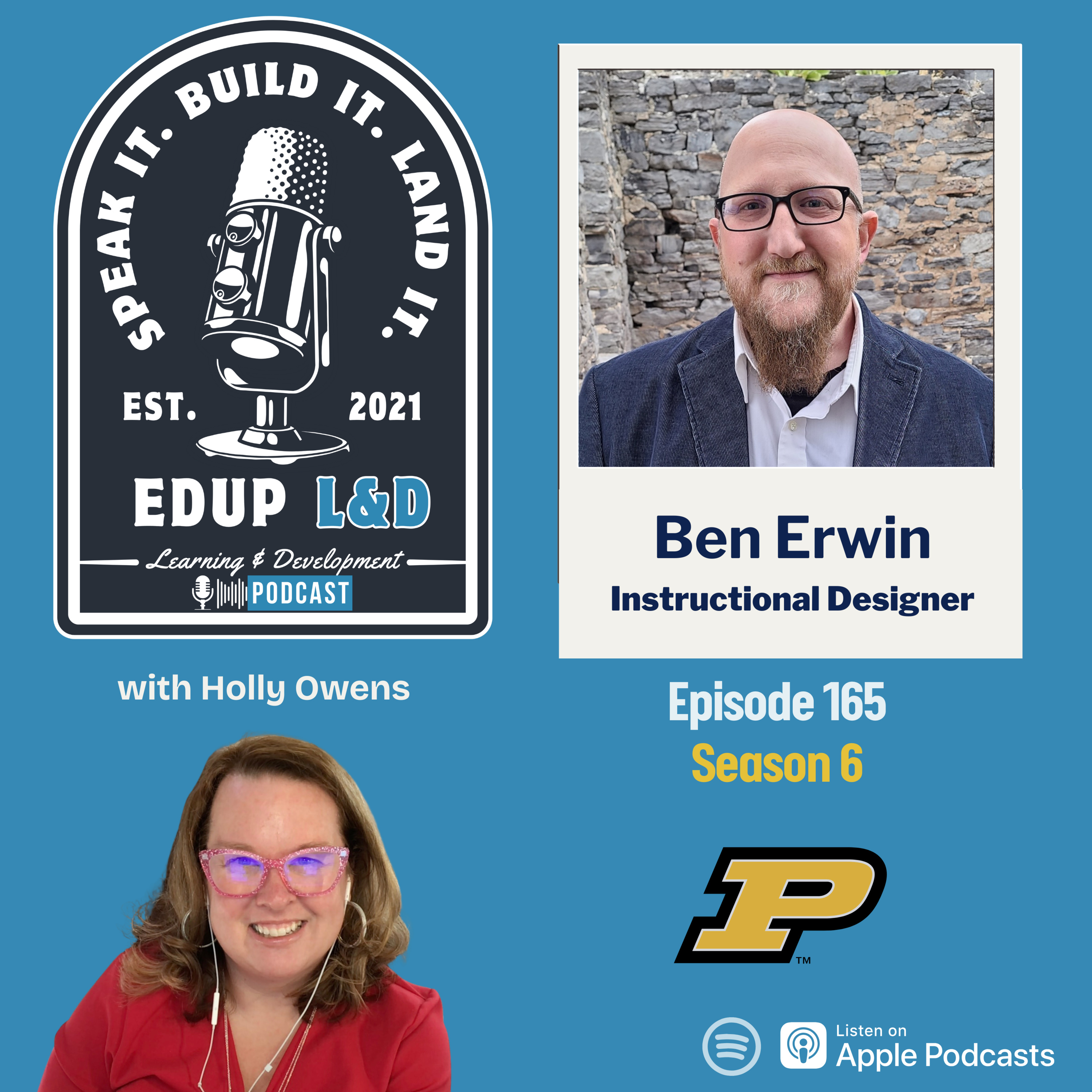
In this episode of EdUp Learning and Development, Ben Erwin shares his journey from being a writing instructor to becoming an instructional designer at Purdue University. He discusses the challenges of burnout in education, the importance of community and networking, and how LinkedIn played a crucial role in his career transition. Ben emphasizes the need for work-life balance and offers valuable advice for those looking to shift careers, highlighting the significance of self-reflection and the understanding that every job is temporary. He also shares insights into his daily productivity habits and the importance of setting boundaries in the workplace.
Guest Contact Information:
_______________________________________________
Episode Sponsor: iSpring Solutions
🎙️ Huge thanks to our friends at iSpring Solutions for sponsoring this episode of the EdUp L&D podcast! 🙌
If you haven’t already, be sure to check out the iSpring Learning Exchange Community — a vibrant space for creators, educators, and L&D pros to connect and grow.
And don’t miss your chance to join the iSpring Course Creation Contest by July 25! 🚀
Grateful for the support and excited to see what our community creates 💡
Thanks for tuning in! 🎧
0:02 In this episode of Add Up Learning and Development, Ben Irwin takes us on an honest and relatable journey from life as a writing instructor to thriving as an instructional designer at Purdue University. This conversation is full of wisdom for anyone considering a career pivot. Ben opens up about the reality of burnout in education, how he found clarity in the chaos, and why LinkedIn became a game changer in his professional growth. We also dive into the power of community, the importance of knowing your value, and what it really takes to break into the field of instructional design today. Whether you're feeling stuck searching for your next step, or just want to hear from someone who's been there and made it through this, this episode will leave you feeling seen and ready to take action. Let's jump in.
0:55 Hi, we're ispring, an international team of e-learning enthusiasts who help more than 60,000 clients across the globe succeed with better online learning. Our two flagship solutions are ispring Suite and ispring Learn LMS. Ispring Suite is an intuitive, all in one authoring tool for creating engaging e-learning content, and ispringlearn is an innovative online training platform for onboarding, upskilling, and certifying your teams. We also provide tons of free resources for aspiring and experienced e-learning professionals, conduct weekly webinars with top industry experts, and organize annual e-learning conferences, challenges, and championships. We'd be happy to get to know you and pick a solution that fits your needs best.
1:46 Go to www.icebringsolutions.com to learn more about us, download our resources and connect. Hello everyone and welcome to another amazing episode of Add Up Learning and Development. My name is Holly Owens and I'm your host. And today we have a fabulous guest. We have Ben Irwin, who is an instructional designer of Purdue University. Amongst other things, he is a job curator, Finder, sharing extraordinaire. So, Ben, welcome to the show. Hello thank you I I will try my best to match your energy. I know I just love talking to people, so it really does like release a lot of endorphins.
2:31 For me. It's like exercising. I get really excited, especially talking to people that I know fairly well, like yourself, because I know this is this episode's going to be really, really great. So I'm I'm so glad you joined me. Well happy, happy to be here and to chat. Well, let's start at the beginning. You know, I know a little bit about your personal journey because we've talked, but you know what kind of led you here to where you're at? You've grown substantially on LinkedIn, like over 50,000 followers now you know, You know what does the path behind that look like? Yeah, celebrate. That is awesome. That is amazing. I use this vanity metrics. Yeah, yeah. Right.
3:12 But it's, it talks about how people trust you and how they value your content. So I think that's really important to to celebrate that for sure. Yeah. So tell us, tell us about your journey, Ben. So, so to try to truncate this, I'm currently an instructional designer. I've been working at Purdue for the last two years. Prior to that, I was a writing instructor and writing center director at a large northeastern university for for 12 years. So I did that for for more than a decade and and prior to that I worked for a number of years in the early 2000s as a journalist in very various capacities. So I was everything from.
4:06 So you're a great writer. That's why people follow your LinkedIn. Like, yeah, everything that I do starts with with writing and and that's, you know, the reason that I don't appear on lots of shows like this is that I'm a much better writer than talker. I'm glad you made an exception. But so, so I've, I've actually had a number of, of different careers and kind of all of that to me is, is really linked in terms of, you know, when, when I was working at daily newspapers, it, it only took a few years to realize I, I loved journalism, but I hated journalists. And what I really enjoyed was working with writers. And I'd sort of thought back to my time as an undergrad working in, in my university's writing center and thinking, oh, like, that's someone's job.
5:06 I could do that for a living. I could spend more of my time working one-on-one with writers, which which is how I, you know, got into, into writing center work and into teaching. And, and again, you know, at at a certain point in my career, realizing there wasn't the opportunity and the upward mobility that I wanted in terms of my own growth and my own learning. Isn't that tough? That's so tough to like, like, oh, I love this. But there's, you know, like it's kind of the end of the path here. And you know, I'll, I'll be honest, like there, there were a lot of things about directing a writing center that really facilitated my, my burnout and an eventual career transition. But I do also sometimes think like, oh, if these other elements had been better, right, I, I might still be doing that. But you know, I, I really love instructional design and, and I'm really, you know, have, have enjoyed that transition because it's, to me, it's fun and rewarding in so many of the same ways that teaching was.
6:23 But I also then get to flex these other creative muscles that outside of the my own courses that I taught frequently, kind of went unused. Yeah. Oh, I love that. And it's so interesting because I've interviewed so many people on the show. Like, people don't realize that we don't come from necessarily education backgrounds. And you're gonna hear my puppy has joined us this morning and he has a squeaky toy. So for those of you who are hearing that in the background, I'll try to edit that out. But it's just it's part of life. That's what it is. And we've started different spots, you know, where I, you know, I come from education K to 12, but I did some other things before I popped into instructional design. I think it's just so interesting that like instructional design has so many places you can go with these transferable skills that you have, no matter what career path you're on. It's really interesting to me to to to discover that as I'm having more and more of these conversations. Yeah.
7:27 And you know, the team that I work on now, there are a few folks who have, you know, degrees and advanced degrees and instructional design. But one of the things that I really appreciate about the field is that you've got folks coming from all over the place with different backgrounds, different experiences. And you know, I'm, I'm working within kind of academic instructional design. But even across the field, if you look at corporate and nonprofit and all of these variations on, you know, ID work, you do really, I think see the the opportunity that the field presents, even if you come from like less traditional paths or a little bit. Like we welcome everybody here.
8:17 We honestly do. Like we welcome everybody. Yeah, right. You'll, you'll see folks from, from Ed on the same team as folks from corporate and you know, folks from all these different industries and different spheres and backgrounds, but still kind of being united by the skill set of how do I craft effective learning environments for different audiences to achieve specified outcomes, right? For sure. I think when I worked at Amazon, 50% of my team were came from the classroom like the K to 12th classroom, but the other 50% came from like you're saying, various aspects of the industry.
9:02 So that's good segue into my next question because you've been doing a lot of job postings. So many of the people that listen to the show I know are looking to shift in to a career in learning and development. So as far as your own journey is concerned, what's like a pivotal moment or decision that you made that kind of just changed everything for you? Like you're like, I know I'm going to go into instructional design and this is what I'm going to do. So there was a few factors, yeah, that that created this like Confluence for change. Part of it was that I was getting burnt out in in my past role and just kind of overseeing a staff of 40 plus people feeling as though I was kind of on call 24/7.
9:52 Yeah. That's a lot. Like, and having to to teach and work with faculty across campus and lead dozens of workshops every semester. It was, you know, my my list of tasks sort of slowly grew every year for more than a decade that. Is not sustainable. That is not sustainable. Yeah, right. And, and made even worse when you know, you're sort of being told, or at least in my case, I was told, oh, hey, we'll, we'll get you this help or we'll do XY and Z. And none of that ever materialized. I think in part because, you know, you're, you're able to hold the ship together right through the expertise of my staff and, and folks within my department. But but that that relationship was becoming more tenuous, which was also exacerbated by COVID.
10:50 Yeah. For sure. So like for for me, COVID was a real sea change in how do we look at employment and a big part of that being the proliferation of remote work as as much as like I taught online and I tutored online and done a lot of synchronous online work. Hadn't really thought up until that point, oh, I could make this a reality. I could work from the literal comforts of my homework faster, work more efficient, be more productive and, you know, not, not have to be in an office every day. Yeah.
11:32 Be the stress of commuting or just like it's so interesting to me that people do go back to the office and I know some people need that kind of stimulation to have Co workers around and things like that. But for me it would be like there would be tons of distractions. I mean, there's enough to deal with at home, but in the office there was just I go, I got to commute. What's the traffic like? You know, what time do I have to be in the office? Am I going to be late? Am I going to be, you know, like who do I need to talk to? Like it just, it was a whole different situation. I yeah. And I, I guess to me also a caveat that I will be transparent about is, you know, my wife and I don't have children.
12:14 We live in a home, you know, live in a home that has enough space for us both to, you know, work separately, but in in the same home every day. If we had kids or if we were living in a one bedroom apartment, I'd get out. Number one, you'd want to get out number. Two, I write like I, I would probably be singing a, a different tune, but very privileged to, to have the space to make, you know, remote work really effective and really seamless. So, so to me, those, those two factors, right where I was at in my career, coupled with COVID and changes in education and academia, all kind of contributing to the, the initial impetus to, to find something else. And when I started looking, I didn't know that that ID was going to be the path.
13:19 I I did a lot of research and networking in a whole lot of other areas before I really kind of narrowed down. Here's here's what the best alignment for my skill set and experience would be. I think that's great advice too, because people, they will come, they probably come to you for advice and they come definitely come to me for advice. And they say, well, where do I start? And I'm like, well, where do you want to be? And you did that. You did the research, you figured out where you wanted to be what, what was going to work for you, what didn't work for you. I think people think like, OK, I created this goal. I want to go into instructional design, but they're not thinking about how vast that field is. Absolutely.
14:00 I and that was my problem too, right? I had a very specific idea, you know, prior to doing any real research, I had a very specific idea about what instructional design was. And it was one of the reasons that I hadn't really considered it. And, and again, my, my own ignorance kind of holding me back. And once I started networking on LinkedIn, once I started kind of doing more research on my own and really analyzing and breaking down job posts and, and seeing, oh, there, there are different iterations of this job. There are so many variations of this work. How can I find a role that that is going to be a good fit for me?
14:49 Right? So that that's another piece of advice that I always offer folks is your job search will take significantly longer than you think. Yeah, I think lots of people learn that. They think that it's not like a corporate job where you're like a sales representative or like a Stockbrook or something. You can just transition, you know, even those have little caveats to it, but it's something that you really have to find where where you belong. I should have never bought that toy. I, I want to go back to something you said about the burnout because one of the questions I like to ask is like, what's something people don't talk about enough in this field that you've had to navigate behind the scenes? And I think this applies to all roles. And it's burnout.
15:33 It's the constant pressure of feeling like you always need to be on. You're the person that people turn to to answer the questions quickly, especially if you're in that leadership role, just navigating all the projects, being the face of the of the department when you are in the leadership role. So as far as burnout is concerned, how do you feel that shifted from when you were the directing the writing center to now you're in this instructional design role? I'm going to grossly oversimplify, but it's, it's night and day. I'll, I'll be honest, you know, in my director role, as I said, kind of the, that position was growing every year and we had, or I should say the university had these kind of KPIs for growth and contact hours. And you know, what are we doing and how are we doing it and how can we make it more efficient and how can we spend less money and use fewer man hours to get more? Do more with less, yeah.
16:38 Yes, right. And like, I had the data to know, hey, short of dining services, we see more students across campus than any other service at the university. Like we are seeing thousands of students. We had, you know, north of 7000 contact hours every accident here. Like it, it was a sizable operation and the and as much as like I said, I was fortunate to have a really great staff, but never had assistant directors, never really had infrastructure in place and part of that was my fault as well. I think my tendency to just take everything on and just yeah. We gotta not do that, Ben.
17:28 That's bad for us. Right. But part of me was like, oh, I can make anything work. Yeah, for sure. But then you realize how intricate the project is. You know, like, oh, this looks so simple from the outside. Yes, right. So, so as I said, it was, it was high stress, high demand. So much of that job, by the time that I left, was essentially solving, you know, 40 people's problems every. We can imagine how. Many emails you got or slack messages. Jesus. Yeah. So in in an average day in that role, I would get 60 to 70 emails, about 90% of which would require a direct response because I was running all of the comms, all of the social media. I was the point.
18:22 Person. For like software training for students, so, so many random tasks, right. So that that was a very in terms of weekly hours was very intense. And one of the things that I very much appreciate about my current role is, you know, I'm fortunate to be in a department and on a team where, you know, I have supervisors who say, like, we here are the hours that we work. You should not be working, you know, mornings, nights, weekends, right there. There might be times when because of projects and deadlines, that happens. That's just the nature of the work. But, you know, having folks above me very actively say, hey, if you find yourself having to work nights and weekends all the time, that's a problem.
19:15 And it's not a you problem. It's a workload problem. Like that's something that we then need to talk about and address. And it's not this negative reflection on you or your abilities or your work ethic. It's that, hey, maybe you have too much work. Yeah, you know, that's a great, that's great leadership if I'm being honest to to recognize those things and be able to set those healthy boundaries. I think I read a study recently about like the four day work week and how productivity increased like 80% with the 44 day work week. And especially in our culture, it's so ingrained to us. The more you work, the the more productive you are.
19:56 When I absolutely just knowing myself and and being in other roles, I think it's the opposite because you get to a certain point where your brain's just not, it's, it can't focus anymore. It's just like like burnout and stuff like that. So that I am so happy to hear that you have that sort of leadership on your team. And I think it really does help people kind of feel like they. Are able to step away from the job because the job is not your life. You do other things right, Ben. And I think that's a problem that I've felt and that I think a lot of educators feel right. You're so much of your identity is wrapped up in here's what I do for a living or, or thinking about myself. It it was the sense of here are all the courses I teach. Here are the students that I'm helping in the writing center. Like you're proving yourself.
20:51 You're showing your credentials like all the time. Right, yeah, right. And that becomes this weird kernel of your identity. And and then if, if that suddenly goes away for for any reason, then thinking like, oh, what, what am I now? If I'm not these other things that I was, what, what am I in this new role? And I think that that I think. This definitely resonates with a lot of people who are listening right now. And, and like I, I'm going to say I'm one of them. Like what I do is who I am, so if something were to I definitely have a breakdown of some sort.
21:37 Well, I think we, we also don't talk nearly enough about, you know, there's a reason that when you like, go to a party or something, people ask, what do you do for a living? And it's the worst, often times most boring question to ask a human being. Plus just. Can't explain it. We can't explain it, and we can't explain our jobs in a way people understand. They don't know what instructional designers do anyways. So that adds a whole extra layer of stress on the, you know, trying to explain and and share what we do. Yeah, yeah. I think people, if you say, oh, hey, I teach whatever the level is, they they get that if you say, well, I work with subject matter experts to bring their vision to life to craft more efficient, effective learning environments for X audience.
22:30 OK, well, what does that mean? Yeah, exactly. That's the next question. Well, what does that mean? Oh yeah, I'm several of these topics. We could probably go off and tanges on it, but I want to save those for some future episodes and maybe for some future LinkedIn lives. One of the things I do want to ask you, and I'm kind of curious about this too, is if someone were to shadow you for a day, what's something that would surprise them about what you do in a day or how you work? Yeah, different. Like something, something fun or something like interesting. Like I do this to stay productive or I do this during the day. Like, I don't know. I'm interested to know because you're such a creative person. Yeah, that I, I wouldn't go that far. Let's see things we can't take back. I'm, I'm definitely a morning person, especially the, the older I get, the easier it becomes to wake up at, you know, 5:45 than it is to stay up until 2:00 in the morning. So I'm usually up for at least an hour or two before my wife gets up.
23:38 So to me that is like prime working hours. No one. No one is emailing, no one is interrupting me. I can just turn on music and and and get to work for the day. I usually will make A to do list at the end of every day or every evening for the next day so that as soon as I'm up and capable of thinking enough to get something done I can just jump into work and start checking things off A to do list. I also live and buy, live and die. Buy to do lists my. We're similar that very much the same that way.
24:18 Like and part of it is very self-serving in that I love checking something off of a list I love. Psychology proves it's a thing. It's motivation, whether extransic, intransic, like, whatever it's it's a thing, yes. And, and I at my core, I'm just a big dumb animal. I want that, that serotonin hit of, of, oh, I accomplished a task, right. So I don't know what might surprise people other than, you know, I, I try to have, have a very clear structure to my day. A lot of my time is spent in meetings. So, so that both both complicates things and gives the structure right.
25:07 So I'll, and, and I'll try to plan my week knowing all right, here are my standing meetings. So these other days have to be the real buckle down, get stuff done, make sure you're, you're ahead of deadlines, etcetera. You know, but I, I think like, like most remote workers, my biggest struggle might be the fact that everything in my house is vying for my attention. And so many things in my house are potentially more enticing than than getting work done. But I, I think I've become pretty good at, at, like I said, blocking out time and making sure that, that I give myself enough time to, to get certain things done like that. That was something I really struggled with in the beginning was not knowing how long certain tasks would take and budgeting my time effectively.
26:08 But, but now I think I have a much better sense of, OK, here's here's where I need to block out my calendar. Here's where I need, you know, 0 distractions. As much as I am prone to like working in our living room there there are certain tasks where I know, OK, I need to be in the office. I need 100% or especially I need uninterrupted time because some of you know, some of the work is so meticulous if I get interrupted in the middle of something. Oh. It takes forever to get back on focus. It just. Yeah, I feel you. I have. I was just talking to my boyfriend about this last night. I was like, I have generalized anxiety disorder and that the part where it's like, you know, getting distracted. I was like, I that has to do with ADHDI can it takes me like I need like these are soundproof. I need to have music on.
27:06 I need the door to be shut. I need you to know that it not come bother me. I mean, the puppy distracts me enough or the dogs distract me enough and just focus because I am so proud. I use Pomodoro technique to focus in on the specific tasks and I only do one thing for 25 minutes because you know, like I love checking those LinkedIn notifications or I love going out there and seeing what's out LinkedIn world. So I have to turn that that stuff off. But yes, I'm a morning person as well. I love the quiet time in the morning. It's like my time. Yeah, I to me, the get getting up early offers all of the same advantages that people talk about, you know, when they're a night owl. Yeah.
27:49 And I think that the common denominator is always no interruptions. Like that's that's what makes that time great is no one else is around. And you, you have, you have kind of unfettered freedom without intrusion, which which is becoming more and more rare as, as like we're required by professions to be tethered to electronic devices all day, every day. Absolutely, absolutely. Well, I want to know from you. So in closing, you've shared a lot of great information and for the listeners out there who are thinking about they're taking the leap of the best transitioning teachers or they're just trying to transition their roles, they're already in L&D. What 3 pieces of the best advice you could give for them to hold on to at this point?
28:39 Because you know, a lot of different people are looking for jobs and we hear all the stuff about job saturation, market saturated. What 3 pieces of bias could you give to them? So first, as I've mentioned, plan for your transition to take longer than you think. You know, I I was studying options and doing research for the better part of a year before I really started to even apply for things. And even then it was for me, it was a slow process of narrowing things down more and more as as I was networking, as I was learning, and quite honestly as I was failing miserably feeling. The part of it for sure.
29:21 Rejections and failing. Right. And, and giving yourself that time is, was really helpful for me and being able to kind of recognize that, hey, I'm, I'm going to fail for a while. You know, I hadn't written ACV in more than a decade. Oh yeah. Right. And I have, I worked with students and faculty all the time on their own application materials and consider myself pretty good at it. But when it came to doing it myself, I really, I really struggled and I really struggled to kind of better understand the new job market and initially really struggled with quantifying my work in ways that this new audience would understand and be persuaded by. So I would say give give yourself more time, recognize that that failure is probably going to be a part of that process.
30:25 And I think the key is being willing to be critically self reflective enough to learn from what's not working. As much as I love the transitioning teacher community, the the hubris sometimes is kind of mind boggling to me. Or the the expectations of like, well I'm I'm going to find a new job in a month and it's going to double my salary. Even if you're like fully prepared and you know all the people that know all the people, that's still not the case. Yeah, like listen, if if that's your experience, amazing. Good for your. Anomaly.
31:06 That was not my experience at all. So that that to me is one piece of advice. Second, I'm very biased because I'm on LinkedIn all the time, but I legitimately believe in the potential that LinkedIn offers in terms of not only networking but learning. And I think too many people view networking or view LinkedIn as this networking platform and I view it as a learning platform. Me too. Like my, unless you're, you're directly selling something, not to say audience size doesn't matter, but we get, we get caught up, I think in, in things like how, how many followers do I have?
31:50 How many connections do I have? And it's really a, you know, quality over quantity scenario. And, you know, if if you are looking to learn about a field that you haven't worked in yet, LinkedIn is the absolute best place to do it. There are so many experts who are kind and generous with their time and are willing to to answer questions. Especially in this community. Right. Yeah, like, and one of the reasons that I, I enjoy trying to post jobs and post what I hope who will be helpful content is just the knowledge that like I've been there, I've made all of these mistakes. If something I write or share can help someone avoid even one of the mistakes and setbacks that I had, like, that's great. I think there's there's I also have a lot of like teacher energy that's pent up and I'm like, Oh my, how can I help someone today?
32:55 Like what can I do that's going to? Yeah, that's ingrained in US, right? That never goes away. That never goes away. Yeah. So, so use LinkedIn, use it as as a tool to learn. And then I guess the last piece of advice, and this is for anyone transitioning careers, realize that you are not your job and that every job is temporary. I I talk with so many transitioning educators who essentially say, hey, I want to land my dream job. Oh I just did a poll about Dream and Job being in the same sentence.
33:39 Like the the rhetoric of that I bristle with real hard, but but also I think recognizing OK if you're particularly if you're shifting industries, what you want is a foot in the door. Right. Like and, and, and recognize that you might only have that job for the next year or two until you accrue the experience that's going to get you the next role. And if you're, if you're stuck on this idea of, well, I'm going to finish out my career at this company. Like good luck even even the best employee at the best company.
34:19 That's just not a thing nowadays. Yes, and and also if you want to make more money you need to hop from job to job. It is the only way at this point to legitimately improve your earning power. And, and I know four or five years ago there was a lot of, you know, bad negative press about quote UN quote job hoppers. But my thought was always, well, these are bad faith takes being made by people who aren't actually in the job market. Because if if you're getting, you know, 2% cost of living increases every year at your job. And inflation is 9%.
35:01 Yeah, right. You're losing money every year. Only way to have a significant impact on your earning power might be to, you know, short of a promotion is to shift companies, to shift roles and, and to find something. So I, I think that is, is something folks might get hung up on is I need the perfect role. Also, I, you know, I, I was very fortunate and privileged that I could make a lateral move in terms of salary. And, you know, we can still pay our bills. We're fine. To me, trying to get significantly more money wasn't nearly as important as I want a job that isn't grinding me into the ground and, and negatively impacting every other aspect of my life.
35:53 So things like being able to work remotely, being able to work typical hours and not receive emails and messages 24 hours a day just immediately have we're not. Vampires, we don't stay up all night. Seriously folks, this is great advice and I, I really think people need to understand this that it's OK to I think money is a taboo topic in our culture as well. Like people just they don't talk about it now I talk about it. But Ben, thank you so much. I, I, I know you and I could talk a lot longer about a lot of different things, but that just means you have to come back on the show again.
36:37 So everything that Ben talked about, you know, we're going to have information in the show notes where they find him out on LinkedIn, the work that he's doing with job postings. You need to follow him. Great resource. So thank you so much for coming on and sharing this with our audience. Yeah, thank you for letting me blather on for. Of course, of course. I mean, it's great advice. It really is the job hopping stuff, talking about the burnout stuff, you know, just trying to figure your way through and everybody needs support. So thank you so much. Absolutely. Hi, we're Ice Spring, an international team of e-learning enthusiasts who helped more than 60,000 clients across the globe succeed with better online learning.
37:18 Our two flagship solutions are Ice Spring Suite and Ice Spring Learn LMS Ispring Suite is an intuitive all in Go to www.ispringsolutions.com to learn more about us and connect. Thanks for spending a few minutes with Holly. She knows your podcast queue is packed. If today's episode sparked an idea or gave you that extra nudge of confidence, tap, follow or subscribe in your favorite app so you never miss an episode of Ed Up L&D. Dropping a quick rating or review helps more educators and learning pros discover the show, too. Want to keep the conversation going? Connect with Holly on LinkedIn and share your biggest take away.
38:10 She reads every message. Until next time, keep learning, keep leading, and keep believing in your own story. Talk soon.

Instructional Designer
Ben Erwin holds a B.A. in journalism from Eastern Illinois University and an M.A. in English rhetoric and composition from Southern Illinois University at Carbondale. He currently works as an Instructional Designer at Purdue University; he previously served as the Writing Center Director at Syracuse University, where he also taught in the Writing Department. When he’s not working, Ben is most likely watching horror films, listening to obscure subgenres of heavy metal, or attempting to befriend animals. He currently resides in Syracuse, NY with his wife, Kate.